First Year in America

First Year in America: A Practical Guide for Burmese Immigrants
Arriving in the United States can feel exciting and overwhelming at the same time.
For years, your family may have focused on immigration paperwork, USCIS, the National Visa Center, the embassy interview and finally getting the visa.
Then you arrive in America and realize immigration was only the beginning.
Now you have to figure out:
Social Security numbers. Green cards. Banks. Credit. Healthcare. Schools. Jobs. Paychecks. Taxes. Housing. Driver’s licenses. Insurance. Government offices.
Nobody hands you one instruction manual when you arrive.
That is what this page is for.
If you are still somewhere in the immigration process and have not arrived yet, start with BurmaHeaven’s Start Here guide or use My Immigration Journey to understand which immigration stage applies to your case.
If you have already arrived in the United States, welcome.
You do not have to learn everything at once. Your first year in America will probably include many small learning experiences that eventually become routine.
Your First Year in America: Build Knowledge One Step at a Time
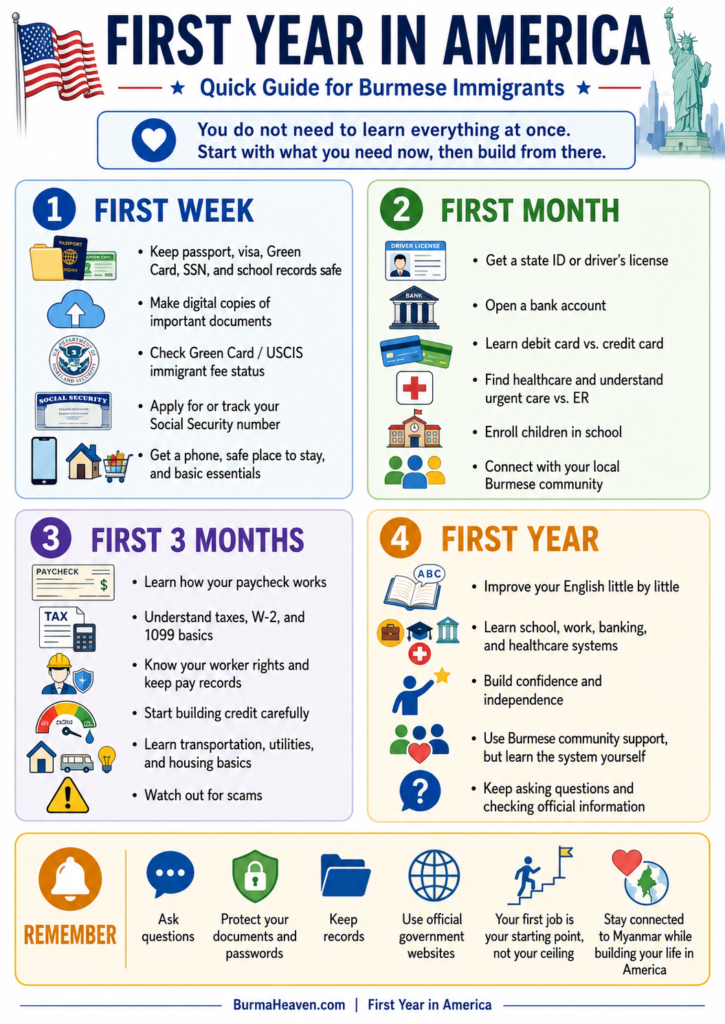
Your First Week in America
Your first few days should be about getting settled and making sure the most important documents and basic necessities are handled. During your first year in America, keep copies of important documents, pay records, tax forms, school records, and medical information.
Keep Your Immigration Documents Safe
Do not carry every important document with you every day.
Keep important originals in a safe place, including:
- Passport
- Immigrant visa
- Green card when it arrives
- Social Security card
- Birth certificates
- Marriage certificate
- Immigration notices
- Vaccination records
- School records
- Employment authorization documents, if applicable
- Copies of important immigration paperwork
Make digital copies too.
Email copies to yourself or store them securely online so losing one bag does not mean losing your entire immigration history.
Do not casually give your Social Security number, immigration documents, banking password or PIN to people simply because they say they need them.
Make Sure Your Green Card Is Being Processed
If you entered the United States with an immigrant visa and became a lawful permanent resident upon admission, USCIS generally uses the USCIS Immigrant Fee to produce your physical Permanent Resident Card.
If the fee has not been paid, USCIS says that can delay or prevent production of the Green Card.
Official USCIS information:
If you are waiting for the physical card, USCIS also provides information about when you should expect to receive it.
Do not panic if the physical Green Card does not appear immediately after you land.
But do keep track of it.
Get Your Social Security Number
A Social Security number, or SSN, is one of the most important numbers you will use in America.
Employers use it to report wages. You may also need it for taxes, banking, credit and other financial matters.
Many immigrants can request an SSN during the immigrant visa process. If you requested one through that process, the Social Security Administration says you generally should not need to file a separate SSN application after arriving. If you did not request one, you may need to apply through Social Security.
Official Social Security information:
Social Security Numbers and Immigrant Visas
Protect your Social Security number
Your Social Security number is not something you should give to everyone who asks.
Ask:
Why do you need my Social Security number?
A legitimate employer, bank, tax agency or government program may have a valid reason.
A stranger on the phone usually does not.
Get a State ID or Driver’s License
You will quickly discover that Americans are constantly asked for identification.
A state identification card or driver’s license can make everyday life much easier.
Driver’s license requirements are controlled by individual states, so the process depends on where you live.
You may need documents showing:
- Identity
- Immigration status
- State residency
- Social Security number or applicable alternative documentation
If you plan to drive, do not assume your foreign license allows you to drive indefinitely.
Check your state’s Department of Motor Vehicles or equivalent agency.
And understand something extremely important:
Car insurance is not optional in most situations
States generally require drivers or vehicle owners to meet financial-responsibility requirements, commonly through auto insurance.
Driving without required insurance can become very expensive very quickly.
Open a Bank Account
Many newcomers are used to dealing heavily in cash.
In the United States, having a bank or credit-union account makes everyday life much easier.
You may use it for:
- Direct deposit
- Paying bills
- Receiving wages
- Debit-card purchases
- Sending money
- Saving
- Building a financial record
The Consumer Financial Protection Bureau has a Newcomer’s Guide to Managing Money and a checklist for opening a bank or credit-union account.
Official resource:
CFPB Newcomer’s Guide to Managing Money
When opening an account, ask about:
- Monthly fees
- Minimum balance requirements
- ATM fees
- Overdraft fees
- Direct deposit
- Online banking
- Fraud protection
Do not choose a bank simply because somebody you know uses it.
Compare.
Learn the Difference Between a Debit Card and Credit Card
They look almost identical.
They are not the same thing.
A debit card generally spends money directly from your bank account.
A credit card generally allows you to borrow money from the card issuer and repay it later.
Credit cards can help build U.S. credit history when used carefully, but they can also create expensive debt.
If you are completely new to American banking, do not worry about becoming a credit expert immediately.
Start with understanding:
Checking account → Debit card → Credit report → Credit score → Credit card
BurmaHeaven’s Money Made Simple section is designed to explain financial topics in plain language as you encounter them. One of the biggest lessons during your first year in America is learning where to find reliable information instead of depending completely on other people.
You May Arrive With No U.S. Credit History
Having no American credit history does not necessarily mean you have bad credit.
It may simply mean American credit-reporting systems do not know enough about you yet.
Over time, your credit history can affect things such as:
- Credit cards
- Auto loans
- Mortgages
- Some rental applications
- Interest rates
Do not rush to borrow money simply to “build credit.”
Credit is useful, but debt is still debt. Your first year in America is also a good time to begin building credit carefully and learning how American banking works.
Find Healthcare Before You Have an Emergency
The American healthcare system can be extremely confusing.
Learn these terms early:
- Health insurance
- Premium
- Deductible
- Copay
- Primary-care doctor
- Specialist
- Urgent care
- Emergency room
- Medicaid
- Medicare
- Marketplace insurance
One of the biggest mistakes newcomers can make is waiting until somebody is seriously sick before learning how healthcare works.
Lawfully present immigrants may qualify to buy coverage through the Health Insurance Marketplace and may qualify for financial assistance depending on household circumstances and income. Eligibility rules can differ by program and immigration status.
Official federal resource:
HealthCare.gov — Health Coverage for Immigrants
If you have children, also look into your state’s Medicaid and Children’s Health Insurance Program, or CHIP.
Learn Where to Go When Someone Is Sick
Not every medical problem requires an emergency room.
Generally:
Primary-care doctor: routine care, physicals, chronic medical conditions, preventive care.
Urgent care: problems that need relatively quick attention but are not necessarily life-threatening.
Emergency room: serious or potentially life-threatening emergencies.
Understanding the difference can save enormous amounts of money.
If you believe someone is experiencing a true medical emergency, call 911.
Enroll Your Children in School
If you arrive with children, school enrollment should become one of your early priorities.
The American school system can be very different from Myanmar’s.
You may hear unfamiliar terms such as:
- School district
- Attendance boundary
- Elementary school
- Middle school
- High school
- GPA
- Credits
- Honors
- AP
- Dual enrollment
- English Learner
- IEP
- 504 Plan
BurmaHeaven has a full U.S. School System for Burmese Parents guide explaining grade placement, enrollment, English-language support, school vaccinations, special education, graduation requirements and parent rights.
One particularly important issue for teenagers arriving from Myanmar is foreign transcript and credit evaluation.
Do not only ask:
“What grade will my child be in?”
Ask:
“Which classes and credits from Myanmar did you accept, and what does my child still need to graduate?”
That can completely change a teenager’s educational path.
Do Not Be Afraid to Ask the School Questions
Many immigrant parents come from environments where questioning teachers, principals or government officials is discouraged.
America works differently.
You can respectfully ask:
Why?
Where is that written?
Can I have a copy of the policy?
How was this decision made?
Who can review this decision?
Can I have an interpreter?
You do not need perfect English to advocate for your child.
And you should not automatically assume the first person who gives you an answer is correct.
Your First Job in America
For many immigrants, the first job is simply the first place willing to hire them.
That is okay.
Many Burmese newcomers find work through relatives, friends and Burmese community networks.
You may begin in:
- Restaurants
- Sushi businesses
- Salons
- Warehouses
- Manufacturing
- Retail
- Cleaning
- Delivery
- Factories
- Community businesses
There is absolutely nothing wrong with starting there. Work can be one of the most confusing parts of your first year in America, especially if you have limited English or do not yet understand worker protections.
But there is something important you should understand:
Your first job does not have to become your permanent job.
Your first job can give you:
Income + American work experience + English practice + confidence + time to learn the system.
Then you can move forward.
Know Your Rights at Work
Do not assume only undocumented workers can be exploited.
A person can have a Green Card, Social Security number and complete legal authorization to work and still be cheated simply because they do not understand American labor laws.
The U.S. Department of Labor says its Wage and Hour Division helps workers and enforces the laws it administers without regard to a worker’s immigration status.
Official worker-rights resource:
U.S. Department of Labor — Worker Rights
Workers may have protections involving:
- Minimum wage
- Overtime
- Payment for hours worked
- Certain recordkeeping requirements
- Retaliation
State law can provide additional protections.
Keep:
- Your pay stubs
- Work schedules
- Records of hours
- Text messages about shifts
- Employment documents
- Records of cash payments
If something does not look right, ask.
Learn How to Read Your Paycheck
Your hourly rate is not the same as your take-home pay.
Your paycheck may show:
Gross pay: what you earned before deductions.
Net pay: what actually reaches you after deductions.
Common deductions may include:
- Federal income-tax withholding
- State income-tax withholding where applicable
- Social Security tax
- Medicare tax
- Health insurance
- Retirement contributions
- Other authorized deductions
Do not just look at the number deposited into your bank.
Look at the pay stub.
Make sure:
Your hours are correct.
Your hourly rate is correct.
Overtime is correct when applicable.
Deductions make sense.
This matters because correcting payroll problems becomes much easier when you notice them immediately.
Do Not Assume Your Employer Is Handling Your Taxes Correctly
This is a lesson many immigrants learn the hard way.
If you are an employee, look at your paycheck and see whether taxes are actually being withheld.
Do not simply accept:
“Don’t worry, I take care of it.”
You are ultimately the person whose name appears on your tax return.
The IRS generally treats lawful permanent residents as U.S. residents for federal tax purposes under the green-card test, and resident aliens are generally subject to U.S. federal income-tax filing rules similar to U.S. citizens, depending on income and filing requirements.
Official IRS information:
Keep every tax document you receive, especially:
- W-2
- 1099 forms
- Pay stubs
- Bank tax forms
- Investment tax forms
BurmaHeaven’s Money Made Simple section can help you understand unfamiliar financial and tax terminology as your finances become more complicated.
W-2 Employee and 1099 Contractor Are Not the Same Thing
You may eventually hear someone say:
“You’re W-2.”
or
“You’re 1099.”
Those are very different arrangements.
Being an employee versus an independent contractor can affect:
- Taxes
- Payroll withholding
- Overtime rights
- Benefits
- Unemployment eligibility
- Employment protections
Do not assume an employer can simply call you an independent contractor because it is convenient for them.
If you do not understand how you are being classified, ask before signing paperwork.
Learn American Work Culture — but Do Not Accept Abuse
Many immigrants are taught:
Do what your boss says.
Do not complain.
Be grateful you have a job.
Do not cause problems.
That mindset can make newcomers extremely easy to exploit.
You can be hardworking without allowing someone to mistreat you.
You can be respectful without being afraid.
You can appreciate your job while still asking:
“Why is my paycheck wrong?”
“Where is my overtime?”
“Why was this deducted?”
“Can you explain this?”
If you believe you are being discriminated against because of national origin, ethnicity or certain accent-related issues, the federal Equal Employment Opportunity Commission provides information about national-origin discrimination. Employers covered by federal law generally may not discriminate because someone comes from a particular country or ethnic background.
Official resource:
EEOC — National Origin Discrimination
Connect With the Burmese Community
The Burmese community can be one of your most valuable resources when you first arrive.
Someone may know:
- Who is hiring
- Which apartment has an opening
- Which doctor speaks Burmese
- Where the temple is
- Which church has Burmese services
- Which grocery store sells Burmese ingredients
- Who can translate
- Which employer treats Burmese workers fairly
- Which school has Burmese families
- Who can help with transportation
BurmaHeaven is building a Find a Burmese Community Near You directory covering all U.S. states so newcomers have somewhere to begin.
But there is an important limitation.
Do Not Rely Only on the Internet
We search online for Burmese and Myanmar community organizations, nonprofits, temples, churches and local resources, but not every community has a strong online presence.
Some Burmese organizations have no website.
Some community groups have an old Facebook page.
Some nonprofits barely appear in Google.
And some of the most helpful people are not organizations at all.
They may simply be:
A longtime Burmese resident.
A trusted auntie.
A church member.
A monk.
A shop owner.
A community volunteer.
A person who has helped dozens of new families find jobs.
Those people may never appear online.
Use online directories as a starting point, but talk to your local Burmese community too.
Some of the most valuable information in immigrant communities is still passed person to person.
Stay Connected to the Burmese Community — but Learn the System Yourself
Community networks are powerful.
Use them.
But do not become so dependent on one person that you cannot function without them.
Learn how to:
- Make your own doctor’s appointment
- Talk to your child’s school
- Read your paycheck
- Call your bank
- Apply for a job
- Understand government letters
- Pay bills
- Ask for an interpreter when appropriate
- Look up official information yourself
The goal is not to stop asking for help.
The goal is to eventually know enough that you can help the next person.
Learn English, but Do Not Wait for Perfect English
English matters.
Better English can create more employment opportunities and make everyday life easier.
But do not wait until your English is perfect before participating in American life.
Libraries, adult schools, community colleges, refugee organizations and community groups frequently offer English-language programs.
Practice.
Ask questions.
Make mistakes.
Your accent does not make you unintelligent.
And you should not automatically limit yourself to jobs where everyone speaks Burmese because you are embarrassed about your English.
Protect Yourself From Scams
New immigrants are frequent targets for scams because scammers know newcomers may not understand American government agencies yet.
Common scams may involve someone pretending to be:
- USCIS
- IRS
- Social Security
- Police
- A bank
- An immigration attorney
- A landlord
- An employer
- A government benefits office
The Federal Trade Commission specifically publishes scam information for immigrants and refugees.
Official resources:
FTC — Scams Against Immigrants
Be extremely suspicious if someone demands immediate payment through:
- Gift cards
- Cryptocurrency
- Wire transfer
- Zelle
- Cash
especially while threatening arrest, deportation or cancellation of immigration status.
Do Not Give Anyone Your Government Login
Another mistake newcomers can make is allowing one helpful person to control everything.
Someone may help you set up:
- USCIS account
- Bank
- Social Security
- Healthcare account
- School portal
That is okay.
But you should eventually know the login information yourself.
Do not allow a community helper, relative, tax preparer or immigration preparer to become the only person who knows the password to your own accounts.
Renting Your First Home
Housing in America can involve unfamiliar rules.
Renting may require:
- Application
- Identification
- Proof of income
- Credit check
- Security deposit
- Lease
- Utilities
- Renters insurance
Read the lease before signing.
Ask questions if you do not understand something.
Do not assume a verbal promise overrides the written lease.
And be careful about rental scams involving properties you have never seen.
The U.S. Department of Housing and Urban Development provides information for renters and housing assistance programs.
Official resource:
Do Not Send Money for an Apartment You Have Never Verified
Rental scams are especially dangerous for immigrants looking for housing from another city or country.
Be careful when somebody says:
“I am overseas, just send the deposit.”
or
“You cannot see the apartment until you pay.”
Verify that the property and landlord are real.
If the price looks far below everything else in the neighborhood, investigate further.
Learn How Utilities Work
Depending on where you live, you may need separate accounts for:
- Electricity
- Gas
- Water
- Trash
- Internet
- Phone
Some apartments include certain utilities.
Others do not.
Ask before signing the lease:
What is included in the rent?
That $1,800 apartment may actually cost much more once utilities, parking, insurance and other charges are included.
Learn Emergency Numbers
911
Call 911 for serious emergencies involving police, fire or medical emergencies.
Do not be afraid to call during a genuine emergency because your English is limited.
988
The 988 Suicide & Crisis Lifeline provides crisis support in the United States.
211
Many communities use 211 to connect residents with local social services such as food, housing and community assistance.
Availability and specific services vary by area.
Culture Shock Is Real
Sometimes immigration goes perfectly on paper and the person is still miserable.
That can surprise families.
You may miss:
- Food
- Family
- Friends
- Language
- Familiar neighborhoods
- Burmese holidays
- Religious community
- The feeling of knowing how everything works
In America, suddenly you may not even know how to make a doctor’s appointment.
That does not mean coming here was a mistake.
It means adjusting to an entirely different society takes time.
Your Children May Adjust Faster Than You
This is very common in immigrant families.
Children go to American schools every day.
They hear English constantly.
They learn slang.
They understand American culture quickly.
Soon the child may know more about certain American systems than the parent.
That can change the family dynamic.
Do not make your child responsible for every adult situation simply because their English becomes better than yours.
Children should not have to become the family’s permanent interpreter, financial adviser or immigration adviser.
Build your own independence too.
Stay Connected to Myanmar
Becoming American does not require abandoning where you came from.
Cook Burmese food.
Speak Burmese at home if you want.
Teach children family history.
Celebrate Burmese holidays.
Visit Burmese temples and churches.
Tell children about grandparents.
Maintain family relationships.
Your children can understand America and understand where their family came from.
BurmaHeaven exists partly for that reason too — immigration, American life, money and Burmese culture do not have to live in completely separate worlds.
Your First 30 Days
Try to understand or complete the following:
- Immigration documents
- Green Card process
- Social Security number
- State identification
- Bank account
- Phone
- Healthcare coverage
- Children’s school enrollment
- Transportation
- Initial employment search
Do not worry if everything is not finished exactly within 30 days.
Every family’s circumstances are different.
Your First 3 Months
Start learning:
- How your paycheck works
- How taxes work
- American workplace expectations
- Credit basics
- Healthcare system
- School communication
- Local transportation
- Your neighborhood
- Local Burmese community
- English-language resources
This is where America begins to feel less like somewhere you are visiting and more like somewhere you actually live.
Your First 6 Months
You may now be ready to think beyond survival.
Ask yourself:
Is my job good for me?
Can I earn more somewhere else?
Should I improve my English?
Do I need additional training?
Am I building credit responsibly?
Do I understand my health insurance?
Are my children doing well at school?
Do I understand our household budget?
You do not need to remain in the situation you accepted during your first week simply because it was familiar.
Your First Year
By the end of your first year, you will probably know something you did not understand when you landed:
America is not one system.
It is thousands of systems.
Immigration.
Schools.
Employment.
Taxes.
Healthcare.
Banking.
Credit.
Housing.
Transportation.
Government.
The goal is not to memorize all of them.
The goal is to become comfortable enough to say:
“I don’t understand this yet, so I am going to find out.”
That one habit can protect you from an enormous number of mistakes.
One Rule I Wish Every New Immigrant Knew
Ask questions.
Do not assume something is correct because:
Someone has lived in America longer than you.
Someone speaks better English.
Someone owns a business.
Someone works for the government.
Someone works at your child’s school.
Someone helped your family before.
People make mistakes.
Sometimes people also take advantage of people who do not know the system.
Be respectful.
But ask:
Why?
Where is that written?
Can you explain it?
Can I have a copy?
Who can I contact if I disagree?
And whenever possible, verify important information through an official government website.
You Do Not Need to Learn America in One Day
When you first arrive, everything feels urgent.
It isn’t.
Learn the part you need today.
Then learn the next part tomorrow.
Use your Burmese community.
Use government resources.
Use people you trust.
Use BurmaHeaven.
And eventually, when another family arrives confused and afraid, you may become the person who tells them:
“I went through this already. Let me show you where to start.”
That is how immigrant communities become stronger.
Continue on BurmaHeaven
If you are not sure where you are in the immigration process, use My Immigration Journey.
For a broader overview of immigration and life after arrival, visit Start Here.
For financial basics, taxes and interactive tools, explore Money Made Simple.
And for newcomers with children, continue to U.S. School System for Burmese Parents for a deeper explanation of enrollment, grade placement, English learners, parent rights and the American education system.
Work Culture in America: A Guide for Burmese Immigrants
For many Burmese immigrants, the first job in America is not really a career choice. It is often the first place willing to hire you.
If you arrive with limited English, everything feels harder: the application, the interview, the paperwork, the manager, the schedule, the paycheck, even asking a simple question. That fear can push newcomers toward jobs where someone already speaks Burmese or where another Burmese person can introduce them.
That is why community job networks matter so much.
In New York, many Burmese immigrants I knew worked in places such as the Diamond District, sushi businesses, restaurants, salons, laundries and other businesses where another Burmese person could help them get through the door. Sometimes there was one trusted person in the community who seemed to know who was hiring and helped connect newly arrived families with jobs.
That kind of person can be incredibly valuable.
When you have just arrived in America, one trustworthy person saying, “Go here, they are hiring,” can mean the difference between having income and having nothing.
But there is another side to this.
Community Connections Can Help You — but They Can Also Make You Vulnerable
When your first job comes through a relative, friend or someone in the Burmese community, you may feel that you owe the employer something.
You may think:
- They gave me a chance.
- My English is bad.
- Nobody else will hire me.
- I do not want to embarrass the person who introduced me.
- I do not want to lose my job.
- I am new here, so maybe this is just how America works.
That is where people can get taken advantage of.
A community connection should help you get through the door. It should not mean you have to accept illegal wages, unpaid work, unsafe conditions or disrespect.
If you are completely new to the country, the First Year in America guide is a good place to start learning the everyday systems that begin after immigration paperwork ends. BurmaHeaven created that section specifically for the practical problems newcomers face after arrival.
Stories From My Own Family
I have seen this inside my own family.
About twenty years ago, my brother-in-law worked delivering for a sushi business and was paid around $3 an hour.
My aunts worked doing laundry and other low-level jobs in salons before eventually moving up to shampooing customers. Looking back, I sometimes wonder what they accepted or gave up because keeping a stable job mattered more than challenging the employer.
My mother-in-law also worked for a Burmese-owned store. She was a refugee and extremely vulnerable as a newcomer. The owner treated her badly and took advantage of the fact that she needed the job.
And there are many more stories like these.
Some are probably never told because the person eventually moved on, survived, found something better and never looked back.
But surviving something does not mean it was right.
Your Immigration Status Does Not Determine Whether Your Work Has Value
One thing Burmese newcomers should understand very early is that workplace rights and immigration status are not the same thing.
The U.S. Department of Labor says its Wage and Hour Division enforces wage-and-hour laws without regard to a worker’s immigration status. Covered workers may have rights involving minimum wage, overtime and payment for hours worked.
That means being a refugee, asylee, lawful permanent resident or newly arrived immigrant does not give an employer permission to pay you whatever they feel like paying.
And exploitation is not only something that happens to undocumented immigrants.
People with full legal authorization to work can still experience:
- Wage theft
- Unpaid overtime
- Missing wages
- Off-the-clock work
- Illegal deductions
- Unsafe conditions
- Harassment
- Discrimination
- Retaliation
- Employers taking advantage of limited English
If you are still working through your immigration process, BurmaHeaven’s My Immigration Journey can help you understand where you are in the immigration process and which resources apply to your situation.
Your Employer Is Paying You Because You Worked
This can be a difficult mindset change for newcomers.
Someone hiring you does not mean they own your loyalty forever.
Your employer is paying you because you are providing labor.
You can be thankful someone gave you your first opportunity and still expect:
- The wages you were promised
- Payment for all hours worked
- Lawful overtime when applicable
- Required meal or rest protections under applicable law
- A safe workplace
- Respectful treatment
- Accurate pay records
Federal law generally requires covered, nonexempt employees to receive at least the applicable minimum wage and overtime for hours over 40 in a workweek, although state law may provide stronger protections.
If you do not understand your paycheck yet, that is normal. BurmaHeaven’s Money Made Simple section includes beginner-friendly information on pay stubs, W-2s, gross versus net pay, payroll and overtime.
Keep Your Own Records
Do not depend entirely on your employer to keep track of everything for you.
Keep:
- Pay stubs
- Work schedules
- Text messages about shifts
- Times you arrived and left
- Records of cash payments
- Copies of employment documents
- Notes about missing wages or unpaid hours
If someone tells you that you worked 35 hours and you know you worked 48, having your own records makes a huge difference.
This is especially important for newcomers working in small restaurants, salons, delivery jobs or community businesses where things may be handled informally.
Being Paid Cash Does Not Automatically Mean You Have No Rights
Some immigrants assume:
“They pay me cash, so there are no rules.”
That is not necessarily true.
For example, New York’s Department of Labor says its Labor Standards Division protects workers including those who are undocumented or paid off the books, and it investigates violations involving wages, meal periods and other state labor standards.
New York also states that a worker’s immigration status does not prevent the worker from filing a labor complaint and that employers cannot use immigration status as an excuse for failing to pay required wages or overtime.
That matters for Burmese families in New York because community employment is common and many first jobs can be informal.
California Workers Have Strong Protections Too
California’s Labor Commissioner explicitly says California labor laws protect workers regardless of immigration status.
If an employer does not pay wages or benefits that are owed, workers can file a wage claim with the California Labor Commissioner’s Office. The state says wage claims can be filed online, by email, by mail or in person.
Official California resource:
California Labor Commissioner — File a Wage Claim
For workers in Los Angeles and elsewhere in California, this is one government page worth saving.
Do Not Assume Your Boss Knows the Law
This is similar to what immigrant parents learn when dealing with schools.
The person behind the desk is not automatically correct because they have been in America longer than you.
Managers make mistakes.
Payroll departments make mistakes.
Small-business owners make mistakes.
And sometimes an employer understands exactly what the law requires and hopes that you do not.
If something looks wrong, ask:
“How was this calculated?”
“Why wasn’t I paid for these hours?”
“Why didn’t I receive overtime?”
“Can you show me the policy?”
“Can I have a copy of my pay records?”
You do not have to start with a confrontation.
Start with a question.
Your Accent Does Not Mean You Are Stupid
One of the biggest barriers for immigrant workers is embarrassment about English.
You may know exactly what you are doing but become nervous when you have to explain yourself in English.
You may think your accent makes people see you as less intelligent.
It does not.
The Equal Employment Opportunity Commission says federal law prohibits certain workplace discrimination based on national origin, including unfavorable treatment because someone comes from a particular country, has a particular ethnicity or has an accent.
An employer may consider an accent when it genuinely and materially interferes with someone’s ability to perform a particular job, but an accent by itself is not automatically a lawful reason to treat someone differently.
Official resource:
EEOC — National Origin Discrimination
So do not automatically reject yourself before an employer even has the opportunity to consider you.
Ask for Language Help
Another thing many Burmese workers do not realize is that some government labor agencies can communicate with workers in languages other than English.
The U.S. Department of Labor’s Wage and Hour Division says it is multilingual and can communicate with callers in more than 200 languages.
Official federal worker-rights resource:
U.S. Department of Labor — Worker Rights
Wage and Hour Division phone:
1-866-487-9243
You do not have to wait until your English becomes perfect before asking what your rights are.
Your First Job Is Not Your Identity
There is nothing wrong with working in sushi.
There is nothing wrong with working in a salon.
There is nothing wrong with manufacturing, cleaning, restaurants, retail, warehouses, delivery or factory work.
Those jobs can keep a family alive while everyone gets established.
But the first job somebody gives you does not determine what you are capable of doing for the rest of your life.
Think of that first job as:
Income + American work experience + English practice + time to understand the system.
Then keep building.
Learn English.
Learn how American resumes work.
Learn how interviews work.
Learn what your paycheck means.
Learn what jobs exist outside your immediate community.
And when you are ready, apply.
Understand W-2 Employee vs. 1099 Contractor
Another important part of American work culture is understanding how the employer classifies you.
You may hear:
W-2 employee
or
1099 independent contractor
Those are not simply two different ways of receiving a paycheck.
The classification can affect taxes, withholding and workplace protections.
Do not assume an employer can simply call everyone a “1099 contractor” because that is easier for the business.
BurmaHeaven’s Money Made Simple section is being built around exactly these kinds of confusing financial terms so newcomers can understand their pay, taxes and paperwork before making decisions.
And once you start receiving American tax documents, BurmaHeaven also has interactive tools such as the 1099-B guide to help explain unfamiliar tax paperwork in plain English.
Community Reputation Is Powerful
One thing Burmese communities do extremely well is rely on relationships and reputation.
People remember:
That employer treats Burmese workers well.
That restaurant pays correctly.
That person always helps newcomers find jobs.
That business takes advantage of people.
Community knowledge can protect newcomers.
The trusted woman who helps Burmese families get jobs is not just placing workers.
She is acting as a bridge between people who understand almost nothing about the American job market and employers willing to give them a first opportunity.
Those bridges matter.
We need more trustworthy people like that.
But community networks become even stronger when they share information about bad employers too.
If five families know a particular employer steals wages but nobody warns the sixth family because they do not want to cause trouble, the cycle continues.
Do Not Confuse Being Quiet With Being Safe
Many Burmese immigrants are extremely reluctant to complain.
We keep our heads down.
We work.
We tolerate things.
We do not want problems.
Sometimes that attitude helps people survive difficult situations.
But sometimes it also teaches employers:
This person will not complain.
There is nothing wrong with being hardworking.
There is nothing wrong with being grateful.
There is nothing wrong with avoiding unnecessary conflict.
But none of those things require you to accept exploitation.
You can be respectful and still ask:
“Why?”
You can be thankful for your job and still ask:
“Where is my overtime?”
You can appreciate the person who hired you and still leave when a better opportunity appears.
If You Believe Your Wages Were Stolen
Start by collecting your records.
Then check the government agency for your location.
For federal wage-and-hour questions, use the U.S. Department of Labor Wage and Hour Division. The agency says its enforcement applies without regard to immigration status.
For California:
California Labor Commissioner — Worker Rights
California Labor Commissioner — File a Wage Claim
California says its labor protections apply regardless of immigration status.
For New York:
New York Department of Labor — Labor Standards
New York DOL — What to Expect From a Wage Claim Investigation
New York expressly says its Labor Standards Division protects undocumented and off-the-books workers and that immigration status does not remove the right to file a complaint.
If You Are Treated Differently Because You Are Burmese
Workplace discrimination is a separate issue from unpaid wages.
If an employer treats you differently because you are Burmese, Asian, from Myanmar, or because of your ethnicity or accent, the federal Equal Employment Opportunity Commission may be relevant.
Official resource:
EEOC — National Origin Discrimination
Title VII prohibits certain national-origin discrimination by covered employers.
Do Not Let Fear Keep You Trapped
One of the hardest things about being a new immigrant is that you do not know what is normal yet.
When someone tells you:
“That’s just how it works here.”
you may believe them.
Sometimes they are right.
Sometimes they are completely wrong.
That is why the larger purpose of BurmaHeaven’s Start Here guide is not just explaining immigration paperwork. It is helping newcomers understand the systems they are entering: schools, healthcare, money, housing, work and everyday life in America.
A Message to Newly Arrived Burmese Workers
Your English may not be strong today.
Your first job may not be glamorous.
You may depend on another Burmese person to help you find work.
That is okay.
Use the community.
Learn from the people who came before you.
Accept help from trustworthy people.
But also learn the rules yourself.
Keep your records.
Read your paycheck.
Learn what overtime means.
Understand what you are signing.
Ask questions when something does not make sense.
Do not assume that someone can take advantage of you simply because you are new.
And do not stay trapped forever in the first job you were lucky enough to get.
Your first job in America can be your starting point. It does not have to be your ceiling. Work hard, build your English, learn your rights, build your skills, and eventually put yourself in a position where you are working somewhere because you choose to be there—not because you are afraid that nowhere else will take you. By the end of your first year in America, many systems that once seemed intimidating will begin to feel much more familiar.
MY STORY
My First Job in America: I Had Papers, but I Did Not Know My Rights
When I started my first job in America, I had everything I was supposed to have. I had my green card. I had my Social Security number. I was legally allowed to work.
What I did not have was knowledge.
I was young, inexperienced, and came from an environment where questioning authority was not encouraged. I was also surrounded by other immigrants who were afraid, grateful just to have work, and used to doing what we were told.
So when my employer handled my paycheck incorrectly, I did not immediately understand what was happening.
She was not properly withholding taxes from my pay. Instead, she cut checks in a way that left me responsible for a large tax bill when I filed my return. The first time it happened, I confronted her. She told me she would fix it.
She did not.
I worked incredibly hard for that job.
She was also verbally and emotionally abusive. She yelled at me regularly. We traveled for business, yet she was so cheap with me that we shared hotel rooms and she brought Cup Noodles for me instead of properly covering meals. At the same time, I watched her shop for expensive clothes that cost hundreds of dollars while I was earning about $7.25 an hour.
Then the next tax year came.
Again, taxes had not been properly withheld.
Again, I was left owing money.
That was when I was done.
She had already booked me for another business trip. The day before the trip, I sent her a long email and quit.
Her response was to stop my paycheck.
That was the moment I finally stopped being afraid to question what was happening.
I contacted the Department of Labor. I applied for unemployment benefits. I also reported what I knew to the IRS, including information about employment practices at the business.
The biggest lesson from that experience is not simply that I had a bad employer.
It is this:
Having legal immigration status does not automatically protect you from being taken advantage of. Knowing your rights does.
I had papers.
I had permission to work.
I followed the rules.
But I did not yet understand the American employment system well enough to recognize what was being done to me or how to challenge it.
That is exactly why newly arrived immigrants need to learn:
How taxes should appear on a paycheck.
What wage deductions mean.
What records to keep.
What happens if an employer refuses to pay you.
Which government agency to contact.
How unemployment works.
How to question something that does not look right.
And most importantly:
Do not let fear, gratitude, language barriers, or cultural habits teach you that you must accept whatever an employer does.
You can be grateful for a job and still expect to be treated lawfully.
You can respect your employer and still question your paycheck.
You can be new to America and still say:
“This does not look right. Explain it to me.”
That is the lesson I wish I had understood from my very first paycheck.
Burmese & Myanmar Community Organizations Across the United States
Important note
The Burmese community in the United States is extremely diverse. People from Myanmar may identify as Burmese/Bamar, Chin, Karen, Karenni, Kachin, Shan, Mon, Rakhine, Rohingya, Zomi or another ethnic community. For that reason, this directory includes both general Burmese-American organizations and organizations serving specific ethnic communities from Myanmar. Services, addresses and contact information may change, so contact the organization directly before visiting.
Don’t Rely Only on What You Find Online
We search online to find Burmese and Myanmar community organizations, nonprofits, religious groups, cultural associations, and other local resources, but not every community has a strong online presence. Some Burmese organizations do not maintain updated websites or social media pages, and many of the people who help newcomers are simply trusted individuals in the community—not formal nonprofits. A local shop owner, temple member, church leader, family friend, or longtime resident may know about jobs, housing, transportation, interpretation help, doctors, schools, and other resources that never appear in a Google search. If you are new to an area, use this directory as a starting point, but also connect with your local Burmese network and ask people directly. Some of the most valuable help in immigrant communities is passed from person to person rather than posted online.
Find a Burmese Community Near You
Search Burmese, Karen, Karenni, Chin, Zomi, Rohingya and other Myanmar community organizations across the United States.
Burma Center USA
Community organization serving people from Myanmar and/or a specific Myanmar ethnic community.
Burma Research Institute
Community organization serving people from Myanmar and/or a specific Myanmar ethnic community.
Burmese American Community Institute (BACI)
Community organization serving people from Myanmar and/or a specific Myanmar ethnic community.
Burmese American Medical Association of Southern California
Community organization serving people from Myanmar and/or a specific Myanmar ethnic community.
Burmese American Muslims Association (BAMA)
Community organization serving people from Myanmar and/or a specific Myanmar ethnic community.
Burmese Community of North America (BCNA)
Community organization serving people from Myanmar and/or a specific Myanmar ethnic community.
Burmese Community Services, Inc.
Community organization serving people from Myanmar and/or a specific Myanmar ethnic community.
Burmese Islamic Center of Milwaukee
Community organization serving people from Myanmar and/or a specific Myanmar ethnic community.
Burmese Muslim Education & Community Center (BMECC)
Community organization serving people from Myanmar and/or a specific Myanmar ethnic community.
Burmese Rohingya Community of Georgia
Community organization serving people from Myanmar and/or a specific Myanmar ethnic community.
Burmese Rohingya Community of Wisconsin
Community organization serving people from Myanmar and/or a specific Myanmar ethnic community.
EMBARC
Community organization serving people from Myanmar and/or a specific Myanmar ethnic community.
Karen Organization of Minnesota
Community organization serving people from Myanmar and/or a specific Myanmar ethnic community.
Karen Society of Buffalo
Community organization serving people from Myanmar and/or a specific Myanmar ethnic community.
Karen Society of Nebraska
Community organization serving people from Myanmar and/or a specific Myanmar ethnic community.
Network of Myanmar American Association (NetMAA)
Community organization serving people from Myanmar and/or a specific Myanmar ethnic community.
Rohingya Cultural Center
Community organization serving people from Myanmar and/or a specific Myanmar ethnic community.
U.S. Campaign for Burma
Community organization serving people from Myanmar and/or a specific Myanmar ethnic community.
Zomi Community of Oklahoma
Community organization serving people from Myanmar and/or a specific Myanmar ethnic community.
Zomi Innkuan USA
Community organization serving people from Myanmar and/or a specific Myanmar ethnic community.
That does not mean there is no Burmese/Myanmar community in the area. BurmaHeaven can add verified organizations as they are found.