
Sole Proprietor Tax Tips in Plain English
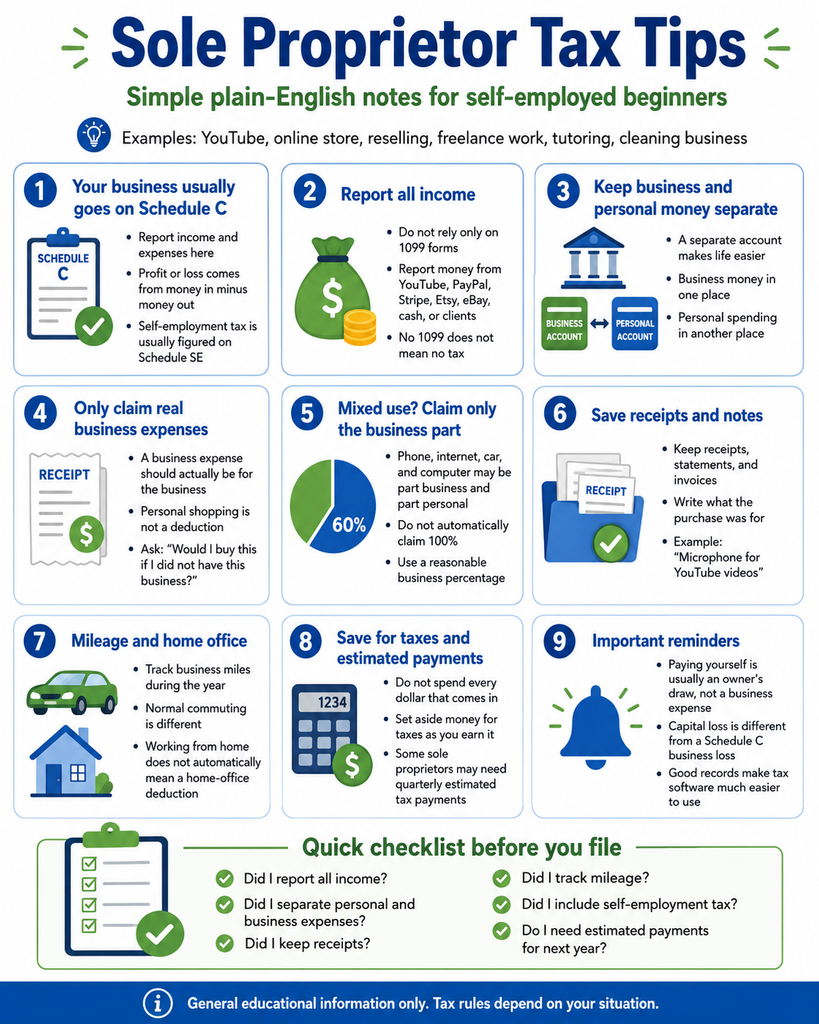
If you run a small business by yourself and you did not create a corporation or partnership, you may be operating as a sole proprietor.
Examples can include a YouTube channel, online store, reselling business, freelance work, consulting, tutoring, cleaning business, content creation, or other work you do for yourself.
1. Your Business Usually Goes on Schedule C
A sole proprietor generally reports business income and business expenses on Schedule C, Profit or Loss From Business, which is attached to Form 1040.
Schedule C basically asks:
How much money did your business make?
minus
How much did you spend running the business?
The result is your business profit or loss.
2. Business Income Is More Than Just 1099 Forms
You should generally report your business income even if you did not receive a 1099.
For example, you may receive money from:
YouTube
AdSense
Affiliate programs
Etsy
eBay
Facebook
TikTok
Freelance clients
Cash payments
PayPal
Venmo
Stripe
Direct bank transfers
A tax form helps report income, but the form does not create the income. Keep your own records of what your business actually received.
3. Your Business Profit Is Not the Same as Your Total Sales
Suppose your sole proprietorship receives $30,000 during the year.
If you have $12,000 of legitimate business expenses, your business profit may be approximately:
$30,000 income − $12,000 expenses = $18,000 business profit
That profit, not simply the $30,000 of gross receipts, is what Schedule C is designed to calculate.
4. Keep Business and Personal Spending Separate
You are not legally required in every situation to have a separate bank account just because you are a sole proprietor, but separating the money makes tax filing much easier.
A simple system is:
Business checking account → business income and business expenses
Personal checking account → groceries, family bills, personal shopping, entertainment, and other personal expenses
This makes it easier to see what belongs on Schedule C.
5. A Business Expense Should Actually Be for the Business
You cannot simply call something a business expense because you are self-employed.
A legitimate business expense generally needs to be connected to running your business.
For example, a YouTube creator might have expenses for:
Camera equipment
Microphones
Editing software
Website hosting
Advertising
Business-related subscriptions
Contractors
Office supplies
But ordinary personal purchases generally do not become deductible just because you own a business.
6. If Something Is Both Personal and Business, Do Not Automatically Claim 100%
Many sole proprietors use the same items for business and personal life.
Examples include:
Cell phone
Internet
Computer
Vehicle
You may need to claim only the portion related to your business.
For example, if you reasonably determine that half of your phone use is for business, claiming 100% of the phone bill may not accurately reflect your actual business use.
Keep records explaining how you determined the business percentage.
7. Keep Receipts and Explain What They Were For
A receipt by itself may not tell the full story.
For example:
Best Buy — $799
does not explain whether you purchased a television for your living room or a computer monitor for your business.
Add a simple note such as:
“Monitor used for video editing business.”
That can make your records much easier to understand later.
8. Know the Main Schedule C Expense Categories
Tax software may ask questions instead of showing you the actual Schedule C form.
Common categories include:
Advertising — ads, flyers, website promotion
Car and truck — qualifying business vehicle expenses
Commissions and fees — certain platform or sales fees
Contract labor — freelancers and independent contractors
Insurance — qualifying business insurance
Legal and professional services — accountant, attorney, tax professional
Office expenses — postage, printer supplies and similar costs
Rent or lease — business property or equipment
Repairs and maintenance — repairs to business equipment
Supplies — materials used for the business
Taxes and licenses — qualifying business permits and licenses
Travel — qualifying business travel
Meals — qualifying business meals, subject to tax rules
Utilities — qualifying business utilities
Home office — if you meet the home-office requirements
Other expenses — legitimate business expenses that do not fit the standard categories
9. Driving for Business Is Different From Commuting
Driving for your business may sometimes qualify as a business expense.
But ordinary commuting from your home to your regular workplace is generally not treated the same way.
If you claim vehicle expenses, keep a mileage log showing:
Date
Starting location
Destination
Business reason
Business miles
Trying to recreate an entire year of mileage in April is much harder than recording it during the year.
10. Working From Home Does Not Automatically Mean You Get a Home-Office Deduction
Many sole proprietors work from home.
That alone does not automatically qualify you for the deduction.
The IRS has specific rules about how the space is used, including requirements involving business use and, in many situations, exclusive use.
If you qualify, tax software may offer either a simplified method or a method based on actual home expenses.
11. Equipment Can Be Different From Everyday Supplies
A box of printer paper and a $3,000 professional computer may not be treated exactly the same way for tax purposes.
Tax software may ask separately about items such as:
Computers
Cameras
Machinery
Furniture
Vehicles
Other major equipment
Do not automatically place every large purchase under “supplies.”
12. You May Owe Self-Employment Tax
This surprises many new sole proprietors.
Employees normally have Social Security and Medicare taxes withheld from their paychecks.
As a sole proprietor, you may have to pay self-employment tax based on your net self-employment earnings.
Tax software generally calculates this through Schedule SE.
This is separate from regular federal income tax.
13. Save Money for Taxes as You Earn It
Do not treat every dollar that enters your business account as money you can spend.
Consider moving part of your income into a separate savings account for taxes throughout the year.
How much you should save depends on your income, deductions, filing status, state taxes, and other circumstances.
14. You May Need Quarterly Estimated Taxes
Because a sole proprietor usually does not have an employer withholding tax from business income, you may need to make estimated tax payments during the year.
These payments are generally made four times during the year.
Tax software often calculates estimated payments after you complete your return if it expects you may owe enough tax the following year.
15. Inventory Is Different From Regular Supplies
If your sole proprietorship buys products to resell, you may need to track inventory and cost of goods sold.
For example, an online reseller may track:
Beginning inventory
Purchases
Other inventory costs
Ending inventory
This is different from simply claiming everything purchased for resale as office supplies.
16. Paying Yourself Is Not Usually a Business Expense
This is an important sole-proprietor concept.
You and the sole proprietorship are generally not separate taxpayers in the same way that you and a corporation can be.
If you transfer $1,000 from your business account to your personal account, that is generally an owner’s draw, not a deductible wage expense paid to yourself.
Your taxes are generally based on the business’s profit, not on how much money you withdraw.
17. You Can Have Business Profit Even If You Leave the Money in the Bank
Suppose your Schedule C business earns a $20,000 profit, but you leave the entire $20,000 sitting in the business bank account.
That does not necessarily mean you avoid tax on the profit.
For a sole proprietor, taxes generally follow the business’s taxable profit rather than simply the amount you transfer to yourself.
18. A Business Loss Is Possible
If legitimate business expenses are greater than business income, your Schedule C may show a loss.
For example:
Business income: $5,000
Allowable business expenses: $8,000
Business loss: $3,000
But there is no simple rule saying a business can claim losses for only three years.
The IRS looks at whether the activity is genuinely being operated with the intention of making a profit.
The commonly heard “3 out of 5 years” rule is a profit-presumption rule, not an automatic three-year limit on business losses.
19. Show That You Are Actually Trying to Make Money
This can be especially important for businesses such as YouTube channels, blogs, social media businesses, photography, crafts, and other activities that can also be hobbies.
Helpful signs of a real business can include:
Keeping income and expense records
Advertising the business
Trying different ways to increase revenue
Keeping a business plan or revenue strategy
Tracking results
Changing methods when something is not profitable
Maintaining separate business finances
Actually trying to find customers or viewers
You do not have to be profitable immediately, but you should be able to show that making money is the goal.
20. Capital Losses Are Different From Schedule C Business Losses
Do not mix these two up.
If you sell stocks or another capital asset at a loss, that may be a capital loss, generally handled through Form 8949 and Schedule D.
If your sole proprietorship spends more running the business than it earns, that may be a business loss, generally calculated on Schedule C.
They follow different rules.
Simple Sole Proprietor Checklist Before Filing
Before submitting your return, check:
- Did I report all of my business income?
- Did I enter my 1099 forms correctly?
- Did I include income that did not come with a 1099?
- Did I separate personal expenses from business expenses?
- Did I claim only the business portion of mixed-use expenses?
- Did I enter equipment separately when required?
- Did I track business mileage?
- Do I qualify for a home-office deduction?
- Did I enter inventory correctly if I sell products?
- Did the software calculate self-employment tax?
- Do I need estimated tax payments for next year?
- Did I save receipts and records supporting my expenses?
Remember
Being a sole proprietor does not mean you need complicated accounting.
The basic idea is:
Track what your business earns.
Track what your business spends.
Keep proof.
Separate personal and business expenses.
Report the numbers accurately.
Tax software can do much of the math, but it cannot know what happened in your business unless you give it accurate information.