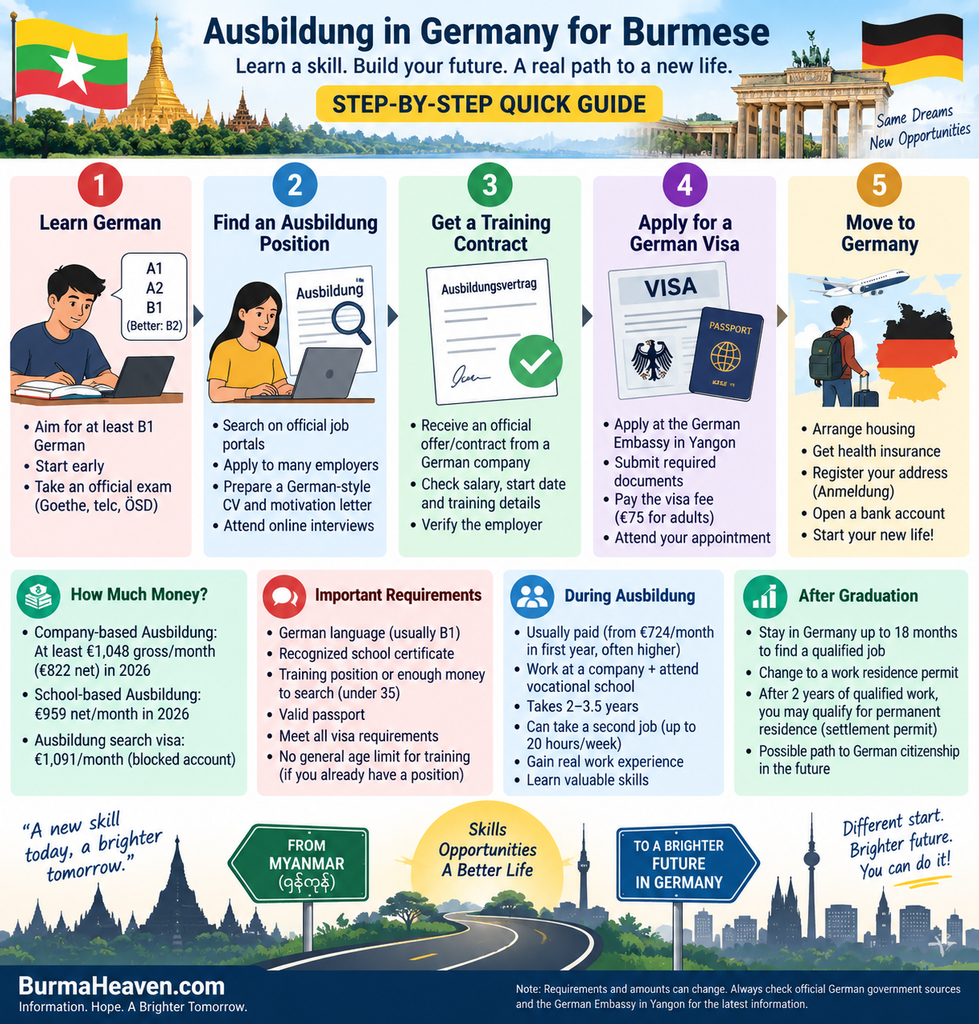
For Burmese citizens looking for a legal way to move to Germany, Ausbildung — Germany’s vocational-training system — may be one of the most practical options to explore.
Ausbildung is not the same as going to a traditional university. Instead, you train for a specific occupation. In many programs, you work for a German company, attend vocational school, gain real work experience and receive a monthly training salary.
After successfully completing the training, you may be able to remain in Germany, find qualified employment and eventually qualify for permanent residence if you meet the requirements.
For a young person in Myanmar who is willing to learn German, train for an occupation and build a life in Germany, Ausbildung deserves serious consideration.
What Is Ausbildung?
Ausbildung means vocational training or professional training.
Germany has hundreds of recognized vocational occupations. Instead of spending several years only studying at a university, Ausbildung prepares you directly for a profession.
There are two main types.
1. Dual or Company-Based Ausbildung
This is the type most international applicants are interested in.
You normally divide your time between:
- Working and receiving practical training at a company
- Attending a vocational school, called a Berufsschule
- Completing examinations
- Earning a recognized German vocational qualification
You normally receive a monthly training salary from your employer.
Dual vocational training generally takes around two to three-and-a-half years, depending on the occupation.
2. School-Based Vocational Training
Some professions are taught mainly through a vocational school rather than through a company.
The financing rules can be different because you may not receive the same type of employer-paid training salary.
This distinction is important when applying for a German visa because Germany has different financial-support requirements depending on whether your Ausbildung is company-based or school-based.
Is Ausbildung Available to Burmese Citizens?
Yes.
Myanmar citizens are considered nationals of a country outside the European Union, so they generally need a German national visa and residence permit to move to Germany for vocational training.
Germany has a specific residence category for people coming to complete qualified vocational training.
There are actually two possible situations:
You already found an Ausbildung position in Germany
You may apply for a visa for vocational training.
You have not found an Ausbildung position yet
If you meet additional requirements, you may be able to apply for a visa to come to Germany and search for an Ausbildung position.
These are two different routes.
OPTION 1: You Already Have an Ausbildung Position
This is generally the more straightforward situation.
Before applying for the visa, you find a German company or vocational-training institution willing to accept you.
You then use your training agreement or acceptance as part of your visa application.
Germany currently lists several major requirements.
You Need a Specific Training Place
You must normally be able to show that you have been accepted into qualified vocational training in Germany.
For company-based Ausbildung, this usually means having a training contract with a German employer.
German Language Ability
German is extremely important.
Germany’s official immigration portal states that applicants normally need approximately B1 German under the Common European Framework of Reference for Languages (CEFR) when the training institution has not already assessed the person’s language ability or another exception applies.
This requirement makes sense because vocational school, workplace communication and examinations are generally conducted in German.
For Burmese applicants, learning German should therefore begin before applying for Ausbildung positions.
B1 should be viewed as a minimum immigration requirement in many situations — not necessarily the level at which everything in Germany suddenly becomes easy.
Having stronger German, such as B2, may make it easier to:
- Understand teachers
- Communicate with employers
- Pass interviews
- Understand technical vocabulary
- Pass vocational examinations
- Handle daily life in Germany
How Much Money Do You Need?
This depends heavily on the type of Ausbildung.
Company-Based Ausbildung
During a company-based Ausbildung, you normally receive a training salary.
For 2026, Germany considers your livelihood secured for the vocational-training visa if your training allowance is at least approximately:
€1,048 gross per month
or
€822 net per month
If your Ausbildung salary is below the required amount, that does not necessarily mean you cannot qualify.
You may be able to prove the difference through methods such as:
- A blocked account
- A qualifying declaration of commitment from someone in Germany
Always check the current amount because Germany updates financial requirements.
School-Based Ausbildung
If the vocational training is school-based and you are not receiving sufficient salary, Germany currently requires proof that you can support yourself.
For 2026, Germany lists at least approximately:
€959 net per month
This may be demonstrated through methods such as a blocked account, scholarship or qualifying declaration of commitment.
Do Ausbildung Students Get Paid?
Many do.
One of the major differences between university study and dual Ausbildung is that company-based trainees normally earn money while they train.
Germany’s official immigration portal states that trainees in dual vocational training in 2026 generally earn at least approximately €724 per month during the first year, with training pay normally increasing during later years.
Actual salaries can be considerably higher depending on:
- Occupation
- Employer
- Industry
- Region
- Training year
- Collective bargaining agreements
Remember that the minimum training salary and the amount Germany considers sufficient for visa living expenses are not necessarily the same number.
If your salary is too low to satisfy the immigration requirement, you may need additional financial proof.
Can You Work Another Job During Ausbildung?
Yes, under the current rules.
Someone holding a German residence permit for vocational training can generally take a separate second job for up to 20 hours per week, provided it is independent of the vocational training.
However, Ausbildung itself can already involve substantial work and school obligations.
Do not assume that working an additional 20 hours every week will necessarily be practical.
OPTION 2: Come to Germany to Look for an Ausbildung Position
Germany also has a special visa for people who want vocational training but have not found a training position yet.
This is called a visa for seeking a vocational-training place.
It is particularly important to understand that the rules for this visa are stricter than simply applying after you already have a training contract.
Current requirements generally include:
- Being under age 35
- Having a qualifying school-leaving certificate
- Having at least B1 German
- Showing sufficient financial resources
- Meeting the normal German visa requirements
For 2026, the financial requirement for this search visa is approximately:
€1,091 per month
This can generally be demonstrated through a blocked account or qualifying declaration of commitment.
How Long Can You Stay in Germany to Look for Ausbildung?
The vocational-training search visa can allow an eligible applicant to stay in Germany for up to:
9 months
During that period, you can search for an Ausbildung position.
You may also currently:
Work up to 20 hours per week
and
Complete up to two weeks of trial work
This gives applicants an opportunity to meet employers and search from inside Germany rather than attempting everything from Myanmar.
However, this route requires significantly more money upfront because you must be able to financially support yourself during the search.
Important: The Age 35 Rule Is Often Misunderstood
You may see people online saying:
“You must be under 35 to do Ausbildung in Germany.”
That is not generally correct.
Germany’s official immigration information says there is no general age limit for beginning vocational training.
The under-35 requirement applies specifically to the visa for entering Germany to search for an Ausbildung position.
That means:
Age 25 + no training position yet
You may potentially qualify for the Ausbildung search visa if you meet the other requirements.
Age 32 + no training position yet
Potentially eligible for the search route if the other conditions are satisfied.
Age 38 + no training position yet
The under-35 Ausbildung-search visa would generally not be available.
However:
Age 38 + already accepted into an Ausbildung
You may still potentially qualify for the regular vocational-training visa if you meet its requirements.
Applicants over age 45 should pay particular attention to additional German immigration rules concerning income or retirement provision and should verify their individual situation before applying.
What Education Do Burmese Applicants Need?
There is no single education requirement covering every Ausbildung occupation.
Employers and vocational schools may have their own requirements.
However, your Burmese educational documents may need to be evaluated to determine how they compare with German educational qualifications.
For the separate visa used to enter Germany and search for vocational training, Germany requires a school-leaving certificate that provides access to higher education or a qualifying certificate from a German school abroad.
Having a school certificate does not automatically guarantee that every German employer will accept it.
Always check the individual Ausbildung advertisement.
What German Language Certificate Should You Get?
Germany normally expects applicants to demonstrate German at approximately B1 level for the vocational-training visa.
Germany recognizes language certificates from approved providers for immigration purposes.
Recognized testing providers include organizations such as:
- Goethe-Institut
- telc
- ÖSD
- TestDaF for applicable higher levels
For someone living in Myanmar, the Goethe-Institut is one important place to investigate for German-language learning and recognized examinations.
Do not spend significant money on a private language certificate without first checking whether German immigration authorities will recognize it.
Which Ausbildung Careers Are in Demand?
Germany’s official immigration portal identifies several vocational fields with demand for trainees and workers.
Examples include:
Nursing and Healthcare
Germany needs workers in healthcare and nursing.
Nursing Ausbildung can be attractive because healthcare workers are needed throughout Germany.
However, nursing requires substantial German-language communication.
Patients, medical terminology, documentation, instructors and examinations may all be in German.
For Burmese applicants interested in nursing, reaching a stronger German level than the minimum can be extremely helpful.
Transport and Logistics
Possible areas include transportation, warehousing and logistics.
Germany has a large industrial and logistics economy, creating vocational-training opportunities in these fields.
Electrical and Metal Industries
Training opportunities can include occupations connected with:
- Electronics
- Electrical systems
- Machinery
- Metalworking
- Industrial equipment
- Mechatronics
These occupations may be attractive to applicants who prefer technical and hands-on work.
Construction and Building Trades
Germany also lists construction and related trades among vocational fields where workers are needed.
Hotels and Restaurants
Hospitality Ausbildung can include careers involving:
- Hotels
- Restaurants
- Kitchens
- Food service
- Guest services
Good German communication is especially important when working directly with customers.
Retail and Sales
Vocational training also exists in retail, sales and commercial occupations.
Food Trades
Germany has vocational programs in occupations such as baking, food production and other skilled food trades.
Medical, Orthopedic and Rehabilitation Technology
Applicants interested in combining healthcare and technical work may also find vocational-training occupations involving medical equipment and rehabilitation technology.
Information Technology
Germany also has Ausbildung occupations in information technology.
Examples can include areas involving:
- Computer systems
- Software
- Systems integration
- Data and process analysis
- Digital networking
IT Ausbildung should not be confused with Germany’s skilled-worker immigration routes for people who already have significant IT qualifications or experience.
How Do You Find an Ausbildung Position From Myanmar?
This is one of the most important parts of the process.
For the regular vocational-training visa, you usually need the Ausbildung position before moving to Germany.
You can search official German job and training portals.
Good places to start include:
Make it in Germany Job Listings
Germany’s official immigration portal includes job listings and Ausbildung opportunities.
German Federal Employment Agency
The Bundesagentur für Arbeit operates Germany’s official employment system and provides Ausbildung searches and career information.
IHK Training Listings
Germany’s Chambers of Industry and Commerce may also provide Ausbildung listings.
Individual Company Websites
Large German companies frequently publish Ausbildung openings directly on their career websites.
Search using combinations such as:
Ausbildung + occupation
Ausbildung + city
Ausbildungsplatz + occupation
For example:
Ausbildung Pflege
Ausbildung Fachinformatiker
Ausbildung Mechatroniker
Ausbildung Hotel
Apply Early
Do not wait until shortly before you want to move.
Germany’s Federal Employment Agency advises applicants to begin looking early, commonly around one year before the intended Ausbildung start date.
Many Ausbildung programs traditionally begin around:
August or September
although exceptions exist.
For someone applying from Myanmar, starting early is especially important because you may need time for:
- German-language study
- Language examinations
- School-document preparation
- Translations
- Employer interviews
- Visa application
- Visa processing
- Housing arrangements
- Travel preparation
A Burmese applicant considering Ausbildung should realistically begin planning many months before the desired start date.
What Does an Ausbildung Application Usually Include?
German employers may request documents such as:
- CV or résumé
- Cover letter or motivation letter
- School certificates
- Educational records
- German-language certificate
- References
- Previous employment information
- Passport information
- Other documents required by the employer
German job applications may look different from applications commonly used in Myanmar.
Make sure your application is professional and tailored to the actual occupation.
Do not send exactly the same generic letter to hundreds of employers if you can avoid it.
Explain:
- Why you want that occupation
- Why you chose Germany
- Why you chose that company
- What education or experience you have
- Your German-language level
- When you can begin training
Can You Apply From Myanmar?
Yes.
The German Embassy in Yangon handles German visa matters for applicants residing in Myanmar.
Germany now allows several national-visa categories to begin through its online Consular Services Portal, including vocational-training visas.
The Embassy states that applicants can use the online system to submit information and receive an initial check of whether documentation is complete.
The applicant later attends an in-person appointment for requirements such as:
- Original documents
- Identity verification
- Biometrics
- Visa fee
Appointments for long-term national visas should be handled according to the current instructions of the German Embassy Yangon.
Germany Ausbildung Visa: Step-by-Step From Myanmar
Step 1 — Decide What Occupation You Want
Research German Ausbildung occupations.
Do not choose a profession simply because someone on TikTok says the visa is easy.
Think about whether you could actually work in that occupation for years.
Step 2 — Start Learning German
Aim for at least B1 German.
Starting German early is extremely important.
For highly communication-dependent careers such as nursing, hospitality and customer service, stronger German may substantially improve your chances.
Step 3 — Prepare Your Education Documents
Gather documents such as:
- School certificates
- Academic records
- Training certificates
- Employment documents
- Passport
Find out whether your school qualification requires German recognition or evaluation.
Documents that are not in German or English may need certified or notarized translations depending on the requirements applying to your case.
Step 4 — Search for Ausbildung Positions
Use official employment portals and German company websites.
Apply broadly.
Do not limit yourself only to Berlin, Munich, Frankfurt or other famous cities.
Smaller cities and towns may also have employers searching for trainees.
Step 5 — Attend Employer Interviews
Many employers may initially interview international applicants online.
Be prepared to discuss:
- Your German ability
- Why you want Ausbildung
- Why you chose the occupation
- Why you want to live in Germany
- Your education
- Work experience
- Your understanding of the job
Your employer needs confidence that you understand what you ar
Step 6 — Receive an Ausbildung Contract
If the employer accepts you, you will normally receive a vocational-training contract.
Read it carefully.
Check:
- Training occupation
- Training duration
- Start date
- Salary
- Weekly work arrangements
- Vacation
- Location
- Employer information
Never assume an offer is legitimate simply because someone sends you a document.
Verify the employer.
Step 7 — Check the Financial Requirement
Compare your Ausbildung salary with Germany’s current immigration requirement.
If the salary does not satisfy the required amount, determine whether you need additional financial proof.
Step 8 — Apply for the German National Visa
Use Germany’s current national-visa application system and follow the German Embassy Yangon instructions.
The standard German national visa fee is currently €75 for adults, although exceptions or reductions can apply in particular situations.
Visa fees and procedures can change, so check the Embassy again before applying.
Step 9 — Attend Your Visa Appointment
Bring all documents requested for your specific application.
Missing documents can delay processing or contribute to a refusal.
Do not rely entirely on another applicant’s checklist because circumstances can differ.
Step 10 — Receive the Decision and Prepare for Germany
If your visa is approved, begin preparing for:
- Travel
- Housing
- Health insurance
- German registration requirements
- Bank account
- Transportation
- Starting your Ausbildung
Your German employer may also help with some arrival arrangements.
How Hard Is It for a Burmese Applicant to Get Ausbildung?
There is no reliable official percentage saying something such as:
“Burmese applicants have a 70% chance of getting an Ausbildung visa.”
That kind of claim should be treated cautiously unless it comes from official statistics for the exact visa category.
Your practical chances depend on several separate things.
1. Your German Ability
This may be one of the biggest factors.
Someone who speaks strong German will generally be in a better position to interview with employers, communicate at work and succeed in vocational school than someone who barely passed B1.
2. The Occupation You Choose
Some fields have greater demand for trainees than others.
Applying only to highly competitive occupations or famous companies can make the search harder.
3. How Many Employers You Apply To
One application is not enough to judge whether Ausbildung is possible.
International applicants may need to apply to many employers.
4. Your Location Flexibility
Someone willing to consider smaller German cities and regions may have more possibilities than someone demanding only Berlin or Munich.
5. Your Education and Experience
Relevant education, technical skills, work experience or previous training can make an application stronger.
6. Whether You Can Meet the Visa Requirements
Finding an employer does not automatically mean the visa will be approved.
You still need to satisfy the applicable immigration requirements.
Is Ausbildung a Realistic Way for Burmese People to Leave Myanmar?
For the right applicant, yes — it is a legitimate immigration pathway worth investigating.
It may be especially relevant for someone who:
- Wants to move abroad legally
- Is willing to learn German seriously
- Does not necessarily want a four-year university degree
- Wants practical career training
- Is willing to work and study simultaneously
- Can meet German visa requirements
- Is flexible about occupation and location
- Wants the possibility of building a longer-term career in Germany
However, Ausbildung is not an instant or guaranteed escape route.
The language requirement alone may require months or longer of serious preparation.
Applicants normally must also convince an actual German employer or school to accept them.
Think of Ausbildung as a career and immigration pathway, not simply a visa.
What Happens After You Finish Ausbildung?
This is one of the most attractive parts of the German system.
After successfully completing qualified vocational training in Germany, you may be able to remain in the country for up to:
18 months
to search for qualified employment.
Once you find qualifying employment, you may be able to change to an appropriate German work residence permit without returning to Myanmar just to begin the entire immigration process again.
Can Ausbildung Eventually Lead to Permanent Residence?
Potentially, yes.
Germany provides a favorable rule for people who complete vocational training in Germany.
Someone who successfully completes vocational training in Germany and subsequently works in Germany for two years may potentially qualify for a settlement permit, provided all of the additional requirements are met.
A settlement permit is a form of permanent residence.
This does not mean:
Finish Ausbildung + work two years = automatic permanent residence.
The applicant must still satisfy the other legal requirements applying at the time.
But it shows why Ausbildung can become much more than temporary training.
The possible path can look like:
Learn German
↓
Find Ausbildung
↓
Get German vocational-training visa
↓
Move to Germany
↓
Complete Ausbildung
↓
Find qualified employment
↓
Change to work residence status
↓
Potentially qualify for settlement permit
↓
Possible long-term life in Germany
Can Ausbildung Eventually Lead to German Citizenship?
Potentially.
Ausbildung itself does not automatically give someone German citizenship.
However, time spent legally living in Germany may become part of a person’s longer immigration history.
German citizenship has separate requirements involving matters such as legal residence, identity, language, financial circumstances and other eligibility rules.
Citizenship law can also change.
Someone considering Ausbildung should first focus on:
Training → employment → legal residence → permanent status
and investigate citizenship requirements later based on the law that applies at that time.
Can You Bring Your Family?
Family reunification may sometimes be possible depending on the residence status, relationship, finances, housing and other German immigration rules.
However, someone entering Germany primarily as a vocational trainee should not assume that bringing a spouse, children or other relatives will automatically be simple.
Family reunification should be researched separately based on the person’s exact residence permit and family circumstances.
Ausbildung Is Not the Same as Asylum
Ausbildung is a regular immigration and vocational-training route.
Asylum is a separate protection system for people who fear persecution or serious harm.
Someone should not apply for an Ausbildung visa pretending to have a training purpose when that is not actually their intention.
Likewise, receiving an Ausbildung visa does not prevent a person who later genuinely needs international protection from learning about Germany’s asylum system.
But the two processes have different purposes and different legal standards.
Watch Out for Ausbildung Scams
Burmese applicants should be particularly careful with people claiming:
“Pay me and I guarantee you an Ausbildung visa.”
“I have connections at the German Embassy.”
“Pay this large fee and Germany will definitely accept you.”
“You do not need German.”
“You don’t need an actual employer.”
“I can guarantee permanent residence.”
No private agent can guarantee that Germany will issue a visa.
Germany’s official employment services are available without applicants having to pay someone thousands of dollars simply to access job listings.
The German Embassy Yangon also warns applicants that visa appointments are free to book and does not encourage applicants to use agencies or third parties to obtain appointments.
Be especially suspicious if someone:
- Demands a very large cash payment
- Refuses to identify the German employer
- Gives you a Gmail or Facebook-only contact
- Tells you not to contact the employer directly
- Guarantees visa approval
- Provides a suspicious employment contract
- Tells you to lie to the Embassy
- Asks you to submit fake education or language documents
Verify the company independently before sending money.
Quick Guide: Which Ausbildung Route Applies to You?
I already have an Ausbildung contract.
Start with the German vocational-training visa.
I don’t have an Ausbildung position, I am under 35, I have B1 German and I have enough money.
Investigate the visa for seeking a vocational-training position.
I don’t have an Ausbildung position and I am over 35.
The Ausbildung-search visa generally will not fit because of its age requirement.
Instead, you can continue searching for an Ausbildung employer from outside Germany and investigate the regular training visa once you receive a qualifying position.
I already have a university degree and professional experience.
Ausbildung may still be possible, but also compare it with Germany’s:
- Skilled-worker visa
- EU Blue Card
- Opportunity Card
- Other employment routes
You may already qualify for a route that does not require starting your career again as a trainee.
I want university instead.
See our Burmese Guide to Studying in Germany.
A Practical Plan for Someone in Myanmar
If you are starting from zero, a reasonable order is:
1. Research Ausbildung occupations
Choose several occupations rather than only one extremely narrow option.
2. Begin German immediately
Work toward B1 and consider continuing toward B2.
3. Prepare your passport and education records
Check document validity and translations.
4. Prepare a German-style CV and application
Explain your motivation clearly.
5. Search and apply to employers
Begin well before the Ausbildung start date.
6. Interview
Demonstrate that you understand the occupation and can communicate in German.
7. Obtain your training contract
Verify the employer and contract.
8. Check salary and financial requirements
Determine whether additional financial proof is necessary.
9. Apply for your German national visa
Follow the German Embassy Yangon instructions.
10. Move to Germany and begin vocational training
Complete your training and build German work experience.
Bottom Line
Germany’s Ausbildung system can offer Burmese applicants something that does not exist in exactly the same form in many countries:
Learn a profession + work for a company + receive training + earn money + obtain a recognized qualification + potentially remain in Germany for employment afterward.
It is not easy.
The biggest barrier for many Burmese applicants will probably be learning enough German and finding a real German employer willing to offer an Ausbildung contract.
But for someone willing to spend the time learning German and preparing properly, Ausbildung is a real legal pathway worth considering.
And unlike a short-term visitor visa, the pathway can potentially develop into:
Vocational training → skilled employment → long-term residence in Germany.
Official Resources
Before paying an agent or making major decisions, verify current requirements through official German government sources.
Make it in Germany — German Government Immigration Portal
Use this for vocational-training requirements, visa rules, occupations and job listings.
German Embassy Yangon
Use this for applications made while residing in Myanmar, visa appointments and current Myanmar-specific procedures.
German Federal Employment Agency — Bundesagentur für Arbeit
Use this to search for Ausbildung positions and learn about German occupations.
German Federal Foreign Office — Consular Services Portal
Use this for eligible online national-visa applications.
Goethe-Institut
Use this to research recognized German-language courses and examinations.
Useful official links: Germany — Visa for Vocational Training · Official Ausbildung Job Listings · German Embassy Yangon — National Visas · German Federal Employment Agency — Ausbildung
Important
Burma Heaven provides general educational information and is not a German immigration authority or law firm.
German immigration rules, required financial amounts, visa procedures and employment requirements can change. Amounts shown on this page reflect official information available for 2026.
Always verify the current requirements with the German Embassy Yangon, the German Federal Foreign Office, Make it in Germany or another appropriate German government authority before applying.