US school system for Burmese parents can feel confusing at first, especially for families arriving from Myanmar.“ This US school system for Burmese parents guide is designed to help newly arrived families understand their options.” “One important part of the US school system for Burmese parents to understand is grade placement.” “Special education is another area covered in this US school system for Burmese parents guide.” “Understanding parent rights is an important part of navigating the US school system for Burmese parents.”
This US school system for Burmese parents guide explains the most important things families should know before and after enrolling a child in public school.
How U.S. Public Schools Are Organized: A Guide for Burmese Parents
Moving to the United States can make the school system feel confusing at first. School names, grade levels, enrollment rules, buses, lunch programs, English classes, counselors, and graduation requirements may all be very different from what families are used to in Myanmar.
This guide explains the basic structure of U.S. public schools and what Burmese parents should expect when enrolling a child.
1. Public School Is Generally Free
Public elementary, middle, and high schools do not charge tuition to students who live within the school district.
Families may still have optional or incidental expenses for things such as:
School supplies
Field trips
Sports
Yearbooks
School pictures
Certain extracurricular activities
Students may also qualify for free school meals or other assistance depending on the school and program.
2. How U.S. Public Schools Are Divided
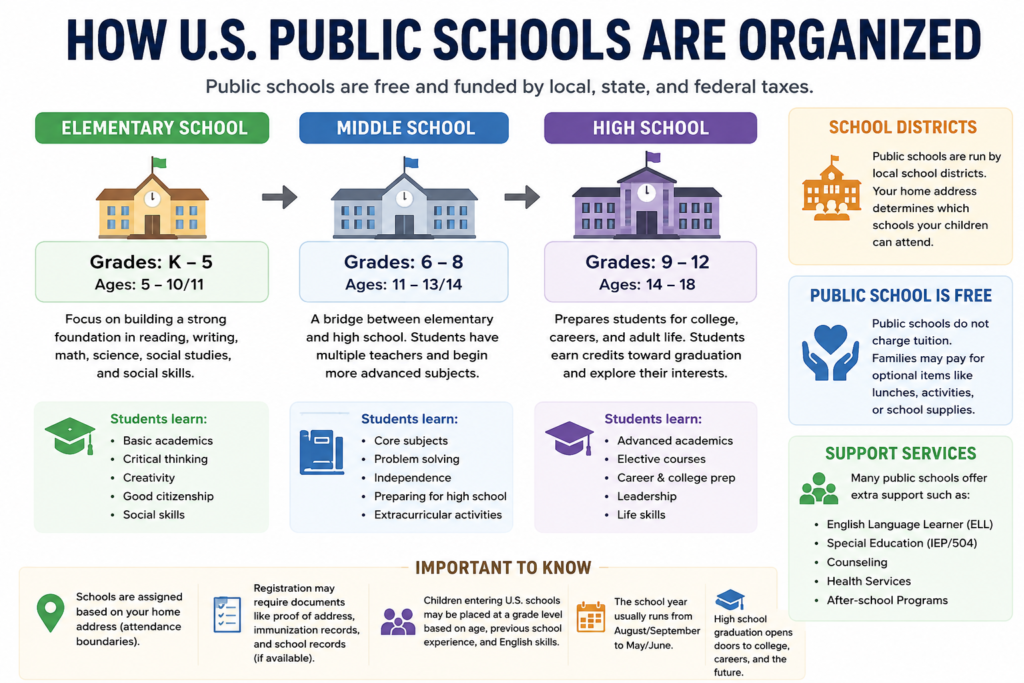
The exact grade configuration can vary by school district, but the most common structure is:
Elementary School
Usually:
Kindergarten through Grade 5
Typical ages: approximately 5–11
Children learn subjects such as:
Reading
Writing
Mathematics
Science
Social studies
Physical education
Art and music
Some districts include Grade 6 in elementary school.
Middle School
Usually:
Grades 6–8
Typical ages: approximately 11–14
Middle school is more independent than elementary school.
Instead of staying with one teacher for most of the day, students often move between different classrooms and teachers.
For example:
Math
English
Science
History
Physical education
Electives
Electives may include music, art, technology, foreign languages, drama, or other subjects.
Some districts call these schools junior high schools.
High School
Usually:
Grades 9–12
Typical ages: approximately 14–18
The four high-school years also have special names:
High-school students must complete required courses and earn enough credits to graduate.
Requirements vary by state and school district.
3. Kindergarten Is the Beginning of Formal Public School
Many children enter kindergarten around age five.
However, the exact birthday cutoff and compulsory-school age depend on state law.
Some schools also offer:
Transitional Kindergarten
Pre-K
Preschool
These programs are not organized exactly the same way in every state.
4. Your Home Address Usually Determines Your School
This is one of the biggest differences newcomer families need to understand.
In many U.S. communities, children are assigned to a public school based on their home address.
This is sometimes called:
school attendance boundaries
or
school zones
Two families living only a few streets apart may be assigned to different schools.
The local organization responsible for the schools is usually called a:
School District
A school district may operate:
Elementary schools
Middle schools
High schools
Special education programs
Transportation
English Learner programs
Other student services
Parents usually enroll their child through the district or assigned school.
5. Not Every Public School Is the Same
Public schools can include several different types.
Traditional Public School
The regular neighborhood school operated by the local school district.
Magnet School
A public school that may focus on a particular subject such as:
Science
Technology
Performing arts
Languages
Admission rules vary.
Charter School
A publicly funded school that operates independently under a charter.
Charter-school admission rules vary by state and school.
Alternative School
A school designed for students who may need a different academic or behavioral environment.
Families should verify individual school rules before assuming a child can automatically attend.
6. Children Arriving From Myanmar May Need Grade Placement
A child who attended school in Myanmar will normally be placed into an appropriate U.S. grade.
Schools may consider:
Age
Previous grade level
School transcripts
Report cards
Academic records
Previous coursework
English ability
Graduation-credit requirements for older students
Families should bring any school records they have from Myanmar.
If records are incomplete or unavailable, parents should still contact the school district. The district can explain what information it requires and how placement will be handled.
7. English Ability Does Not Determine Whether a Child Can Attend School
A child does not need to speak fluent English before entering public school.
Students who are learning English may receive additional support.
You may hear terms such as:
English Learner
EL
ELL
English Language Development
ELD
ESL
The terminology varies by state and district.
Schools may test a student’s English proficiency after enrollment to determine what language support is appropriate.
8. Parents Can Ask for Language Assistance
Parents who are not fluent in English should ask the school whether interpreter or translated-language assistance is available.
This can be particularly important for:
Enrollment
Parent-teacher conferences
Special education meetings
Discipline matters
School notices
Academic concerns
Graduation planning
Do not assume that your child should act as the family’s interpreter for important school matters.
Ask the school directly about language assistance.
9. Students Receive Report Cards and Grades
Elementary schools may use:
Numbers
Letters
Standards-based ratings
Written teacher evaluations
Older students commonly receive letter grades:
A — Excellent B — Above average / good C — Satisfactory D — Low passing grade in many systems F — Failing
Exact grading policies vary by district and teacher.
10. GPA Becomes Important in High School
High-school students often receive a Grade Point Average, commonly called a:
GPA
A GPA summarizes academic performance across classes.
It can become important for:
College applications
Scholarships
Academic honors
Certain school programs
Class ranking in schools that use ranking
Parents of high-school students should become familiar with both grades and credits.
11. High School Students Need Credits to Graduate
Passing Grade 12 does not automatically mean a student can graduate.
Students generally must complete required courses and earn a certain number of credits.
Required subjects may include:
English
Mathematics
Science
Social studies
Physical education
Other state or district requirements
This is especially important for teenagers entering the United States from Myanmar during high school.
A counselor may need to review previous coursework and determine which credits can be accepted.
12. School Counselors Are Important
Middle and high schools often have school counselors.
Counselors may help students with:
Class schedules
Graduation requirements
College planning
Career planning
Academic problems
Course selection
Personal concerns
School adjustment
For a newly arrived high-school student, the counselor may be one of the most important people for the family to contact.
13. Advanced Classes May Be Available
Older students may have access to more challenging coursework.
Terms parents may hear include:
Honors
More advanced classes than the standard course.
AP — Advanced Placement
College-level coursework offered in high school.
Dual Enrollment
A student may take college courses while still attending high school.
Gifted Programs
Programs for students identified as needing advanced academic instruction.
Availability and admission requirements vary considerably.
14. Students Can Choose Electives
Not every class is mandatory.
Middle- and high-school students may choose electives, depending on the school.
Examples include:
Band
Orchestra
Choir
Art
Computer science
Robotics
Drama
Journalism
Business
Foreign languages
Career education
These classes can become an important part of a student’s school experience.
15. Sports and Activities Are Part of School Life
American schools often offer activities outside regular academic classes.
Examples include:
Soccer
Basketball
Football
Volleyball
Track
Tennis
Swimming
Cheerleading
Debate
Student government
Clubs
Music
Theater
Some activities require tryouts, fees, physical examinations, minimum grades, or other requirements.
16. Attendance Is Taken Seriously
Schools track whether students:
Attend school
Arrive on time
Leave early
Miss individual classes
Parents usually need to notify the school when a child is absent.
Repeated unexcused absences can lead to school or district intervention.
Attendance laws vary by state.
17. School Usually Runs Monday Through Friday
Most public schools operate five days per week.
A normal school day may begin sometime in the morning and end during the afternoon.
Exact hours vary by school.
The school year is divided into periods that may be called:
Semesters
Trimesters
Quarters
Schools also close for holidays and scheduled breaks.
Common breaks include:
Thanksgiving
Winter break
Spring break
Summer vacation
Always check your school’s official calendar.
18. School Transportation May Be Available
Some school districts provide buses.
Others provide transportation only for certain students, distances, programs, or circumstances.
Parents should never assume that a school bus is automatically provided.
Ask the school district:
Is my child eligible for a bus?
Where is the bus stop?
What time is pickup?
Is there a transportation fee?
Does my child need a bus pass?
19. School Breakfast and Lunch May Be Available
Many public schools serve breakfast and lunch.
Depending on the school and student eligibility, meals may be:
Free
Reduced price
Paid
Some states or districts provide free meals to all students.
Families should check the school’s current meal program.
20. Parents Communicate Directly With Teachers
Parents in the United States are generally expected to communicate with the school when they have questions or concerns.
You may contact:
Teacher → Counselor → Principal → School District
depending on the issue.
Schools may communicate through:
Email
Phone
Parent portals
Apps
Text messages
Printed notices
Parents should make sure the school has their current phone number and email address.
21. Parent-Teacher Conferences
Schools may schedule meetings where parents speak directly with teachers about their child’s:
Grades
Behavior
Attendance
Strengths
Difficulties
Academic progress
Parents can ask questions.
You do not need to wait for a serious problem before contacting a teacher.
22. Special Education and Disability Support
Students with disabilities may qualify for additional educational services.
Parents may hear terms including:
IEP
Individualized Education Program
504 Plan
A plan that can provide accommodations for qualifying students with disabilities.
Evaluation and eligibility involve specific legal processes.
Parents who believe their child may need support can ask the school how to request an evaluation.
23. School Discipline Works Differently From School to School
Schools establish behavioral rules.
Consequences may include:
Warning
Parent contact
Detention
Loss of privileges
Suspension
Expulsion in serious cases
Schools should provide families with their student handbook or discipline policy.
24. School Safety Procedures May Be New to Burmese Families
Schools may regularly practice emergency drills.
These can include:
Fire drills
Earthquake drills in some areas
Lockdown drills
Emergency evacuation
A drill does not necessarily mean that an emergency is occurring.
Schools practice these procedures so students and staff know what to do if a real emergency happens.
25. The Biggest Difference for Burmese Parents: Ask Questions
The U.S. school system is decentralized.
There is not one identical national school system.
Important rules can differ between:
State → School District → Individual School
So when another Burmese family tells you:
“My child’s school does it this way.”
that does not necessarily mean your child’s school follows the same rule.
Always verify major requirements with your own school or district.
Quick Guide for Newly Arrived Burmese Families
When enrolling your child, try to bring whatever records you have, including:
Child’s identification documents
Proof of address
Vaccination records
Previous school records
Report cards
Transcripts for older students
Custody documents if applicable
Then ask the school about:
Grade placement • English Learner services • school meals • transportation • school calendar • parent portal • language assistance • graduation requirements for teenagers
Important for Families With Teenagers
If your child arrives in the United States during Grades 9–12, do not focus only on what grade the school places them in.
Ask the counselor:
How many graduation credits does my child already have?
Which Myanmar classes will the school accept?
Which courses are still required?
Is the student on track to graduate?
What happens if there is not enough time to complete all requirements?
For immigrant families with older teenagers, this can be much more important than simply knowing the child’s grade level.
BH Note
U.S. education rules vary by state and school district. This guide explains the general structure of American public schools and is intended to help newly arrived families understand common terminology and practices. Always verify enrollment, vaccination, attendance and graduation requirements with your local school district.
Free or Low-Cost School Vaccination Clinics
Area
Clinic / location
Cost & eligibility
Contact
Los Angeles County, CA
LA County Public Health / VFC clinics throughout LA County
Free/no-cost vaccines are available for VFC-eligible children 18 and younger; LA County also maintains a finder for free and low-cost immunization clinics. (Public Health – Los Angeles County)
1-833-540-0473
Pasadena / LA County area
Pasadena Public Health Immunization Clinic, 1845 N. Fair Oaks Ave., 2nd Floor, Pasadena, CA
VFC vaccines available for children 6 months–18 who are uninsured, underinsured, or enrolled in Medi-Cal. Walk-ins currently Mon/Wed. (City of Pasadena)
626-744-6121
Monrovia / Pomona area, CA
LA County Public Health Centers — Monrovia and Pomona
LA County directs residents to these public-health centers and its free/low-cost immunization network; call first to confirm vaccine and eligibility. (Los Angeles County Public Health)
1-833-540-0473
Brooklyn, NYC
Fort Greene Health Center Immunization Clinic, 295 Flatbush Ave. Extension, 5th Floor, Brooklyn, NY 11201
Low- or no-cost vaccinations; serves people age 4+ regardless of immigration status. Provides school vaccines including DTaP/Tdap, MMR, polio, Hep B, varicella and meningococcal. (New York City Government)
347-396-7943
Brooklyn, NYC
Gotham Health – Broadway, 815 Broadway, Brooklyn, NY 11206
NYC H+H provides pediatric vaccinations at little or no cost throughout the city. (NYC Health + Hospitals)
844-692-4692
Brooklyn, NYC
Gotham Health – Crown Heights, 1218 Prospect Place, Brooklyn, NY 11213
Pediatric/immunization services available through NYC H+H; little or no cost based on the program/patient circumstances. (NYC Health + Hospitals)
844-692-4692
Queens, NYC
Gotham Health – Roosevelt, 37-50 72nd St., Jackson Heights, NY 11372
Saint Paul–Ramsey County Public Health Immunization Clinic, 555 Cedar St., St. Paul, MN 55101
Low- or no-cost vaccinations for uninsured/underinsured families; Minnesota also provides free vaccines to qualifying children through VFC. (Facebook)
651-266-1255
Fort Wayne, IN
Super Shot, 1515 Hobson Rd., Fort Wayne, IN 46805
Nonprofit vaccine clinic serving uninsured/underinsured and Medicaid-eligible children; vaccines are free or low-cost and no one is turned away for inability to pay. (Southwest Allen County Schools)
260-424-SHOT
Milwaukee, WI
Milwaukee Health Department Immunization Clinics
Free vaccinations for children 18 or younger who are uninsured, Medicaid/BadgerCare eligible, or American Indian/Alaska Native. Routine school vaccines are offered. (City of Milwaukee)
414-286-8034
Omaha, NE
Douglas County Health Department Children’s Immunization Clinic, 1111 S. 41st St., Omaha, NE 68105
VFC-eligible children can receive free/reduced-cost vaccines; Nebraska 211 lists this clinic as no fee, donations accepted for eligible clients. (Douglas County Health)
402-444-6163
Omaha area, NE
OneWorld Community Health Center
Nebraska immunization resources list OneWorld among free/low-cost/sliding-scale vaccination providers. (Immunize Nebraska)
402-734-4110
Buffalo, NY
Erie County Department of Health – Jesse Nash Health Center, 608 William St., Buffalo, NY 14206
Provides vaccines through the Vaccines for Children program. Erie County has also run free back-to-school clinics here for Buffalo students. Call because eligibility/cost varies outside specific free clinic events. (Erie County)
716-858-7687
Utica, NY
Oneida County Health Department Immunization Clinic, 406 Elizabeth St., Utica, NY 13501
Children and adults; some vaccinations are free, insurance accepted, and income-based/sliding-scale assistance is available. Current schedule is Mon–Fri with appointments preferred. (Oneida County)
315-798-5747
Bowling Green, KY
Warren County Health Department, 1109 State St., Bowling Green, KY 42101
Provides childhood immunizations. I would label this “low-cost/VFC may be available,” rather than promise every vaccine is free, because its current official page does not state that every school vaccine is free for every child. (Barren River District Health Department)
270-781-2490 / 270-781-8039
Des Moines, IA
Polk County Health Department, 1907 Carpenter Ave., Des Moines, IA 50314
Provides free vaccines to eligible children through the childhood/VFC program. (Polk County Iowa)
515-286-3798
Tulsa, OK
Tulsa Health Department – Central Regional Health Center, 315 S. Utica Ave., Tulsa, OK
No-charge VFC vaccines for eligible children 18 and younger—uninsured, Medicaid/SoonerCare eligible, American Indian/Alaska Native, or underinsured. (Tulsa Health Department)
918-582-9355
Tulsa, OK
James O. Goodwin Health Center, 5051 S. 129th E. Ave., Tulsa, OK
Same Tulsa VFC program; routine childhood/school immunizations available. (Tulsa Health Department)
918-582-9355
North Tulsa, OK
North Regional Health & Wellness Center, 5635 N. Martin Luther King Jr. Blvd., Tulsa, OK
Same no-charge VFC eligibility; current Tulsa back-to-school information lists walk-in availability on selected days. (Tulsa Health Department)
918-582-9355
How U.S. Public Schools Place Newly Arrived Immigrant Students
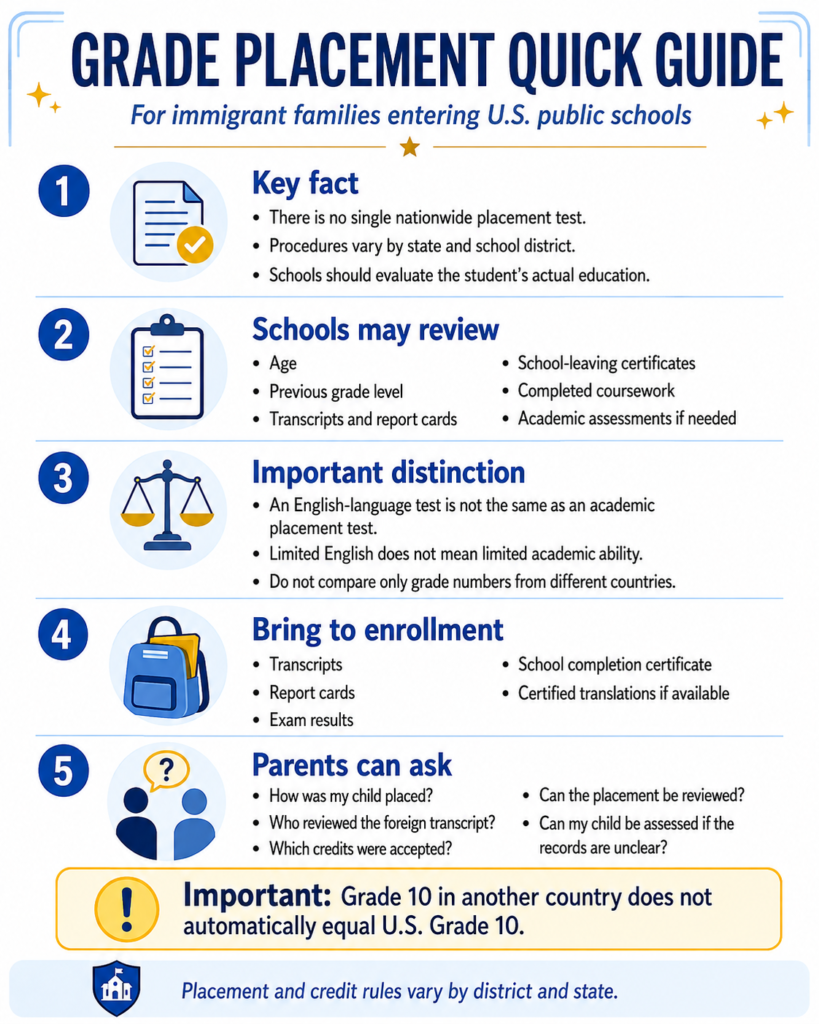
For families coming to the United States from Myanmar or another country, grade placement can be confusing because school systems do not always match the American K–12 structure. A child who completed “Grade 10” in another country may not have the same educational background as an American student who just completed 10th grade.
There is no single national placement test that every immigrant student must take before entering a U.S. public school. Placement procedures vary by state and school district. In general, schools may look at the student’s age, previous grade level, school records, transcripts, completed coursework, school-leaving certificates, and other academic information. For older students, especially those entering middle school or high school, schools may also need to determine how previous coursework should count toward U.S. graduation requirements.
If the school records are incomplete, difficult to interpret, or do not clearly show the student’s academic level, the district may also use academic assessments, interviews, reading or math evaluations, competency assessments, or other methods to better understand what the student already knows.
A Grade Number Should Not Be the Only Thing Used
Parents should not assume that a foreign grade number automatically equals the same American grade.
For example:
Grade 10 in one country does not necessarily mean the same thing as Grade 10 in the United States.
Some education systems historically ended secondary school earlier than the American 12-grade system. Other systems organize primary and secondary education differently or use different school-leaving examinations.
The important questions are:
What level of education did the student actually complete?
Was that the final year of secondary school in that country at that time?
Did the student receive a secondary-school completion certificate?
Which subjects did the student complete?
What level of mathematics, science, language and other coursework did the student study?
How should that coursework translate into U.S. high-school credits?
A school should evaluate the student’s actual educational history, not simply look at the number printed next to the word “Grade.”
English Testing Is Different From Academic Placement
New immigrant students may also receive an English-language proficiency assessment.
Parents should understand that this is not the same thing as testing a child’s overall academic ability.
A student can be very strong in:
Mathematics
Science
History
Reading in another language
Writing in another language
Other academic subjects
while still being a beginner in English.
English-language screening is generally used to determine whether a student needs services such as:
English Learner support
ESL
ELD
Additional language instruction
Limited English proficiency should not automatically be treated as limited intelligence or limited academic ability.
For High School Students, Credit Evaluation Is Extremely Important
For students arriving during the high-school years, grade placement is only part of the issue.
Parents should ask the school to evaluate all previous coursework and determine what can count toward graduation.
Ask questions such as:
Which classes from my child’s previous school were accepted?
How many U.S. high-school credits did my child receive?
Which classes were not accepted?
Why were those classes denied credit?
What graduation requirements are still missing?
Is my child on track to graduate?
Can my child demonstrate competency if records are incomplete?
Is there a process for reviewing or appealing the placement or credit decision?
Parents should ask for this information in writing whenever possible.
Parents Are Allowed to Question a Placement Decision
Immigrant parents may feel uncomfortable questioning teachers, school administrators, counselors or enrollment staff.
You are allowed to ask questions.
You do not have to assume that the first decision made by a school employee is automatically correct.
If the placement does not make sense, ask:
“How did you determine my child’s grade placement?”
“Who evaluated the foreign transcript?”
“Did you evaluate what this grade level means in my child’s previous education system?”
“Which previous courses were accepted for credit?”
“Can the placement be reviewed?”
“Would an academic assessment help determine the correct level?”
Asking for an explanation does not mean that parents can simply choose whatever grade they want. It means parents can ask the school to explain the evidence and process used to make the decision.
My Own Experience Coming From Myanmar
When I came to the United States, I had already completed Grade 10 in Myanmar, which was the final year of high school under the education system I attended at that time.
My family did not understand how the American school system worked, and we did not know that we could question the school’s decision or ask for a proper evaluation of my previous education.
Instead, I was placed into 11th grade.
Looking back, the school should not simply have treated “Grade 10” in Myanmar as if it automatically meant American Grade 10. Someone should have examined what completing Grade 10 actually represented in the Myanmar education system, reviewed my school-completion records and coursework, and determined whether I had already completed secondary education.
If the records were unclear, an academic placement assessment could also have helped determine my actual level.
I ended up doing very well academically and made the honor roll. I also found that I was already familiar with much of the material being taught.
Knowing what I know now, my family should have asked whether my Myanmar secondary-school completion credential could be evaluated for college or community-college eligibility instead of automatically accepting placement back into high school.
That experience is one of the reasons I want Burmese immigrant parents to understand this:
Do not be afraid to ask questions.
Your child’s education matters too much to assume that every school employee automatically understands Myanmar’s education system.
If Your Child Finished High School Outside the United States
If your child completed secondary school in Myanmar or another country, bring as much documentation as possible.
Useful records may include:
Secondary-school completion certificate
High-school diploma or school-leaving certificate
Transcript
Report cards
Examination results
Course descriptions
Ministry of Education documents
Certified translations when available
Ask whether the credential should be evaluated as completed secondary education, rather than automatically placing the student into the American grade with the same number.
Completing secondary school abroad does not automatically guarantee admission to every U.S. college or university. Colleges may have additional admission requirements, including specific coursework, grades, English proficiency requirements or credential evaluations.
But a foreign student should not automatically be required to repeat American high school simply because their home country’s final secondary grade had a different number.
A Simple Rule for Burmese Parents
Do not let a school compare only grade numbers. Ask them to evaluate what your child actually completed.
Education systems are different around the world.
If something about your child’s placement does not make sense, ask the school:
How was this decision made?
What records were reviewed?
What credits were granted?
Who can review the decision?
You are your child’s advocate, and asking those questions can prevent a misunderstanding from affecting years of your child’s education.
Important Note
School enrollment, grade placement, transcript evaluation and graduation requirements vary by state and school district. There is no single nationwide placement procedure for newly arrived immigrant students. Families should verify the current rules with their local school district and request a review when previous education or foreign credentials may have been misunderstood.
Understanding the US school system for Burmese parents can make enrollment much less stressful for newly arrived families.
Grade placement is one of the most important parts of the US school system for Burmese parents to understand.
Dual Enrollment for Immigrant Families: Your Child May Be Able to Start College While Still in High School
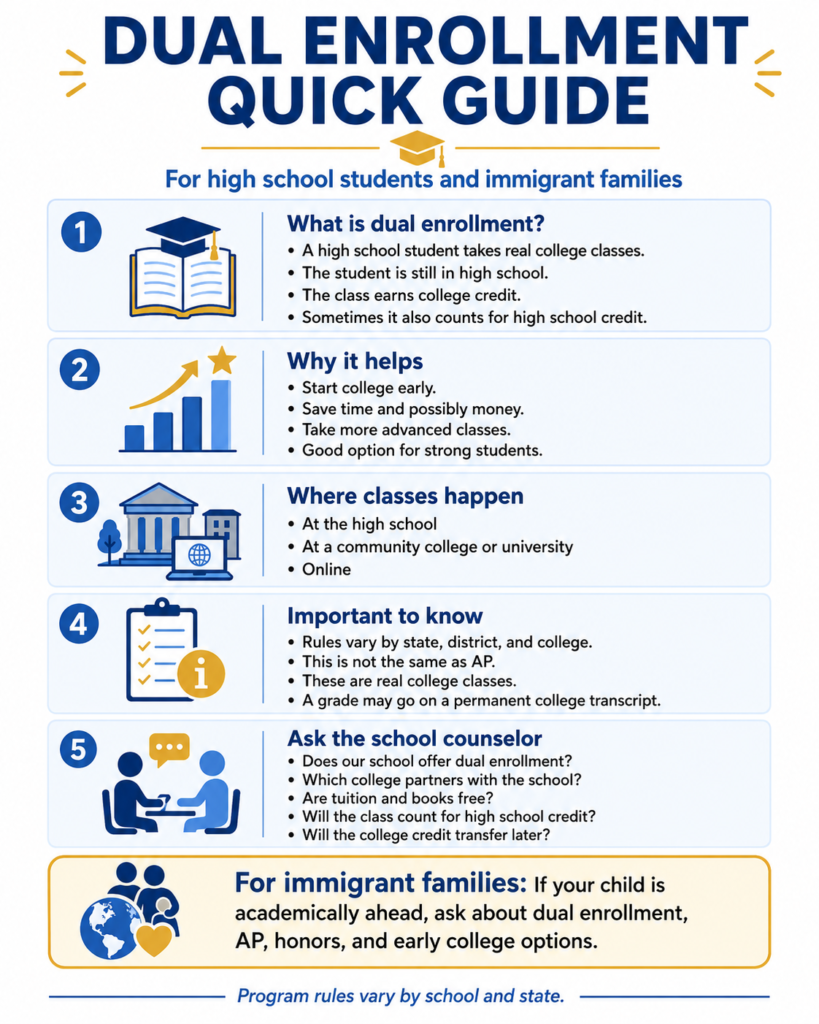
In the United States, many high-school students can take real college courses before they graduate from high school. This is commonly called dual enrollment, although some states and districts use names such as concurrent enrollment, early college, College Now, or PSEO.
The basic idea is simple:
Your child is still a high-school student, but also takes a course through a college or community college and earns college credit. In many programs, the same class can also count toward high-school graduation. The U.S. Department of Education’s NCES describes dual enrollment as high-school students earning college credit through a postsecondary institution.
Why immigrant parents should know about this
For a newly arrived student who is academically strong, dual enrollment can be especially important.
A teenager coming from Myanmar may enter an American high school already having studied material that classmates are still learning. Instead of assuming the student must simply sit through every standard high-school class, the family can ask whether the school offers:
Dual enrollment
Community-college classes
Advanced Placement (AP)
Honors courses
Early-college programs
College-credit classes
Career or technical college courses
These programs can allow a student to continue moving academically instead of being held back simply because they recently entered the U.S. school system.
It can save both time and money
Dual enrollment can potentially reduce the number of classes a student needs to take after entering college because the student begins accumulating college credit while still in high school.
For example, instead of waiting until college to take introductory psychology, statistics, English composition or another general-education course, an eligible high-school student might take the college version early.
Some programs are provided at little or no tuition cost to the high-school student, although the rules vary dramatically by state, school district and college.
California’s Community Colleges explicitly describe dual enrollment as an opportunity for high-school students to take community-college courses while still attending high school and earn college credit. Some courses can also count toward the student’s high-school diploma.
Your child does not necessarily have to leave the high school
Dual-enrollment classes can be organized in different ways.
A student might take a college class:
At the high school — sometimes taught by a qualified instructor through a college partnership.
At a community college or university — the student physically attends the college.
Online — depending on the participating college.
During the regular school day or outside school hours.
So don’t assume dual enrollment means your teenager has to commute to a college every day.
Is dual enrollment only for seniors?
No.
This is another area where the rules vary.
Some programs concentrate on juniors and seniors, while others allow younger students who meet academic requirements.
For example, Minnesota’s Postsecondary Enrollment Options (PSEO) program allows eligible high-school students to enroll at participating colleges and universities and earn both high-school and college credit. Students must meet the college’s admission requirements.
California also permits high-school students to take community-college courses, with the exact enrollment process depending on the college and the type of dual-enrollment agreement.
Dual enrollment is different from AP
Parents often confuse the two.
AP: The student takes an Advanced Placement high-school course and generally must take an AP exam. Whether a college grants credit depends on the student’s exam score and the college’s AP policy.
Dual enrollment: The student actually enrolls in a college course. If the student passes, the course normally becomes part of the student’s college transcript, although whether and how another college accepts that credit can still vary.
That last part is important.
College credit does not necessarily mean every university will accept it exactly the same way.
A community-college course may transfer easily to one university but not fulfill the same requirement at another. Families who already know which university system their child is considering should check transferability before choosing courses.
For California families, this can be especially important for students hoping eventually to attend a UC or CSU.
NYC families should ask about College Now and other college-credit programs
New York City Public Schools specifically lists dual-enrollment classes where students can earn high-school and college credit simultaneously among its advanced course options.
NYC also partners with the City University of New York through College Now, which lets high-school students take CUNY courses before graduating.
So an immigrant parent in NYC can specifically ask the counselor:
“Does this school participate in College Now or another dual-enrollment program?”
Parents should ask about this immediately if a child is academically ahead
This connects directly to the placement issue we were discussing.
Imagine a 16-year-old arrives from Myanmar.
The school places the student into 11th grade.
Fine — but that should not end the conversation.
If the student already has advanced mathematics, science or other academic preparation, the parent should ask:
“Can my child take a college class instead of repeating material they already know?”
That is a much better question than simply accepting whatever default schedule appears on the student’s first day.
But be careful: these are real college classes
This is one thing I would make very clear to immigrant parents.
Dual enrollment is an opportunity, but it is not simply another high-school elective.
The student may be creating a permanent college transcript.
That means a poor grade can matter later.
Students should be ready for:
College-level reading
More independent work
Deadlines
Fewer reminders from teachers
College grading standards
More responsibility for communicating with professors
Parents should not push a child into five college classes simply because the classes are available.
The goal should be to give an academically ready student appropriate opportunity, not overload them.
What immigrant parents should ask the high-school counselor
When your child enters middle or high school, especially if the child was a strong student overseas, ask:
Does this school offer dual enrollment? Which colleges does the school partner with? What grade can students begin? What GPA or prerequisites are required? Are tuition and textbooks free? Will the course count toward high-school graduation? Will the course appear on a permanent college transcript? Is the course transferable to state universities? Can my child take college classes online? Can an English Learner participate if academically qualified?
That last question is especially important for immigrant students.
A student’s English-learning status should not cause the family to assume advanced opportunities are automatically unavailable. Ask what the actual eligibility requirements are.
The message from BH
Do not assume your child must wait until high-school graduation to begin college-level work. Many U.S. high schools partner with community colleges and universities to offer dual-enrollment courses, allowing qualified students to earn college credit while still attending high school. Program names, eligibility rules, costs and transferability vary by state, district and college. If your child arrives from Myanmar with strong academic preparation, ask the school counselor specifically about dual enrollment, early college, community-college courses, AP, honors and other advanced options.
Dual enrollment can be a valuable opportunity within the US school system for Burmese parents who have academically advanced teenagers.
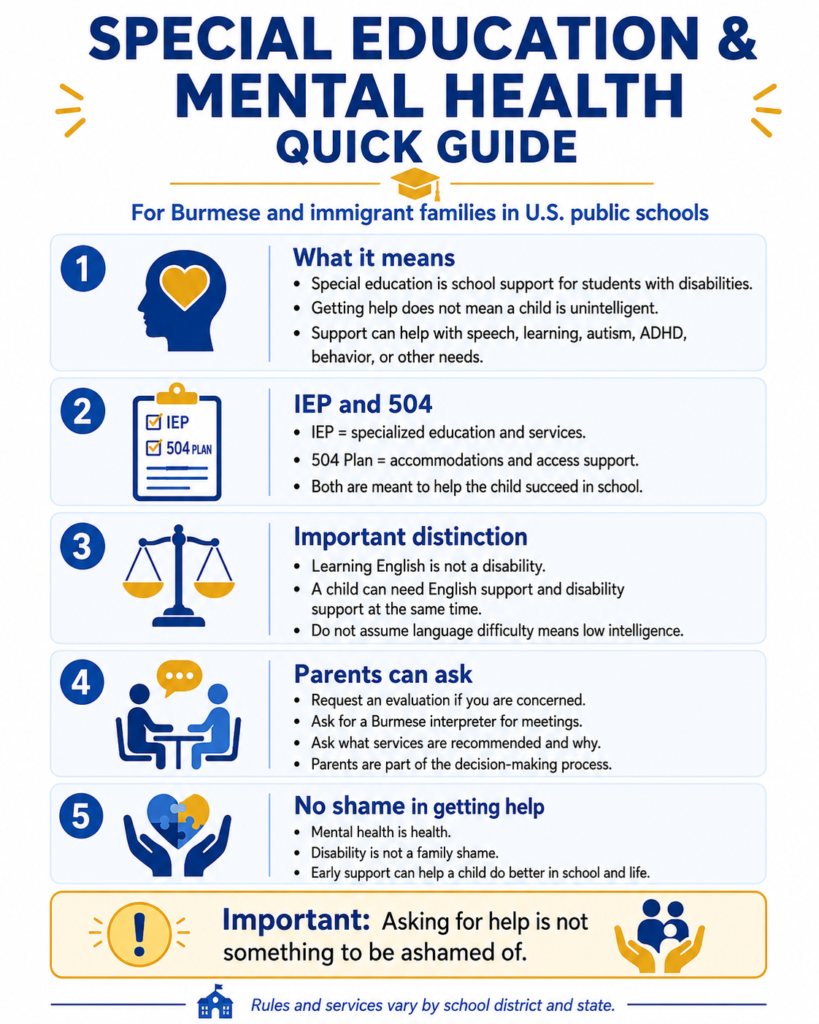
Special Education in the U.S.: Getting Help Is Not Something to Be Ashamed Of
In some Burmese families and communities, developmental disabilities, learning disabilities, autism, ADHD, speech delays, or mental-health conditions may be misunderstood, minimized, or treated as something the family should hide. Some parents may worry that asking for help means their child is “crazy,” unintelligent, badly behaved, or permanently labeled.
That is not what special education means in the United States.
Special education is a system of educational support for children whose disabilities affect their ability to learn or participate in school. Under the federal Individuals with Disabilities Education Act (IDEA), eligible students can receive specialized instruction and related services designed around their individual needs.
A child can be intelligent, talented, academically capable, and still need support in one particular area.
For example, a student may need help with:
Speech or language
Reading or writing
Attention and executive functioning
Autism-related needs
Hearing or vision
Physical or motor difficulties
Emotional or behavioral needs
Intellectual or developmental disabilities
Other disabilities that interfere with education
Getting help does not mean parents failed. It does not mean the child cannot succeed. It means the school is trying to identify what support the child needs in order to access education.
Parents Can Ask the School for an Evaluation
You do not necessarily have to wait for the school to bring up a concern.
Under IDEA, a parent or the public school agency can request an initial evaluation to determine whether a child has a disability and may qualify for special education.
Federal Child Find requirements also require school systems to identify and evaluate children who may have disabilities and need special education, including children who are still passing their classes or moving from grade to grade.
A parent might say:
“I am concerned about my child’s speech, learning, development, attention or behavior. I would like to request an evaluation for special education.”
Making a request for an evaluation does not automatically place the child in special education. An evaluation is used to gather information and determine whether the child is eligible and what services may be needed.
What Is an IEP?
If a student qualifies for special education under IDEA, the school may develop an:
IEP — Individualized Education Program
An IEP is a written education plan created for an individual child.
Depending on the student’s needs, it may describe:
Current academic or developmental needs
Educational goals
Specialized instruction
Speech therapy
Occupational therapy
Behavioral support
Classroom accommodations
Related services
How progress will be measured
Parents are members of the IEP team. They are not simply observers.
Parents can ask questions, provide information about their child, discuss goals, and raise concerns about proposed services.
What Is a 504 Plan?
Some students have a disability but do not need specialized instruction through an IEP.
They may instead qualify for protection and accommodations under Section 504 of the Rehabilitation Act.
Section 504 is a federal civil-rights law that protects qualified students with disabilities from disability discrimination and requires schools to provide appropriate educational access.
A 504 Plan might provide accommodations such as:
Extra time on tests
Preferential seating
Breaks
Medication access
Assistive technology
Modified assignments or testing conditions
Other accommodations related to the student’s disability
IEP and 504 are not the same thing.
An IEP generally involves eligibility under IDEA and specialized education.
A 504 Plan generally focuses on ensuring access and accommodations for a student with a qualifying disability.
The appropriate option depends on the individual child.
Learning English Is Not a Disability
This is especially important for immigrant families.
A child should not be treated as having a disability merely because the child is still learning English.
At the same time, being an English Learner does not prevent a child from also having a disability.
A child can need both:
English-language support + special-education services.
Federal guidance specifically addresses students who are both English Learners and students with disabilities, and schools must take the student’s language needs into account when developing an IEP.
Parents should ask the school to distinguish between:
“My child doesn’t understand this because English is new”
and
“My child is having a learning or developmental difficulty that exists beyond learning English.”
That distinction matters.
Burmese Parents Can Ask for an Interpreter
Parents should also understand this right.
If a parent has limited English proficiency, the school must meaningfully communicate important school information in a language the parent can understand. This includes information about programs and services, and federal guidance specifically addresses communication about disability-related services.
If you need Burmese-language assistance, tell the school:
“I need a Burmese interpreter for this meeting.”
For an important IEP, evaluation or special-education meeting, parents should not feel pressured to rely on their child to translate complicated educational or disability information.
Mental Health Is Health
Mental-health concerns should also not be treated as a family shame.
Children can experience:
Anxiety
Depression
Trauma
Emotional regulation difficulties
Attention problems
Behavioral difficulties
Stress caused by immigration, displacement or family experiences
These concerns do not mean a child is weak or “crazy.”
And not every mental-health condition automatically means a student needs special education. A child may instead receive support from a counselor, psychologist, physician, therapist, school social worker, 504 Plan, IEP, or another service depending on the child’s needs.
The important part is not ignoring a child who is struggling because the family is afraid of a label.
Do Not Be Afraid of the Word “Disability”
A disability is not a description of a child’s worth.
A diagnosis or educational classification is meant to help professionals understand what support may be appropriate.
Your child is still the same child before and after an evaluation.
Knowing the reason a child is struggling can often give families more options—not fewer.
A student receiving speech therapy can still go to college.
A student with ADHD can still be academically gifted.
A student with autism can have significant strengths.
A student with a learning disability can still earn advanced degrees.
Special education is support, not a prediction of what a child will become.
Parents Do Not Have to Agree With Everything the School Says
Just as parents can question grade placement, parents can ask questions during the special-education process.
You can ask:
Why is the school recommending an evaluation?
What areas will be tested?
What do the test results mean?
Why does my child qualify—or not qualify?
What services are being proposed?
How often will the services occur?
How will progress be measured?
What happens if I disagree?
Can I receive the documents in a language I understand?
IDEA provides formal procedures for resolving disagreements between families and school agencies, including mediation, state complaints and due-process complaints.
That does not mean every disagreement needs to become a legal fight. It means parents are participants in the process and have rights.
Free Help for Parents
Families do not necessarily need to figure out special education alone.
The U.S. Department of Education funds a nationwide network of Parent Training and Information Centers (PTIs) and Community Parent Resource Centers (CPRCs) that help families of children with disabilities understand special education and their rights. There are nearly 100 of these centers across the United States and territories.
Parents can find their local center through:
Center for Parent Information and Resources — Find Your Parent Center
The directory allows families to locate organizations serving their state.
For California families specifically, the national Parent Center network lists seven Parent Training and Information Centers, including centers serving Los Angeles and surrounding counties.
A Message to Burmese Parents
Do not hide a child’s difficulty because you are afraid of what relatives, friends or the community may think.
If your child is struggling with speech, learning, development, attention, behavior, emotional health or another issue, asking questions early can help you understand what is happening.
You do not have to accept every opinion a school gives you, and you do not have to agree to everything immediately. But refusing to investigate a genuine concern because disability or mental health feels shameful can prevent a child from receiving support that could make school much easier.
Ask questions. Request an evaluation when appropriate. Learn what the results mean. Get an interpreter if you need one. Then make decisions based on your child’s actual needs—not fear of a label.
Quick Difference
English Learner: Needs support learning English. IEP: Eligible student needs specialized education because of a disability. 504 Plan: Eligible student needs disability-related access or accommodations. School counseling/mental-health support: May help with emotional, behavioral or mental-health concerns.
One child can sometimes receive more than one type of support.
Special education is another important part of the US school system for Burmese parents guide.
Know Your Rights — and Do Not Be Afraid to Ask Questions
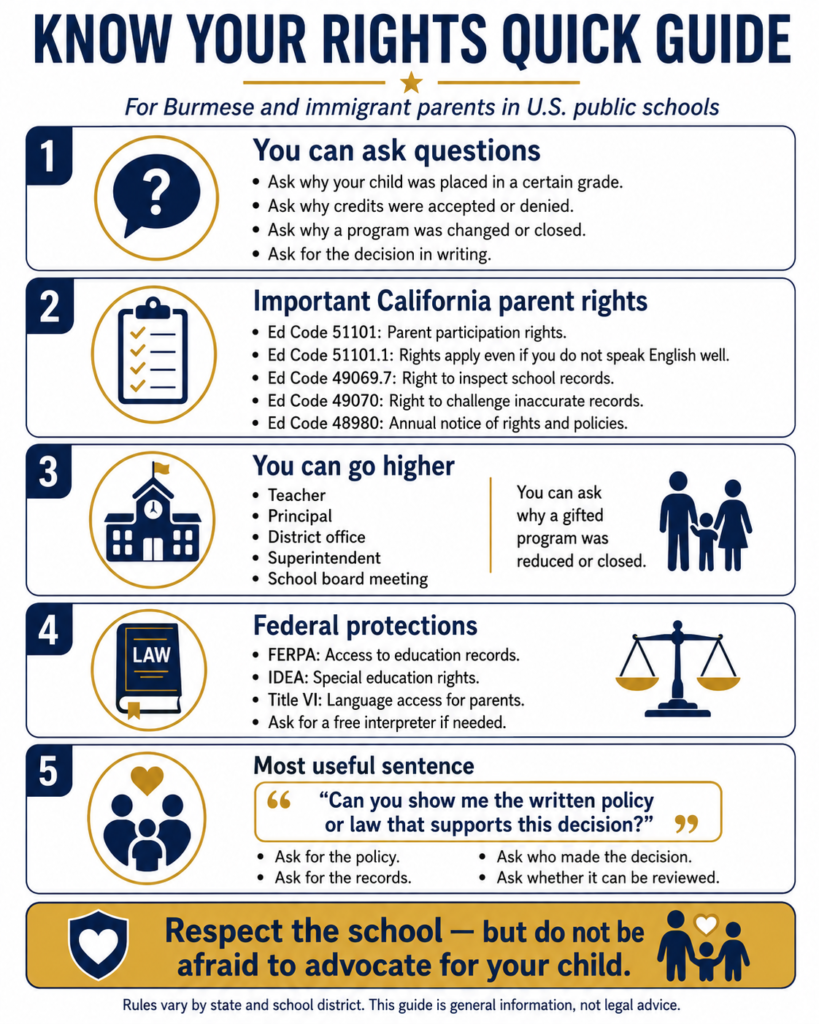
Coming to the United States does not mean you have to quietly accept every decision a school makes. Parents are part of the education process. You can ask why your child was placed in a certain grade, why credits were denied, why a program was changed, why your child was not offered advanced classes, how special-education decisions were made, or why a gifted program was reduced or closed.
If the principal cannot answer your question, you can go higher: district administration, the superintendent, or the elected school board. In California, parents have specific statutory rights to meet with school personnel, inspect curriculum, access records, receive information about academic expectations, question inaccurate records, participate in school advisory groups, and participate in decisions affecting their child’s education. California law expressly describes parents as “mutually supportive and respectful partners” in public education.
Do not confuse being respectful with being silent. You can be respectful and still say:
“Please explain the policy and the legal basis for this decision.” “Where is this rule written?” “Who made this decision?” “Can I have that in writing?” “What is the process to request a review or appeal?”
And if a district closes a gifted program, you can absolutely ask the superintendent or school board why it was closed, what data supported the decision, what alternatives will serve gifted students, and where the decision was approved. But there is an important legal distinction: California no longer provides a separate categorical funding stream requiring districts to operate the old GATE program. The state says the former Gifted and Talented Education funding stream was eliminated under the Local Control Funding Formula. So parents have a right to question and participate in district decision-making, but there is not a general California law guaranteeing every child a district GATE program.
California Parent Rights — Codes Worth Knowing
These are particularly useful for your BH readers in California.
California Education Code § 51101 — Parent participation rights. This is probably the big one I would tell parents to save. It says parents of public-school students have rights that include meeting with their child’s teachers and principal, examining curriculum materials, receiving information about academic standards and their child’s progress, accessing school records, participating in school advisory groups, and participating in decisions concerning their child’s education. It also specifically provides rights related to promotion and retention decisions.
California Education Code § 51101.1 — Rights do not disappear because you do not speak English well. The statute says a parent’s lack of English fluency does not prevent the parent from exercising parental rights. Districts must take reasonable steps to notify parents of those rights in English and their home language as required by law.
California Education Code § 49069.7 — Right to your child’s school records. Parents have an absolute right of access to pupil records maintained by the school or district. California generally requires access within five business days after the parent’s request. Parents can also ask qualified certificated staff to help interpret the records.
California Education Code § 49070 — Right to challenge inaccurate school records. After reviewing the records, a parent can formally challenge information believed to be inaccurate, misleading, an invasion of privacy, or otherwise improper under the statutory grounds.
California Education Code § 48980 — Annual notice of parent rights and school policies. Districts must give parents annual notices covering numerous rights, responsibilities and school policies, including attendance options and certain academic information.
California Education Code §§ 35145 and 35145.5 — School board meetings and public comment. School-board meetings are generally public, and regular meeting agendas must provide an opportunity for members of the public to address the governing board on matters within its jurisdiction. That means a parent concerned about something like the elimination of a gifted program can raise the issue publicly before the elected board, subject to the board’s reasonable meeting procedures and time limits.
California Education Code § 52062 — Parent/community input on the district’s LCAP. California districts must hold a public hearing to receive recommendations and comments regarding their Local Control and Accountability Plan and proposed actions and expenditures. This matters because many educational priorities and spending decisions are now made locally through the LCFF/LCAP system.
Federal Rights Parents Should Know Too
Some protections apply across the United States, not just California.
FERPA — Family Educational Rights and Privacy Act, 20 U.S.C. § 1232g / 34 CFR Part 99. FERPA generally gives parents the right to inspect their child’s education records, seek amendment of records they believe are inaccurate or misleading, and exercise certain controls over disclosure of personally identifiable information.
IDEA — Individuals with Disabilities Education Act, 20 U.S.C. § 1400 et seq. For eligible children with disabilities, IDEA provides the right to a free appropriate public education (FAPE) and special-education services. Parents receive extensive procedural rights and are participants in decisions involving identification, evaluation, educational placement and the provision of FAPE.
IDEA § 615 / 20 U.S.C. § 1415 — Special-education procedural safeguards. Parents of children with disabilities can receive procedural safeguards and use dispute-resolution mechanisms when they disagree with certain school decisions.
Title VI of the Civil Rights Act of 1964 — Language access and national-origin discrimination. Public schools receiving federal funds must comply with Title VI. The U.S. Department of Education states that schools must adequately communicate important school-related information to parents with limited English proficiency in languages they can understand.
For parents who need an interpreter, federal guidance says language assistance must be free and provided through appropriate and competent staff or outside resources.
A Parent’s Most Useful Sentence
“Can you show me the written policy or law that supports this decision?”
You do not have to know every education law before asking a question. You do not need to be a lawyer. You do not need perfect English. If something affecting your child does not make sense, ask the school to explain it. Ask for the policy. Ask for the records. Ask who made the decision. Ask whether it can be reviewed. Ask the principal. Ask the superintendent. Speak at the school-board meeting when appropriate.
Your accent does not make your question less important. Being new to America does not make school officials more knowledgeable about your child than you are. Respect the educators who help your child—but never be afraid to advocate for your child. Know your rights, learn the system, and ask questions until you understand the answer.
US School System for Burmese Parents: Know Your Rights
Knowing parent rights is essential when navigating the US school system for Burmese parents.
Helpful BurmaHeaven Resources
First Year in America — Good internal link for families who recently arrived and are learning how everyday life in the U.S. works.
Learning the U.S. school system takes time, especially when your family is new to the country. Use the resources below to verify school rules, understand your rights, learn about English Learner and special-education services, and explore opportunities such as dual enrollment.