
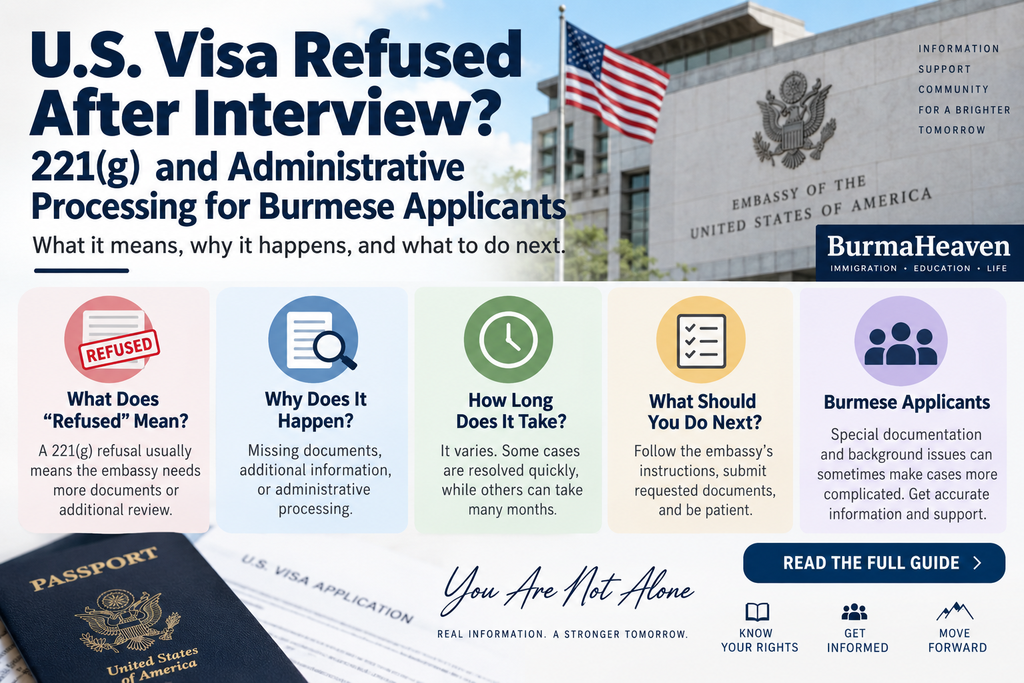
Seeing “Refused” after a U.S. visa interview can be frightening, especially if the consular officer told you that your case needs more documents or additional processing.
But a refusal under INA Section 221(g) is not always the same thing as a final permanent denial.
In many 221(g) cases, the consular officer cannot yet determine that the applicant qualifies for the visa because:
- A required document is missing
- Additional information is needed
- The case requires administrative processing
- Further review must be completed before a final decision can be made
The U.S. Department of State explains that a case refused under 221(g) may later be reconsidered if the applicant provides the requested information or if administrative processing resolves the outstanding issue.
Read the State Department’s official Visa Denials guidance
What Does a 221(g) Refusal Mean?
Section 221(g) of the Immigration and Nationality Act applies when the consular officer does not yet have enough information to conclude that the applicant is eligible for the visa.
There are two common situations.
1. The Embassy Needs More Documents or Information
The officer may ask you to provide something that is missing or incomplete.
Examples could include:
- Birth certificate
- Marriage certificate
- Police certificate
- Financial sponsorship documents
- Joint sponsor information
- Medical documentation
- Evidence of a family relationship
- Updated passport
- Other documents specific to your case
The officer should tell you what is required and how to submit it.
2. Your Case Requires Administrative Processing
Sometimes the applicant has already submitted the normal documents, but the Embassy still needs additional time to review the case.
This is called administrative processing.
The length of administrative processing varies depending on the circumstances of each case.
Why Does CEAC Say “Refused” If My Case Is Still Being Processed?
This causes a lot of confusion.
Before March 2020, some cases undergoing administrative processing appeared in CEAC as:
Administrative Processing
The Department of State changed the CEAC display so that these cases generally appear as:
Refused
The government explained that this was a change in how the status was displayed, not necessarily a change in what was happening with the case.
These applications had technically been refused under Section 221(g) while additional processing was taking place.
So it is possible for all of these statements to be true at the same time:
Your CEAC status says Refused.
The officer told you the case is in administrative processing.
Your visa could still later be issued.
For more help understanding the status itself, see BurmaHeaven’s CEAC Status Guide.
Is a 221(g) Refusal a Final Denial?
Not necessarily.
A 221(g) refusal can potentially be overcome.
If the Embassy requested documents or information, the consular officer can reconsider the case after you submit what was requested.
If the case requires administrative processing, the officer can reconsider the application when that processing is finished.
The final result could be:
- Visa issued
- Additional information requested
- Continued processing
- A finding that the applicant remains ineligible
The word Refused alone does not tell you which outcome will ultimately occur.
What Should I Do If the Embassy Asked for Documents?
Follow the Embassy’s instructions exactly.
Do not simply upload or email documents somewhere because another applicant told you that is what they did.
Different embassies and different cases can have different submission procedures.
If you were given a 221(g) letter, read it carefully.
Check:
- What document was requested
- Whether an original or copy is required
- Whether a translation is required
- Where the document must be submitted
- Whether you need to submit your passport
- Whether the Embassy gave you any additional instructions
Submit a complete response rather than sending pieces of the requested information separately whenever possible.
The State Department says applicants generally have one year from the date of the 221(g) refusal to provide requested information. If the required information is not submitted within that period, the applicant may need to submit a new visa application and pay another application fee.
What If NVC Already Accepted My Documents?
NVC accepting a document does not guarantee that the consular officer will accept it at the interview.
NVC performs document processing before the interview, but the consular officer is responsible for determining visa eligibility.
An officer may still ask for:
- A newer document
- An original document
- A clearer document
- Additional relationship evidence
- Updated financial information
- An explanation of inconsistencies
- A document that NVC did not require earlier
So do not assume:
“NVC accepted it, therefore the Embassy cannot ask for anything else.”
The interview is a separate stage of the immigrant visa process.
What Is Administrative Processing?
Administrative processing means the Embassy or Department of State needs additional review before a final visa determination can be made.
The government does not provide one universal reason for every administrative-processing case.
The review depends on the applicant’s individual circumstances.
Sometimes the Embassy may ask the applicant for additional information.
Other times, the applicant may simply be told:
Your case requires administrative processing.
If the officer did not ask you to submit anything, do not invent additional documents to send.
Wait for instructions unless you have a specific reason to contact the Embassy.
How Long Does Administrative Processing Take?
There is no guaranteed timeline.
Some cases are resolved relatively quickly.
Others can take much longer.
The Department of State’s current general immigrant-visa guidance says that, except for emergency situations, applicants should wait at least 180 days from the interview or from the submission of supplemental documents, whichever is later, before asking about the status of administrative processing.
Individual embassies may publish their own procedures, so always follow the instructions for the Embassy handling your case.
Do not rely on Facebook timelines or another family’s experience as a promise of how long your case will take.
Does the “Last Updated” Date in CEAC Mean Someone Worked on My Case?
Not necessarily.
Applicants often notice that the case last updated date changes even though the status remains Refused.
That may indicate that something happened in the system, but CEAC does not explain exactly what internal action occurred.
A changed date does not guarantee that:
- Your visa is about to be issued
- Administrative processing is finished
- Someone made a final decision
- Your passport is being printed
Treat the CEAC status as limited information.
The Embassy’s actual instructions and communications matter more.
Should I Email the Embassy Every Week?
Usually no.
Repeated emails do not necessarily make administrative processing move faster.
If the Embassy asked for documents, submit them promptly.
If the Embassy told you to wait, follow that instruction.
For general administrative processing, the State Department currently advises most immigrant visa applicants to wait at least 180 days before making an inquiry unless there is emergency travel involving circumstances such as serious illness, injury, or death in the immediate family.
What If My Passport Is Still at the Embassy?
Passport procedures vary by Embassy and by case.
The Embassy may:
- Keep your passport
- Return it while processing continues
- Ask you to send it back later
- Request a new passport if the old one expires
Do not assume that the Embassy keeping your passport means the visa has been approved.
Likewise, having your passport returned does not necessarily mean the case is permanently denied.
Follow the instructions given by the Embassy.
What If They Ask for My Passport After Administrative Processing?
If the Embassy previously returned your passport and later asks you to submit it again, that is generally a sign that the Embassy needs the passport to continue processing the case.
However, do not treat a passport request as a guarantee of visa issuance until the visa is actually issued.
Follow the Embassy’s instructions for returning the passport.
Can Administrative Processing End in a Visa Denial?
Yes.
Administrative processing does not guarantee approval.
After the additional review is completed, the consular officer may determine that the applicant qualifies for the visa.
The officer may also determine that the applicant remains ineligible.
This is why applicants should not make major irreversible plans while waiting.
The State Department specifically warns immigrant visa applicants not to:
- Sell their home
- Sell their vehicle
- Resign from their job
- Buy non-refundable airline tickets
- Make other irreversible financial commitments
until the immigrant visa has actually been received.
Common Reasons a Case May Receive 221(g)
A 221(g) refusal can happen for many different reasons.
Possible situations include:
Missing Civil Documents
For example:
- Birth certificate
- Marriage certificate
- Divorce record
- Police certificate
Burmese applicants should make sure their documents match the State Department requirements for Myanmar.
Financial Sponsorship Problems
The Embassy may require:
- Updated Affidavit of Support
- New tax documents
- Proof of income
- Joint sponsor documents
- Proof of domicile
Relationship Questions
Family-based cases can sometimes require additional evidence showing that the qualifying relationship is legitimate.
Medical Issues
The Embassy may need additional medical examination results or information from the approved panel physician.
Additional Government Review
Some applications require administrative processing even when the applicant has already submitted the ordinary required documents.
Burmese Applicants and 221(g)
Burmese immigration cases can involve documentation issues that applicants from some other countries may not encounter in exactly the same way.
Potential complications can involve:
- Different Burmese names appearing on different documents
- No traditional Western-style surname
- Older civil records
- Birth registration problems
- Marriage records
- Household records
- Police certificate availability
- Political detention or arrest history
- Military history
- Current conditions inside Myanmar
A 221(g) request does not automatically mean the officer believes you did something wrong.
Sometimes the officer simply needs additional evidence before deciding the case.
If your 221(g) involves Myanmar civil documents, use BurmaHeaven’s Myanmar Civil Documents Guide rather than repeatedly submitting the same rejected document.
IMPORTANT FOR BURMESE APPLICANTS:
If your case was refused under 221(g), it may help to review BurmaHeaven’s CEAC Status Guide to understand why CEAC may show Refused, the Embassy Interview Guide for interview-related issues, and the Myanmar Civil Documents Guide if the embassy requested additional Burmese documents. You can also review the U.S. Department of State’s official Visa Denials and 221(g) information and check your current case status through the official CEAC Visa Status Check. Always follow the specific instructions given by the U.S. embassy or consulate handling your case.
What If the Embassy Asks About Arrest, Military Service, NUG or PDF Activity?
These questions can involve much more complicated immigration law than an ordinary missing-document request.
If your 221(g) concerns:
- Arrest or detention
- Military service
- Armed organizations
- NUG or PDF involvement
- Donations or fundraising
- Criminal history
- Political organizations
- Security-related questions
do not guess.
Provide truthful information and consider speaking with a qualified U.S. immigration attorney if the issue could affect admissibility.
Trying to hide a difficult fact can create an additional immigration problem.
221(g) Checklist
If you receive a 221(g) refusal:
☐ Read the refusal letter carefully
☐ Identify exactly what the officer requested
☐ Follow the Embassy’s submission instructions
☐ Gather all requested documents
☐ Check whether translations are required
☐ Keep copies of everything you submit
☐ Save proof of submission or delivery
☐ Watch your email for Embassy messages
☐ Check CEAC periodically
☐ Do not repeatedly submit the same documents unless instructed
☐ Do not buy non-refundable travel yet
☐ Do not hide information because you are afraid of the answer
☐ Seek legal help if the request involves a complicated admissibility issue
Frequently Asked Questions
My CEAC status says Refused. Is my visa denied forever?
No. A case refused under 221(g) can potentially be reconsidered after requested information is submitted or administrative processing is completed.
Is 221(g) the same as Administrative Processing?
Not exactly.
221(g) is the legal basis for the refusal.
Administrative processing is one possible reason a case is refused under 221(g).
Another common reason is missing documents or information.
Why did CEAC change from Ready to Refused?
After the interview, a consular officer may refuse the application under 221(g) because additional documents or administrative processing are required.
Since the State Department changed CEAC’s display in 2020, many such cases display as Refused.
Can Refused later change to Issued?
Yes, in some 221(g) cases.
If the outstanding issue is resolved and the consular officer determines that the applicant qualifies, the case may later proceed to visa issuance.
How long do I have to submit documents requested under 221(g)?
The State Department says applicants generally have one year from the date of refusal to submit requested information before they may need to submit a new application and pay another fee.
Should I contact NVC about my 221(g)?
Usually, once the immigrant visa interview has taken place, the U.S. Embassy or Consulate handling the case is the important authority for the 221(g) request.
Follow the instructions given by the consular officer.
The Bottom Line
A 221(g) refusal does not automatically mean your U.S. visa case is permanently over.
It usually means the consular officer cannot yet conclude that you qualify because:
something is missing, additional information is required, or additional administrative processing must be completed.
If documents were requested, provide exactly what the Embassy asks for.
If your case is in administrative processing and nothing was requested from you, there may be nothing you can do except wait and respond promptly if the Embassy contacts you.
Most importantly, do not panic simply because CEAC displays:
REFUSED
Find out why the case was refused and follow the instructions for your specific case.
Disclaimer: BurmaHeaven provides general immigration information and is not a law firm. Immigration cases involving criminal history, security issues, military involvement, armed organizations, fraud, misrepresentation, or other admissibility concerns may require individualized legal advice.