EMBASSY INTERVIEW

U.S. Embassy Interview Guide for Burmese Applicants

US EMBASSY INTERVIEW GUIDE

U.S. Embassy Interview Guide for Burmese Applicants

Getting an interview appointment can feel like the final step of a very long immigration journey. For some Burmese families, the case may have already spent years moving through USCIS, the National Visa Center, document collection, the Visa Bulletin, and medical preparation.

But the interview is not just a formality.

A U.S. consular officer will review your case, ask questions, look at your documents, and decide whether you are eligible for the visa you applied for. The exact questions and documents depend heavily on your visa category, so a spouse case, sibling case, Diversity Visa case, student visa, and tourist visa should not all prepare the same way.

If you are not sure what type of case you have, use BurmaHeaven’s My Immigration Journey before continuing.


IMPORTANT FOR BURMESE APPLICANTS: CURRENT 2026 VISA RESTRICTIONS

Burmese applicants need to understand something especially important before preparing for an interview.

Effective January 1, 2026, the U.S. Department of State says visa issuance was fully suspended for nationals of Burma in all immigrant and nonimmigrant visa categories, subject to limited exceptions. Those exceptions currently include certain diplomatic/official visas, certain Special Immigrant Visas, some major sporting-event participants, lawful permanent residents, and dual nationals applying with a passport from a nationality that is not covered by the suspension.

There is also a separate Department of State policy, effective January 21, 2026, pausing immigrant visa issuance to nationals of numerous countries, including Burma.

Does that mean Burmese applicants should not attend their interview?

Not necessarily.

The Department of State’s current guidance says affected applicants may still be able to submit visa applications and attend scheduled interviews, even though they may currently be ineligible for visa issuance under the applicable restrictions.

That distinction is extremely important:

Interview scheduled does not necessarily mean visa can currently be issued.

Visa restrictions can change quickly, so always check the latest State Department guidance before relying on older information.

Official current guidance:

U.S. Department of State — Visa Issuance Restrictions


Before Anything Else: Know Your Visa Type

Different visas exist for completely different purposes.

For embassy-interview preparation, it helps to divide cases into these major groups:

  • Immediate-relative family visas
  • Family-preference visas
  • Fiancé(e) visas
  • Diversity Visas
  • Employment-based immigrant visas
  • Visitor visas
  • Student visas
  • Exchange visitor visas
  • Temporary work visas

Your preparation should match your category.
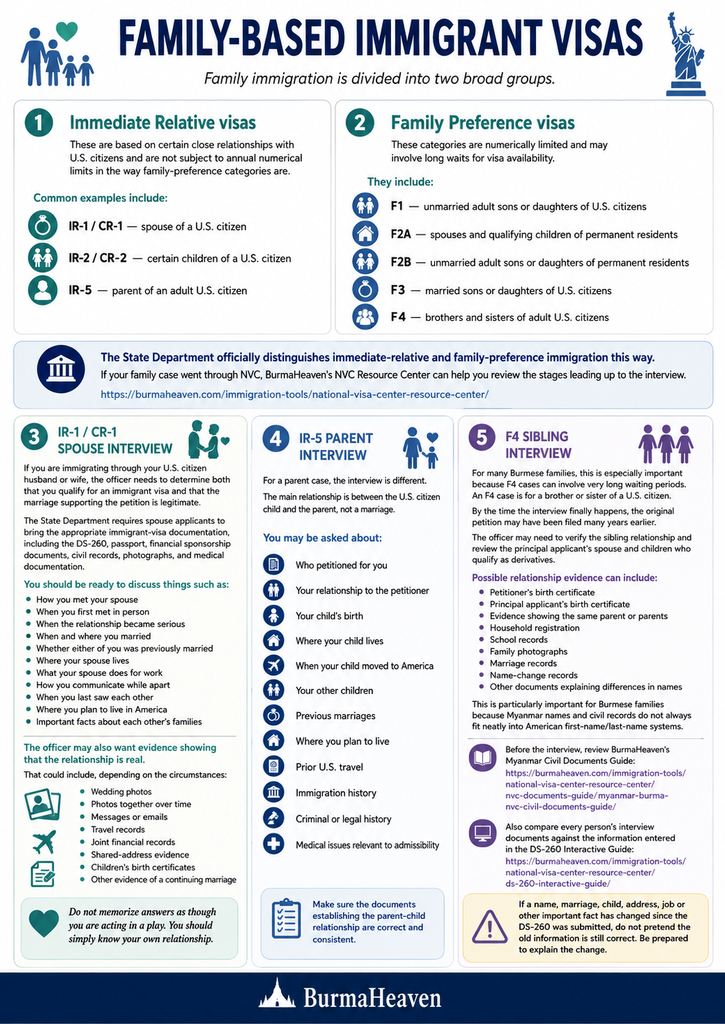

FAMILY-BASED IMMIGRANT VISAS

Family immigration is divided into two broad groups.

Immediate Relative visas

These are based on certain close relationships with U.S. citizens and are not subject to annual numerical limits in the way family-preference categories are.

Common examples include:

IR-1 / CR-1 — spouse of a U.S. citizen
IR-2 / CR-2 — certain children of a U.S. citizen
IR-5 — parent of an adult U.S. citizen

Family Preference visas

These categories are numerically limited and may involve long waits for visa availability.

They include:

F1 — unmarried adult sons or daughters of U.S. citizens
F2A — spouses and qualifying children of permanent residents
F2B — unmarried adult sons or daughters of permanent residents
F3 — married sons or daughters of U.S. citizens
F4 — brothers and sisters of adult U.S. citizens

The State Department officially distinguishes immediate-relative and family-preference immigration this way.

If your family case went through NVC, BurmaHeaven’s NVC Resource Center can help you review the stages leading up to the interview.


IR-1 / CR-1 SPOUSE INTERVIEW

If you are immigrating through your U.S. citizen husband or wife, the officer needs to determine both that you qualify for an immigrant visa and that the marriage supporting the petition is legitimate.

The State Department requires spouse applicants to bring the appropriate immigrant-visa documentation, including the DS-260, passport, financial sponsorship documents, civil records, photographs, and medical documentation.

You should be ready to discuss things such as:

  • How you met your spouse
  • When you first met in person
  • When the relationship became serious
  • When and where you married
  • Whether either of you was previously married
  • Where your spouse lives
  • What your spouse does for work
  • How you communicate while apart
  • When you last saw each other
  • Where you plan to live in America
  • Important facts about each other’s families

The officer may also want evidence showing that the relationship is real.

That could include, depending on the circumstances:

  • Wedding photos
  • Photos together over time
  • Messages or emails
  • Travel records
  • Joint financial records
  • Shared-address evidence
  • Children’s birth certificates
  • Other evidence of a continuing marriage

Do not memorize answers as though you are acting in a play.

You should simply know your own relationship.


IR-5 PARENT INTERVIEW

For a parent case, the interview is different.

The main relationship is between the U.S. citizen child and the parent, not a marriage.

You may be asked about:

  • Who petitioned for you
  • Your relationship to the petitioner
  • Your child’s birth
  • Where your child lives
  • When your child moved to America
  • Your other children
  • Previous marriages
  • Where you plan to live
  • Prior U.S. travel
  • Immigration history
  • Criminal or legal history
  • Medical issues relevant to admissibility

Make sure the documents establishing the parent-child relationship are correct and consistent.


F4 SIBLING INTERVIEW

For many Burmese families, this is especially important because F4 cases can involve very long waiting periods.

An F4 case is for a brother or sister of a U.S. citizen.

By the time the interview finally happens, the original petition may have been filed many years earlier.

The officer may need to verify the sibling relationship and review the principal applicant’s spouse and children who qualify as derivatives.

Possible relationship evidence can include:

  • Petitioner’s birth certificate
  • Principal applicant’s birth certificate
  • Evidence showing the same parent or parents
  • Household registration
  • School records
  • Family photographs
  • Marriage records
  • Name-change records
  • Other documents explaining differences in names

This is particularly important for Burmese families because Myanmar names and civil records do not always fit neatly into American first-name/last-name systems.

Before the interview, review BurmaHeaven’s Myanmar Civil Documents Guide.

Also compare every person’s interview documents against the information entered in the DS-260 Interactive Guide.

If a name, marriage, child, address, job or other important fact has changed since the DS-260 was submitted, do not pretend the old information is still correct.

Be prepared to explain the change.


BURMESE NAMES CAN CREATE CONFUSION

Myanmar does not traditionally use surnames in the same way the United States does.

That can result in the same person’s name appearing differently across:

  • Passport
  • Birth certificate
  • Household list
  • Police certificate
  • DS-260
  • NVC account
  • Marriage records
  • Children’s documents

Do not invent a family relationship simply because two people share part of a name.

And do not hide legitimate name variations.

If the same person has used different spellings, aliases, Chinese names, ethnic-language names, or different Romanizations, bring evidence that helps explain the connection.

This is exactly the kind of issue where the Myanmar Civil Documents Guide can help.


BRING PROOF OF YOUR RELATIONSHIP

The U.S. Embassy Rangoon immigrant-visa instructions specifically tell applicants to be prepared to show evidence of the relationship with the U.S. petitioner.

Examples given by the Embassy include:

  • Household registration
  • Email communications
  • Photographs over time
  • School records

The officer can request additional evidence depending on the case.

For a sibling case, that evidence looks different from a marriage case.

For a spouse case, relationship evidence is usually focused on the marriage.

For a parent case, it is focused on the parent-child relationship.

Bring evidence that actually proves your particular relationship.
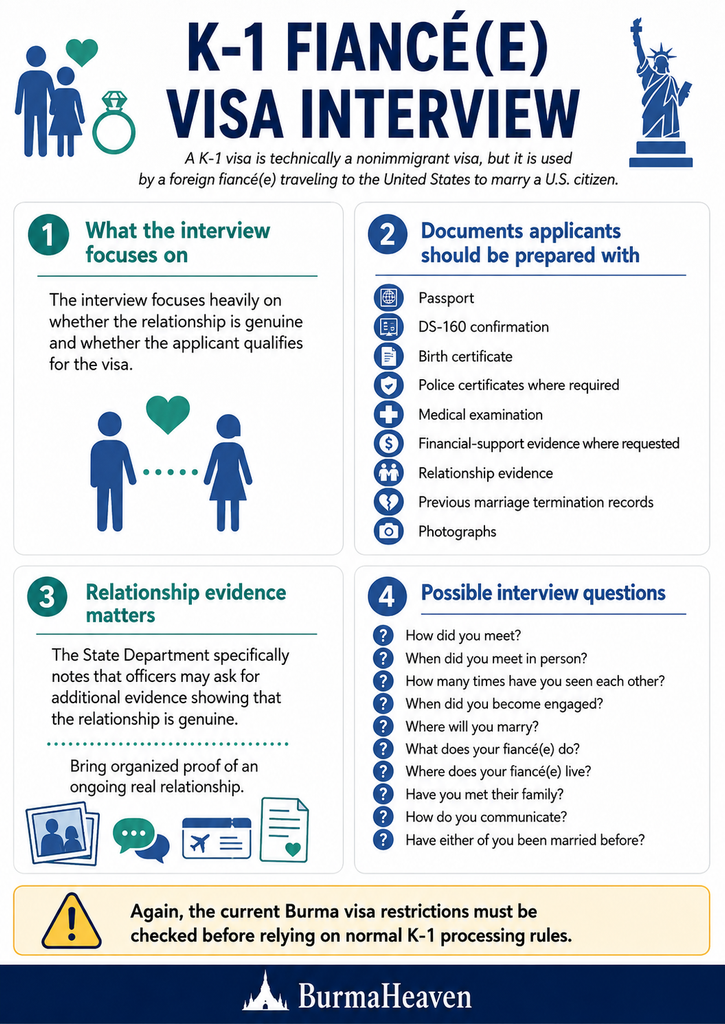

K-1 FIANCÉ(E) VISA INTERVIEW

A K-1 visa is technically a nonimmigrant visa, but it is used by a foreign fiancé(e) traveling to the United States to marry a U.S. citizen.

The interview focuses heavily on whether the relationship is genuine and whether the applicant qualifies for the visa.

Applicants should be prepared with documents such as:

  • Passport
  • DS-160 confirmation
  • Birth certificate
  • Police certificates where required
  • Medical examination
  • Financial-support evidence where requested
  • Relationship evidence
  • Previous marriage termination records
  • Photographs

The State Department specifically notes that officers may ask for additional evidence showing that the relationship is genuine.

Possible questions include:

  • How did you meet?
  • When did you meet in person?
  • How many times have you seen each other?
  • When did you become engaged?
  • Where will you marry?
  • What does your fiancé(e) do?
  • Where does your fiancé(e) live?
  • Have you met their family?
  • How do you communicate?
  • Have either of you been married before?

Again, the current Burma visa restrictions must be checked before relying on normal K-1 processing rules.


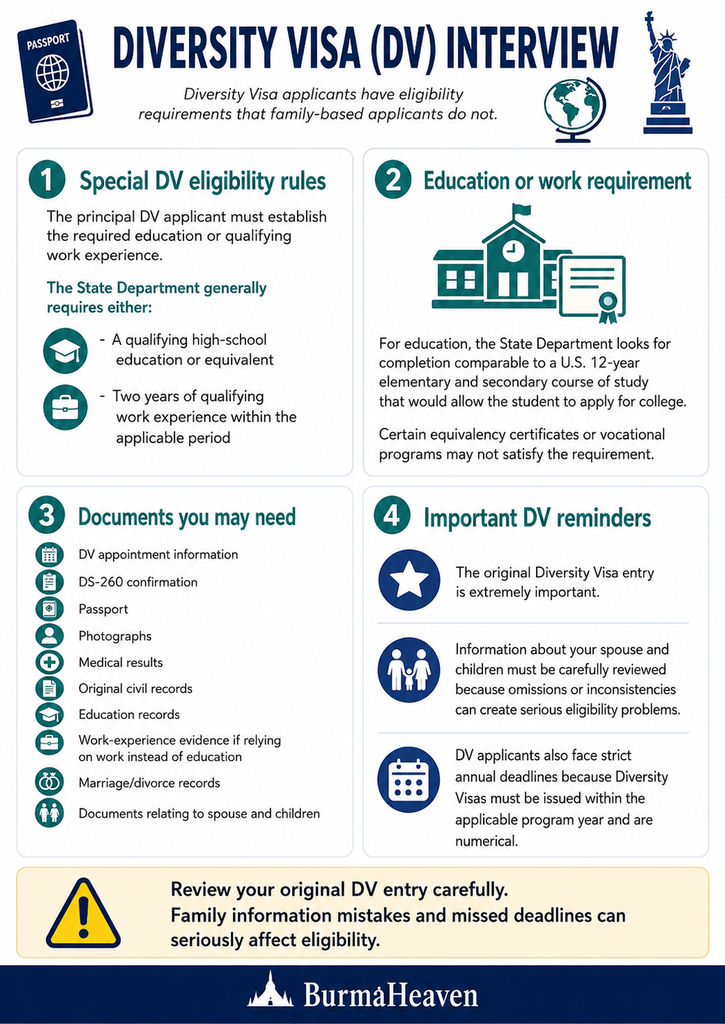
DIVERSITY VISA INTERVIEW

Diversity Visa applicants have requirements that family-based applicants do not.

The principal DV applicant must establish the required education or qualifying work experience.

The State Department says the principal applicant generally must show either:

  • A qualifying high-school education or equivalent, or
  • Two years of qualifying work experience within the applicable period

For education, the State Department looks for completion comparable to a U.S. 12-year elementary and secondary course of study that would allow the student to apply for college. Certain equivalency certificates or vocational programs may not satisfy the requirement.

You may need to bring:

  • DV appointment information
  • DS-260 confirmation
  • Passport
  • Photographs
  • Medical results
  • Original civil records
  • Education records
  • Work-experience evidence if relying on work instead of education
  • Marriage/divorce records
  • Documents relating to spouse and children

The original Diversity Visa entry is extremely important.

Information about your spouse and children must be carefully reviewed because omissions or inconsistencies can create serious eligibility problems.

DV applicants also face strict annual deadlines because Diversity Visas must be issued within the applicable program year and are numerically limited.


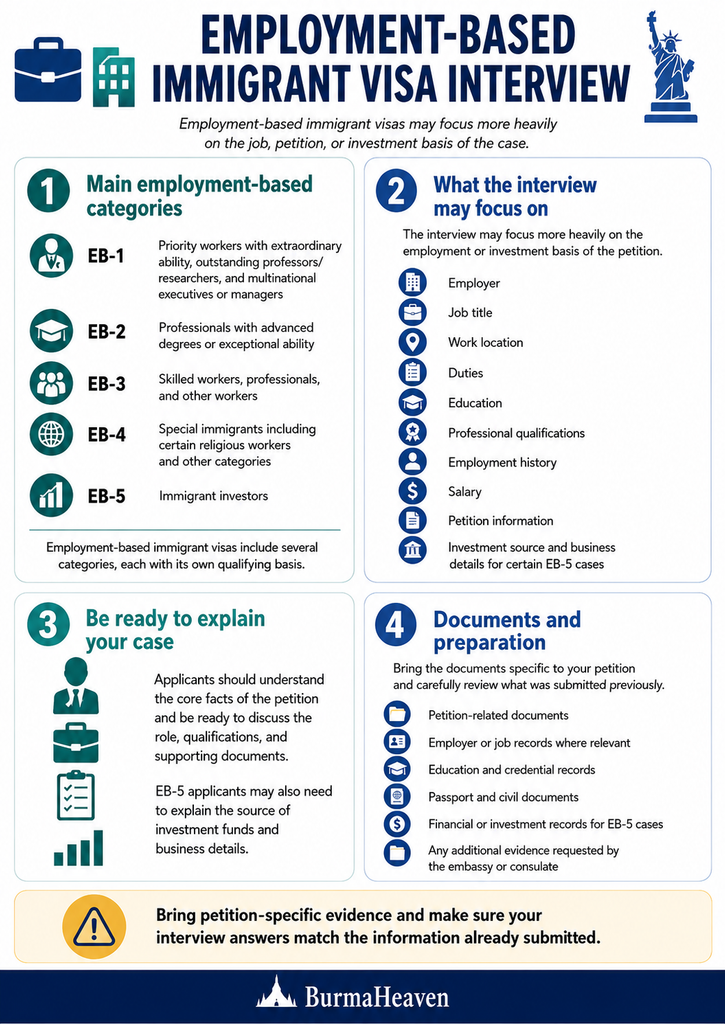
EMPLOYMENT-BASED IMMIGRANT VISA INTERVIEW

Employment-based immigrant visas include categories such as:

EB-1
EB-2
EB-3
EB-4
EB-5

The interview may focus more heavily on the employment or investment basis of the petition.

Possible subjects include:

  • Employer
  • Job title
  • Work location
  • Duties
  • Education
  • Professional qualifications
  • Employment history
  • Salary
  • Petition information
  • Investment source and business details for certain EB-5 cases

Bring the documents specific to your petition and carefully review what was submitted previously.


B-1 / B-2 VISITOR VISA INTERVIEW

A tourist or business visitor visa is very different from an immigrant visa.

The applicant is not trying to prove that they should permanently move to the United States.

They are trying to qualify for a temporary visit.

An officer may ask about:

  • Why you want to visit
  • How long you will stay
  • Where you will stay
  • Who will pay
  • Who you know in America
  • Your job in Myanmar
  • Your family situation
  • Previous travel
  • Your plans after the visit

For nonimmigrant visas such as visitor visas, U.S. law can require applicants to overcome the presumption that they intend to immigrate.

Do not invent a job, property, family obligation or travel history to make your case look stronger.

A false statement can create a much bigger immigration problem than a visa refusal.

And because Burma is currently covered by the 2026 visa-issuance suspension, check the current restrictions before applying or traveling for an interview.


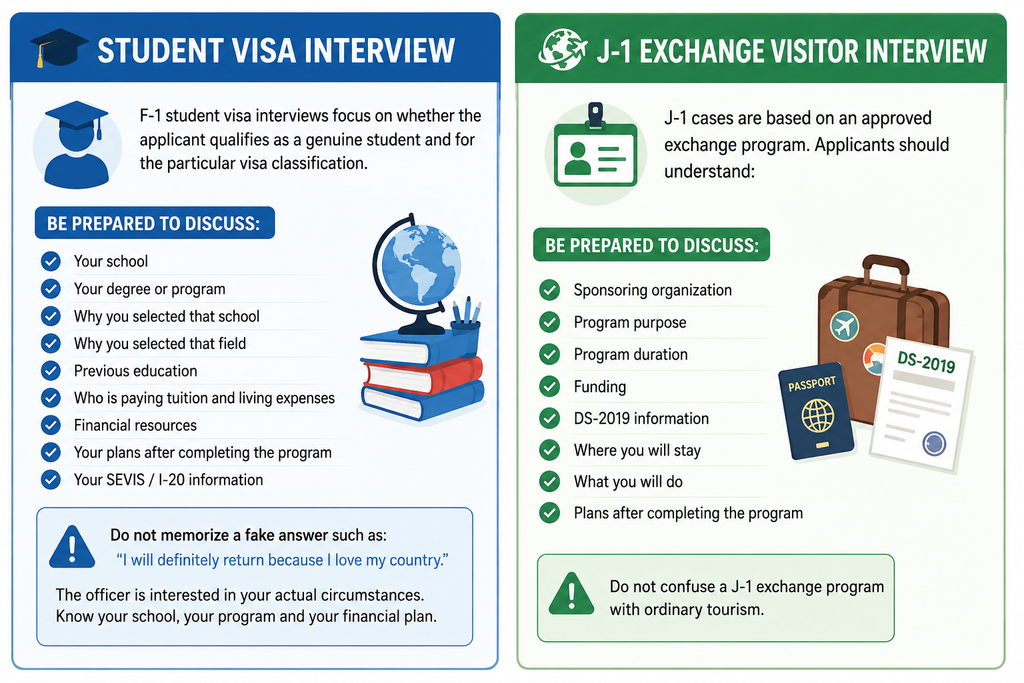
F-1 STUDENT VISA INTERVIEW

Student visa interviews focus on whether the applicant qualifies as a genuine student and for the particular visa classification.

Be prepared to discuss:

  • Your school
  • Your degree or program
  • Why you selected that school
  • Why you selected that field
  • Previous education
  • Who is paying tuition and living expenses
  • Financial resources
  • Your plans after completing the program
  • Your SEVIS/I-20 information

Do not memorize a fake answer such as:

“I will definitely return because I love my country.”

The officer is interested in your actual circumstances.

Know your school, your program and your financial plan.


J-1 EXCHANGE VISITOR INTERVIEW

J-1 cases are based on an approved exchange program.

Applicants should understand:

  • Sponsoring organization
  • Program purpose
  • Program duration
  • Funding
  • DS-2019 information
  • Where they will stay
  • What they will do
  • Plans after completing the program

Do not confuse a J-1 exchange program with ordinary tourism.


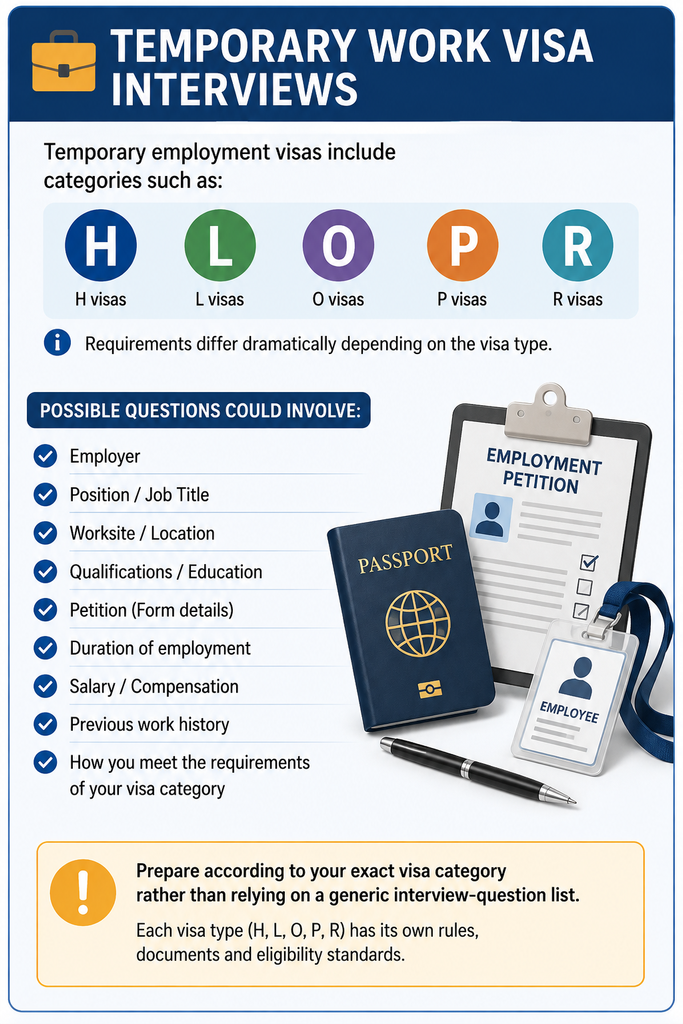
TEMPORARY WORK VISA INTERVIEWS

Temporary employment visas include categories such as:

  • H
  • L
  • O
  • P
  • R

Requirements differ dramatically.

Possible questions could involve:

  • Employer
  • Position
  • Worksite
  • Qualifications
  • Petition
  • Duration of employment
  • Salary
  • Previous work history

Prepare according to your exact visa category rather than relying on a generic interview-question list.


WHAT BURMESE IMMIGRANT VISA APPLICANTS SHOULD BRING TO RANGOON

The U.S. Embassy Rangoon has its own immigrant-visa instructions.

Applicants should follow the embassy’s current checklist rather than relying only on a general online list.

The Embassy currently requires or discusses items including:

  • Appointment information
  • Passport
  • DS-260 confirmation
  • Visa photographs
  • Original civil documents
  • Required translations
  • Medical-exam results
  • Relationship evidence
  • Financial sponsorship documents where applicable
  • Birth certificates
  • Marriage and divorce documents where applicable

The Embassy’s exact requirements can change, so review the official Rangoon instructions before the interview.

Official page:

U.S. Embassy Rangoon Immigrant Visa Instructions


YOUR MEDICAL EXAM IN BURMA

Do not treat the medical examination as something you can handle after the interview.

The current U.S. Embassy Rangoon instructions say immigrant visa applicants must complete the medical exam with an Embassy-authorized physician before the interview.

The Embassy currently states that applicants must bring the medical results in the sealed envelope provided by the clinic and warns that applicants will not be allowed into the Embassy compound without the medical results.

The Embassy’s current instructions list an approved clinic in Yangon and tell applicants to bring items such as:

  • Interview letter
  • Passport
  • Passport-style photographs
  • Immunization records
  • DS-260 confirmation page

Use the Embassy page immediately before scheduling because approved physicians, addresses and procedures can change.


BRING YOUR VACCINATION RECORDS

Immigrant visa applicants are subject to medical and vaccination requirements.

Bring whatever vaccination records you have.

If your records from Myanmar are incomplete or unavailable, tell the panel physician.

Do not create your own vaccination history.

The physician determines what is medically appropriate under the immigration medical rules.


TRANSLATING BURMESE DOCUMENTS

Do not assume an officer will simply read every Burmese document.

Follow the embassy and NVC requirements regarding translations.

For Myanmar-specific examples involving:

  • Birth certificates
  • Marriage certificates
  • Police certificates
  • Household registrations
  • Other civil records

use BurmaHeaven’s Myanmar Civil Documents Guide.

And before the interview, compare what you have against your NVC Document Checklist so you are not trying to remember everything the night before.


REVIEW YOUR DS-260 BEFORE THE INTERVIEW

This is one of the most useful things you can do.

Before going to the Embassy, review the information submitted in your DS-260.

Look carefully at:

  • Names
  • Birth dates
  • Addresses
  • Children
  • Spouses
  • Previous marriages
  • Employment
  • Education
  • Previous U.S. travel
  • Visa refusals
  • Immigration history
  • Criminal history
  • Security questions

If something has changed, be prepared to explain it.

If something was entered incorrectly, do not repeat incorrect information simply because it is already on the DS-260.

Use BurmaHeaven’s DS-260 Interactive Guide to understand what the form was asking.


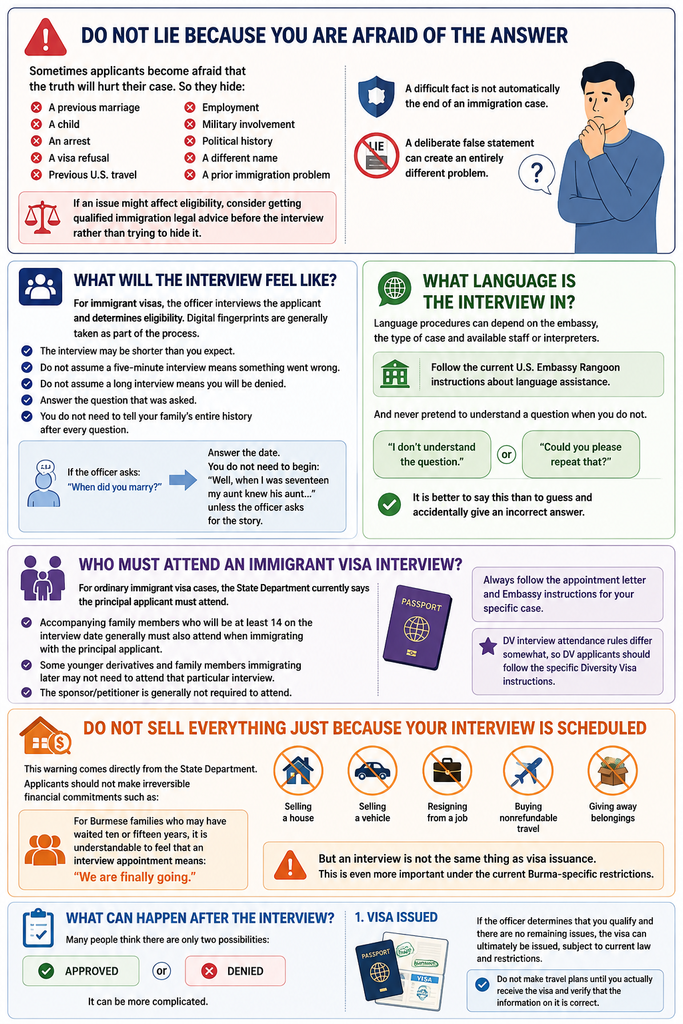
DO NOT LIE BECAUSE YOU ARE AFRAID OF THE ANSWER

This is especially important.

Sometimes applicants become afraid that the truth will hurt their case.

So they hide:

  • A previous marriage
  • A child
  • An arrest
  • A visa refusal
  • Previous U.S. travel
  • Employment
  • Military involvement
  • Political history
  • A different name
  • A prior immigration problem

That can make the situation much worse.

If an issue might affect eligibility, consider getting qualified immigration legal advice before the interview rather than trying to hide it.

A difficult fact is not automatically the end of an immigration case.

A deliberate false statement can create an entirely different problem.


WHAT WILL THE INTERVIEW FEEL LIKE?

For immigrant visas, the officer interviews the applicant and determines eligibility.

Digital fingerprints are generally taken as part of the process.

The interview may be shorter than you expect.

Do not assume a five-minute interview means something went wrong.

Do not assume a long interview means you will be denied.

Answer the question that was asked.

You do not need to tell your family’s entire history after every question.

If the officer asks:

“When did you marry?”

Answer the date.

You do not need to begin:

“Well, when I was seventeen my aunt knew his aunt…”

unless the officer asks for the story.

Clear answers are easier for everyone.


WHAT LANGUAGE IS THE INTERVIEW IN?

Do not assume that poor English automatically means you cannot complete a visa interview.

Language procedures can depend on the embassy, the type of case and available staff or interpreters.

Follow the current U.S. Embassy Rangoon instructions about language assistance.

And never pretend to understand a question when you do not.

It is better to say:

“I don’t understand the question.”

or:

“Could you please repeat that?”

than to guess and accidentally give an incorrect answer.


WHO MUST ATTEND AN IMMIGRANT VISA INTERVIEW?

For ordinary immigrant visa cases, the State Department currently says the principal applicant must attend.

Accompanying family members who will be at least 14 on the interview date generally must also attend when immigrating with the principal applicant.

Some younger derivatives and family members immigrating later may not need to attend that particular interview. The sponsor/petitioner is generally not required to attend.

Always follow the appointment letter and Embassy instructions for your specific case.

DV interview attendance rules differ somewhat, so DV applicants should follow the specific Diversity Visa instructions.


DO NOT SELL EVERYTHING JUST BECAUSE YOUR INTERVIEW IS SCHEDULED

This warning comes directly from the State Department.

Applicants should not make irreversible financial commitments such as:

  • Selling a house
  • Selling a vehicle
  • Resigning from a job
  • Buying nonrefundable travel
  • Giving away belongings

until the immigrant visa has actually been received.

For Burmese families who may have waited ten or fifteen years, it is understandable to feel that an interview appointment means:

“We are finally going.”

But an interview is not the same thing as visa issuance.

This is even more important under the current Burma-specific restrictions.


WHAT CAN HAPPEN AFTER THE INTERVIEW?

Many people think there are only two possibilities:

Approved

or

Denied

It can be more complicated.

Visa Issued

If the officer determines that you qualify and there are no remaining issues, the visa can ultimately be issued, subject to current law and restrictions.

Do not make travel plans until you actually receive the visa and verify that the information on it is correct.


221(g): MORE INFORMATION OR ADMINISTRATIVE PROCESSING

A case may be refused under INA 221(g) because the officer needs:

  • Additional documents
  • Additional information
  • Additional review
  • Administrative processing

A 221(g) refusal is not necessarily the permanent end of the case.

Follow the instructions the Embassy gives you.

Do not send random additional documents that were not requested.


VISA INELIGIBILITY OR OTHER REFUSAL

Other applicants may have a legal issue that prevents visa issuance.

Depending on the ground involved, there may or may not be a waiver or another legal option.

If your case involves:

  • Fraud or misrepresentation
  • Criminal history
  • Prior unlawful U.S. presence
  • Prior removal/deportation
  • Certain medical issues
  • Smuggling
  • False claims to U.S. citizenship
  • Other serious admissibility issues

do not rely solely on social-media advice.

Those are situations where individualized advice from a qualified U.S. immigration attorney may matter.


CURRENT BURMA RESTRICTION

A Burmese applicant may also complete the normal immigration process but encounter the separate current restriction on visa issuance.

That does not necessarily mean the underlying petition disappeared or that NVC made a mistake scheduling the interview.

It means visa issuance is subject to the law and policies in effect when the visa decision is made.

Check the current Department of State information rather than relying on what applied when your petition was originally filed.


SHOULD YOU RESCHEDULE YOUR RANGOON INTERVIEW?

Be very careful about voluntarily rescheduling.

The U.S. Embassy Rangoon warns that there can be a significant wait for another appointment.

For numerically limited family and employment categories, a visa number that was available when NVC scheduled the interview may not necessarily remain available after a reschedule.

The Embassy specifically tells applicants to consult the Visa Bulletin before deciding to reschedule.

BurmaHeaven has several tools for this:

Visa Bulletin Calculator
Visa Bulletin History
Priority Date Tracker

You can access them through My Immigration Journey and the Visa Bulletin section.


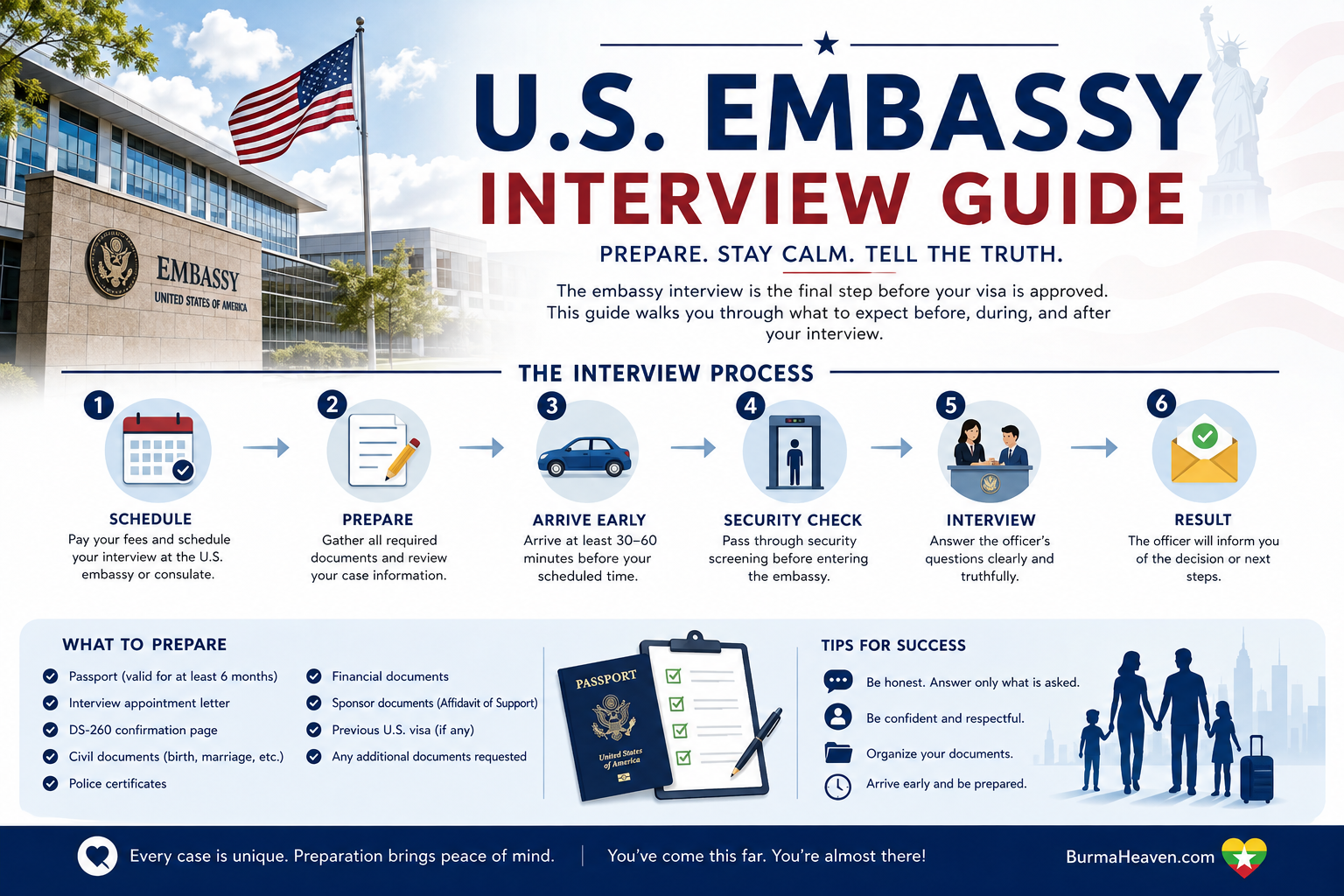
THE NIGHT BEFORE YOUR INTERVIEW

Do not start preparing your entire case that night.

Use the night before for a final check.

Make sure you have:

  • Passport
  • Appointment letter/instructions
  • DS-260 confirmation if applicable
  • Required photographs
  • Medical results
  • Original civil documents
  • Required translations
  • Financial sponsorship documents
  • Relationship evidence
  • Police certificates where applicable
  • Category-specific documents
  • Copies of important records

Put documents into labeled folders.

For a family case, you might use:

Applicant

Petitioner

Marriage

Birth Certificates

Police Certificates

Financial Sponsor

Relationship Evidence

Medical

You should be able to find a document quickly when the officer asks for it.


MORNING OF THE INTERVIEW

Give yourself enough time.

Do not arrive with prohibited items or a huge amount of unnecessary property.

Follow the Embassy’s current security and entry instructions.

And most importantly:

Do not panic.

You are not taking a school exam where you need to memorize the correct answer.

The officer is reviewing your real case.

Know your history.

Know your petitioner.

Know what was submitted.

Bring your documents.

Tell the truth.


FIVE RULES FOR A BURMESE VISA INTERVIEW

1. Know your own case.

Do not let another person prepare everything while you know nothing.

2. Tell the truth.

Do not invent an answer because you think it sounds better.

3. Bring the documents the Embassy actually requests.

TikTok and Facebook are not your interview checklist.

4. If you don’t understand the question, say so.

Guessing can create unnecessary inconsistencies.

5. Do not assume an interview appointment guarantees a visa.

Especially for Burmese applicants in 2026, current visa restrictions can affect issuance even after an interview.


Where to Go Next on BurmaHeaven

If you are still figuring out your overall case, start with My Immigration Journey.

If your case is at NVC, use the NVC Resource Center.

Before completing or reviewing your visa application, use the DS-260 Interactive Guide.

For Myanmar birth certificates, marriage documents, police certificates and other civil records, use the Myanmar Civil Documents Guide.

And once your visa is actually issued and you are preparing to move, continue to First Year in America.

One Final Reminder

You may have waited years for this interview.

Do not let the pressure make you think you have to give the officer a perfect performance.

You need to give truthful, clear and consistent information about your actual case.

Bring the right documents.

Know what was submitted.

Ask for clarification when you do not understand.

And for Burmese applicants especially, check the current Department of State rules shortly before the interview because the visa restrictions affecting Burma can change independently of your underlying petition or NVC case.

BurmaHeaven can help you understand the process, but your appointment letter, U.S. Embassy Rangoon instructions and current U.S. Department of State guidance should always control when they differ from a general guide.