
Capital Gain Calculator
Estimate your capital gain or capital loss in seconds. Learn how gains are calculated using simple explanations and our free interactive calculator.

Capital Gains Calculator: Estimate Your Gain or Loss
Capital Gain Calculator
Estimate a basic capital gain or loss and check whether the holding period is generally short-term or long-term.
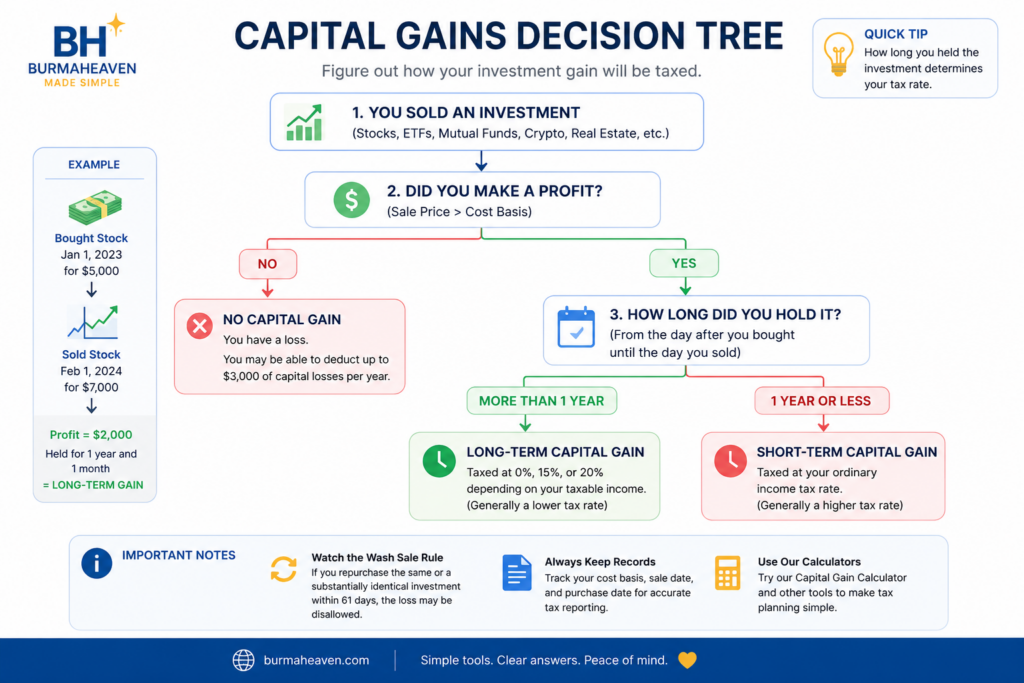
How to Use the Capital Gains Calculator
This calculator helps you estimate the gain or loss from selling an investment, property, stock, or other asset.
Enter the amount you paid for the asset, your selling price, and any applicable costs. The calculator will estimate whether you made a capital gain or a capital loss.
What Is a Capital Gain?
A capital gain happens when you sell an asset for more than your adjusted cost basis.
For example, if you bought an investment for $10,000 and later sold it for $15,000, your gain before adjustments would generally be $5,000.
What Is a Capital Loss?
A capital loss occurs when you sell an asset for less than your adjusted cost basis.
Capital losses may affect your taxes differently depending on the type of asset and your individual tax situation.
What Is Cost Basis?
Your cost basis is usually the amount you originally paid for an asset, but it may also include certain fees, commissions, improvements, or other adjustments.
Your cost basis is important because it helps determine your gain or loss when you sell.
Short-Term vs. Long-Term Capital Gains
In general, the tax treatment of a capital gain can depend on how long you owned the asset.
Assets held for a shorter period may be taxed differently from assets held for a longer period.
For current federal rules and tax rates, check official IRS guidance.
Simple Example
Suppose you purchased stock for $5,000 and paid a $25 purchase commission. Later you sold the stock for $7,500 and paid a $50 selling commission.
Your estimated calculation would be:
- Purchase Price: $5,000
- Purchase Fees: +$25
- Adjusted Cost Basis: $5,025
- Sale Price: $7,500
- Selling Expenses: −$50
- Net Sale Proceeds: $7,450
Estimated Capital Gain
$2,425
Frequently Asked Questions
What is a capital gain?
A capital gain is generally the profit you earn when you sell an investment for more than your adjusted cost basis.
What is a capital loss?
A capital loss generally occurs when you sell an investment for less than your adjusted cost basis.
Does this calculator calculate my taxes?
No. This calculator estimates your capital gain or capital loss. It does not calculate the tax you may owe.
Does this calculator include wash sale adjustments?
No. This calculator provides a simplified estimate and does not include wash sale rules or other special tax situations.
Can I use this calculator for stocks and ETFs?
Yes. It can be used as a general educational calculator for common investment sales such as stocks, ETFs, and mutual funds.
Continue Learning
Learn how investment taxes work with our beginner-friendly guides and interactive tools.