Start Here: Your Guide From Burma to Life in America
Start Here: A Burmese Immigrant Guide to America
This Burmese immigrant guide to America is designed to help families from Myanmar understand where to begin with immigration, schools, money, healthcare, jobs, housing, and everyday life in the United States.
U.S. Cities With Large Burmese Communities
Population figures are estimates based primarily on U.S. Census Bureau American Community Survey 5-year data. Figures may differ from local community estimates and should not be interpreted as exact population counts.
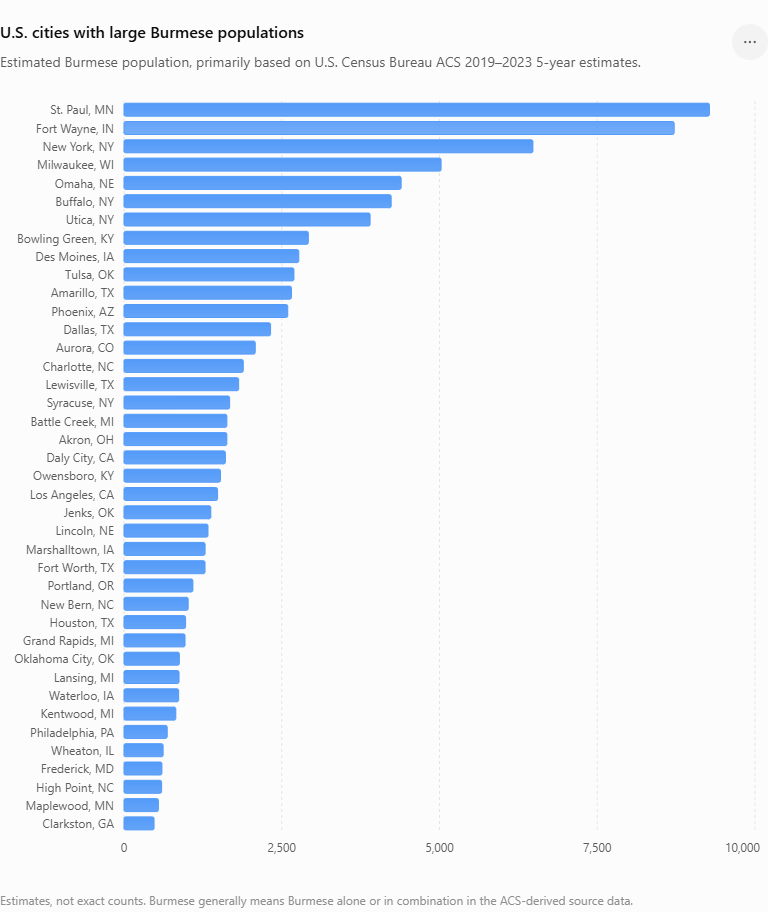
A few especially useful clusters jump out for BH. Minnesota/Indiana are major centers: St. Paul and Fort Wayne are at the very top. Upstate New York is unusually important, with Buffalo, Utica and Syracuse all having substantial Burmese communities. Texas is spread among Amarillo, Dallas, Lewisville, Fort Worth and Houston rather than being concentrated in just one city.
Start Here: Your Guide From Burma to Life in America
Moving to the United States is not one problem. It is a hundred small problems happening at the same time.
You may be trying to understand your immigration case, collect documents from Myanmar, figure out what happens after USCIS approval, prepare for an embassy interview, enroll your children in school, open a bank account, understand taxes, find healthcare, or simply learn how everyday life works in America.
That is why BurmaHeaven is organized around the entire journey — before you arrive, while your immigration case is moving, and after you begin building your life in the United States.
If you are not sure where to begin, start here.
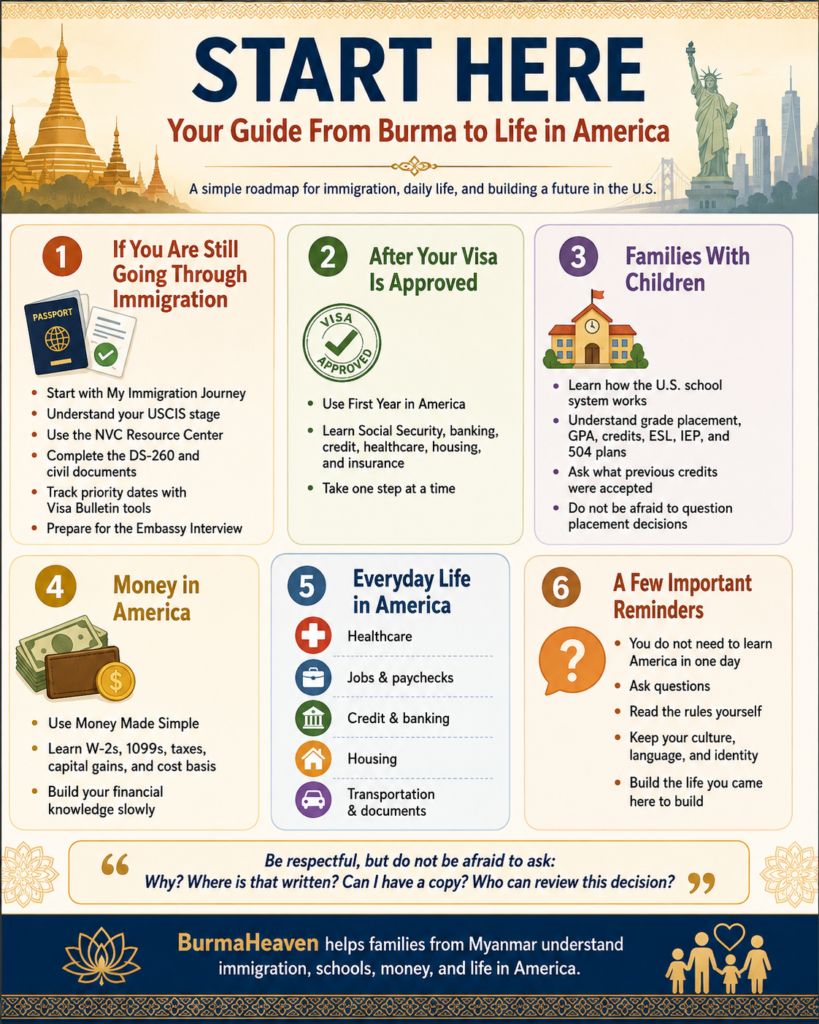
If You Are Still Going Through Immigration
Immigration can feel overwhelming because different government agencies handle different parts of the process.
A family-based immigration case may begin with USCIS, move to the National Visa Center, require forms and civil documents, eventually reach a U.S. embassy or consulate, and then continue with important steps after arrival.
If you do not even know which stage applies to you, start with My Immigration Journey. It is designed to help you identify where you are in the process and point you toward the tools and guides that match your situation. BurmaHeaven’s current immigration workspace includes guidance for USCIS, NVC, Visa Bulletin and interview-stage cases.
Waiting for USCIS?
USCIS is often the first major stage for family-based immigration petitions.
During this stage, families may be waiting for:
- A petition receipt
- Requests for evidence
- Petition approval
- Case transfer to another agency
- Other USCIS decisions
Our USCIS Stage resources are designed to help you understand what happens before a case reaches the National Visa Center.
When Your Case Reaches the National Visa Center
After USCIS approves many immigrant petitions that require consular processing, the case generally moves to the National Visa Center, or NVC. At that point, applicants may need to pay fees, complete forms, submit financial sponsorship documents and upload civil documents before becoming documentarily qualified.
Our NVC Resource Center brings those steps together in one place.
If you are completing the immigrant visa application, the DS-260 Interactive Guide walks through the form in plain English.
And if you are trying to figure out which birth certificates, marriage documents, police certificates or other records are available from Myanmar, use the Myanmar Civil Documents Guide rather than assuming a Burmese document works exactly like an American one.
You can also use the NVC document checklist before submitting through CEAC so you are not trying to remember everything from memory. BurmaHeaven’s NVC center specifically covers DS-260, sponsorship, civil documents, documentarily qualified status and interview preparation.
Waiting Years for a Family Visa?
Some immigrant categories have annual visa limits, which means approval of the original petition does not necessarily mean a visa is immediately available.
If your case has a priority date, BurmaHeaven has tools to help you understand the Visa Bulletin without having to decode government tables every month.
You can use the:
Visa Bulletin Calculator, Visa Bulletin History, and Priority Date Tracker to understand where your case stands and how the cutoff dates are moving.
For families who have been waiting many years, especially in family-preference categories such as F1, F2, F3 and F4, knowing the difference between petition approval and visa availability is extremely important.
Preparing for the Embassy Interview
Reaching the interview stage can feel like the finish line, but there are still important steps before a visa can actually be issued.
Applicants may need to prepare:
- Original civil documents
- Financial sponsorship evidence
- Medical examination records
- Vaccination records
- Police certificates
- Passports
- Interview documents
BurmaHeaven’s Embassy Interview resources are meant to help families understand what to prepare and what usually happens before, during and after the interview.
Immigration rules can change, so important eligibility and visa decisions should always be verified with USCIS, the U.S. Department of State or the appropriate embassy. BurmaHeaven explains complicated processes in simpler language, but it does not replace official government instructions.
Your Visa Is Approved. Now What?
This is where a completely different kind of confusion begins.
People spend years concentrating on getting to America.
Then they arrive and suddenly need to understand:
Social Security numbers. Banks. Credit. Healthcare. Schools. Jobs. Taxes. Housing. Driver’s licenses. Insurance. Government offices.
Nobody hands you one instruction manual when you land at the airport.
That is the purpose of the First Year in America section.
It is for the questions that start after immigration paperwork stops being the only thing you have to worry about.
Families With Children: Learn the U.S. School System Early
If you are moving with children, do not wait until the first day of school to start understanding how American education works.
The U.S. school system may be very different from the school system your family knew in Myanmar.
Parents may encounter unfamiliar terms such as:
- School district
- Attendance boundary
- Elementary school
- Middle school
- High school
- GPA
- Credits
- Honors
- AP
- Dual enrollment
- English Learner
- IEP
- 504 Plan
Your home address can affect which public school your child attends, and grade placement for students coming from another country should involve understanding the child’s previous education rather than blindly comparing grade numbers.
Our U.S. School System for Burmese Parents guide explains enrollment, grade placement, English-language support, school vaccines, special education, parent rights, graduation requirements and advanced opportunities such as dual enrollment.
For teenagers coming from Myanmar, one of the most important questions to ask is not simply:
“What grade is my child in?”
Ask:
“Which previous courses and credits did you accept, and what does my child still need to graduate?”
That question can make a huge difference.
Do Not Be Afraid to Ask Questions
Being new to the United States does not mean you have to quietly accept everything someone behind a desk tells you.
This applies to immigration offices, schools, hospitals, banks and other institutions.
Ask:
Why?
Ask:
Where is that written?
Ask:
Can I have a copy?
Ask:
Who can review this decision?
You do not need perfect English to advocate for yourself or your children.
One of the biggest lessons immigrant families learn over time is that systems are run by people, and people can misunderstand information, make mistakes or give incomplete answers.
Be respectful, but learn the rules yourself.
Money in America Works Differently Too
Once you begin earning, saving or investing money in the United States, another vocabulary appears:
Credit scores. W-2s. 1099s. Tax returns. Capital gains. Cost basis. Retirement accounts. Insurance. Interest.
You do not need to become a financial expert overnight.
Our Money Made Simple section breaks complicated financial topics into smaller pieces using guides, examples and interactive tools. It currently includes tools covering capital gains, cost basis, investment holding periods, Form 8949, Schedule D, wash sales and Form 1099-B.
For example, if you eventually begin investing and sell a stock, our Capital Gain Calculator can help you understand the basic difference between what you paid for an investment and what you received when you sold it.
You may not need those tools today.
That is okay.
The point of BurmaHeaven is that when you eventually run into one of these problems, there is somewhere to start.
Building Credit and Learning the Banking System
Many newcomers arrive without a U.S. credit history.
That does not mean you have bad credit. It may simply mean the American financial system does not have enough information about you yet.
Over time, you may need to learn about:
- Checking accounts
- Savings accounts
- Debit cards
- Credit cards
- Credit reports
- Credit scores
- Loans
- Interest
- Fraud protection
These systems affect much more than borrowing money. Credit history can affect certain housing applications and financial decisions as you establish yourself in the United States.
This is one of the areas BurmaHeaven will continue expanding as part of our practical Life in America resources.
Healthcare Can Be Confusing
American healthcare may be one of the most confusing systems for new immigrant families.
You may encounter terms such as:
- Health insurance
- Premium
- Deductible
- Copay
- Primary-care doctor
- Urgent care
- Emergency room
- Medicaid
- Medicare
- Marketplace insurance
Knowing where to go matters.
A routine medical problem may belong at a primary-care clinic or urgent care center, while a true emergency belongs in an emergency room.
Children may also need vaccination records when enrolling in school, although requirements and available low-cost vaccination programs vary by state.
The goal is not to memorize the entire healthcare system at once. Learn the piece you need when you need it.
Finding Work and Understanding Your First Paycheck
A first job in America may introduce another set of unfamiliar terms:
Gross pay. Net pay. Federal withholding. State withholding. Social Security. Medicare. Overtime. W-2. 1099.
Your paycheck will usually be less than the hourly rate multiplied by the hours you worked because certain taxes and other deductions may be withheld.
And being classified as an employee is different from being an independent contractor.
That distinction can affect taxes, benefits and employment protections.
As BurmaHeaven’s Money Made Simple and Life in America resources grow, these are exactly the kinds of everyday questions we want to explain without assuming the reader already knows how America works.
Housing Is More Than Finding an Apartment
Newcomers may also have to learn how Americans rent and eventually buy homes.
Renting can involve:
- Applications
- Income verification
- Credit checks
- Security deposits
- Leases
- Utilities
- Renters insurance
Buying a home adds:
- Mortgages
- Interest rates
- Down payments
- Property taxes
- Homeowners insurance
- Closing costs
Do not feel pressured to understand all of this immediately after arriving.
Build your knowledge one decision at a time.
Stay Connected to Where You Came From
BurmaHeaven is not only about paperwork and survival.
Moving to America does not require abandoning Burmese culture.
Food, language, traditions, family stories and cultural identity can remain part of your life while you learn a completely different society.
That is why BurmaHeaven also includes Burmese Life, family stories, food, culture and other resources alongside immigration and financial tools. The site is designed around immigration, everyday American life, money and staying connected to Myanmar rather than treating those as completely separate experiences.
You Do Not Need to Learn America in One Day
When you first arrive, everything can feel urgent.
It isn’t.
You do not need to understand taxes before you have income.
You do not need to understand mortgages before you are ready to buy a house.
You do not need to understand college admissions while your child is still in elementary school.
But when that moment comes, knowing where to look makes an enormous difference.
Start with the problem directly in front of you.
If you are still immigrating, begin with My Immigration Journey.
If your case has reached NVC, go to the NVC Resource Center.
If you have just arrived, start working through First Year in America.
If your children are entering school, learn the U.S. school system before assuming every placement or recommendation is correct.
And when money and taxes begin getting more complicated, Money Made Simple will be there when you need it.
Welcome to BurmaHeaven
I built BurmaHeaven around a simple idea:
Information that affects your life should not require hours of searching, complicated government language or knowing the right questions before you even begin.
Some of us had to learn America by making mistakes, asking questions, figuring things out the hard way and realizing years later that there were options we never knew existed.
The next family should not have to start from zero.
Learn the system. Use the tools. Ask questions. Know your options. And build the life you came here to build.