Consular Electronic Application Center CEAC Immigrant Visa Guide
How to Use the Consular Electronic Application Center (CEAC) for NVC Processing, DS-260, Documents, and Visa Status
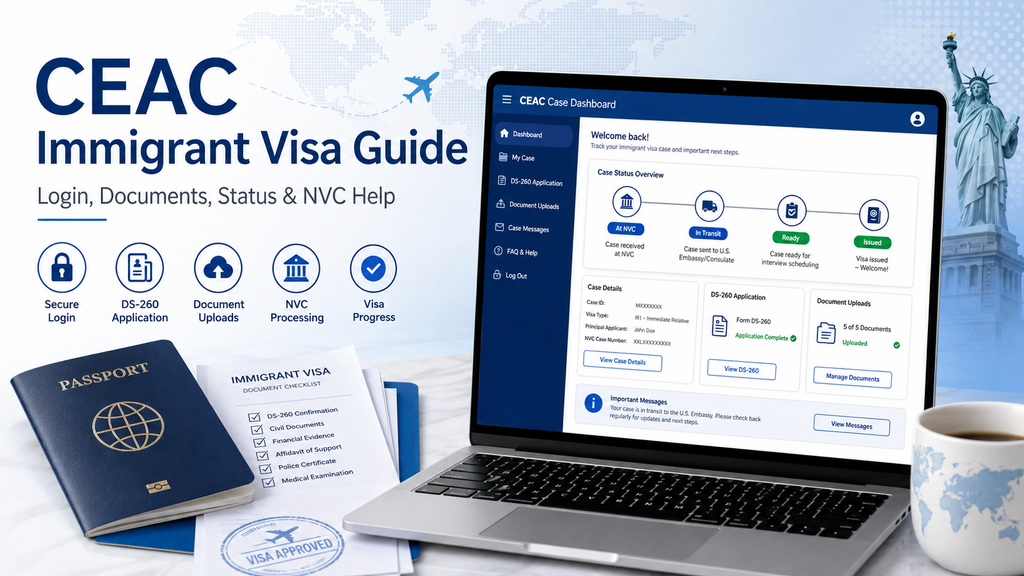

CEAC Immigrant Visa Guide
How to Check Your Case, Upload Documents & Understand Your Status
How to Use the Consular Electronic Application Center
If your family-based immigrant visa case has reached the National Visa Center (NVC), one of the most important websites you will use is CEAC.
CEAC stands for Consular Electronic Application Center. It is the U.S. Department of State’s online system for managing many immigrant visa cases.
Through CEAC, you may be able to:
- Pay your immigrant visa fees
- Pay the Affidavit of Support fee
- Complete Form DS-260
- Upload civil documents
- Upload Affidavit of Support and financial documents
- Check whether NVC accepted or rejected documents
- Read messages from NVC
- See the applicants connected to your case
- See your financial sponsors
- Check whether your case is still at NVC or has been transferred to a U.S. embassy or consulate
- Check your visa status after your case reaches the embassy
This guide explains how CEAC works, what the different statuses mean, and what you may need to do next.
Important: CEAC is an official U.S. Department of State system. Burma Heaven is not affiliated with USCIS, NVC, the Department of State, or any U.S. government agency. This guide is for general educational purposes and is not legal advice.
Official CEAC Websites
There are actually two different CEAC pages that immigrant visa applicants commonly use.
This causes a lot of confusion, so understanding the difference is important.
1. CEAC Immigrant Visa Portal
Use the CEAC Immigrant Visa Portal to manage your NVC case.
👉 Open the Official CEAC Immigrant Visa Portal
This is where you may:
- Pay NVC fees
- Complete your DS-260
- Upload documents
- Review document status
- Read NVC messages
- Review applicants and sponsors
According to the U.S. Department of State, CEAC allows immigrant visa applicants to see the status of their case, submit required forms and documents, and receive messages from NVC.
2. CEAC Visa Status Check
The Department of State also operates a separate CEAC Visa Status Check.
👉 Check Your Immigrant Visa Status on CEAC
This page is mainly used to check the overall status of a visa application.
You may eventually see statuses such as:
- At NVC
- In Transit
- Ready
- Refused
- Issued
The CEAC Visa Status Check is not the same thing as your full CEAC NVC account.
What Do I Need to Log Into CEAC?
For an immigrant visa case being processed through NVC, you will normally need information from your NVC Welcome Letter.
This includes your:
NVC Case Number
Your case number normally contains letters followed by numbers.
For example:
BNK2026123456
The letters usually identify the embassy or consular post associated with the case.
Invoice ID Number
NVC also provides an Invoice ID Number.
You may need both your case number and Invoice ID Number to access parts of your CEAC case.
Keep Your NVC Welcome Letter
Do not throw away your NVC Welcome Letter.
The Department of State recommends keeping it because you may need the information to access CEAC throughout the visa process.
What Can I See Inside My CEAC Account?
After you log into CEAC, you will normally see a case summary page.
This page contains some of the most important information about your immigrant visa case.
You may see:
Your Case Location
Near the top of the page, CEAC may display:
Your case is currently at:
This can help you determine which government agency currently has your case.
For example:
NVC
means your case is still being processed by the National Visa Center.
If the name of an embassy or consulate appears instead, your case may already have been transferred overseas.
CEAC Applicant Information
Your case summary may list each person applying for an immigrant visa.
For a family immigration case, this could include:
- Principal applicant
- Spouse
- Children
- Other eligible derivative applicants
Each applicant may have their own:
- Visa fee status
- DS-260 status
- Civil document status
This is important because each immigrant visa applicant generally has their own application requirements.
CEAC Financial Sponsor Information
CEAC may also display information about the financial sponsor or sponsors associated with the case.
Depending on your situation, this could include:
- Petitioner
- Primary financial sponsor
- Joint sponsor
- Household member
Financial sponsors may need to submit documents such as:
- Form I-864, Affidavit of Support
- Federal tax transcript
- Federal tax return
- W-2
- 1099
- Proof of current income
- Proof of U.S. domicile
- Proof of citizenship or permanent residence
- Other requested financial evidence
The exact requirements depend on the individual case.
Understanding CEAC Fee Status
After NVC creates your case, certain fees may need to be paid.
For many family-based immigrant visa cases, these include:
Affidavit of Support Fee
and
Immigrant Visa Application Processing Fee
CEAC may display different statuses during the payment process.
PAY NOW
If CEAC displays:
PAY NOW
the fee is available for payment.
IN PROCESS
After submitting payment, you may temporarily see:
IN PROCESS
This generally means the payment is still being processed.
Do not immediately submit another payment unless instructed to do so.
PAID
When CEAC displays:
PAID
the payment has been processed.
The Department of State states that applicants generally cannot access Form DS-260 until the immigrant visa fee has been processed.
How Long Do CEAC Fee Payments Take?
The Department of State currently advises applicants to allow up to 10 calendar days for NVC to process payments.
Processing times can change.
👉 Check Official NVC Instructions
Completing the DS-260 Through CEAC
After your immigrant visa processing fee shows:
PAID
you may be able to begin Form DS-260 — Immigrant Visa and Alien Registration Application.
Inside CEAC, look for:
IV APPLICATION
and then:
START NOW
Each qualified family member immigrating to the United States generally needs their own DS-260.
Important: Save Your DS-260 Information Carefully
The DS-260 asks for a large amount of information, including your:
- Name
- Other names used
- Birth information
- Current address
- Previous addresses
- Family information
- Marriage information
- Children
- Education
- Employment history
- Previous U.S. travel
- Previous visa information
- Immigration history
- Security and background information
Answer carefully and truthfully.
Do not guess at important information if you can verify it first.
After You Submit the DS-260
After your DS-260 is submitted, print or save the DS-260 Confirmation Page.
You will normally need to bring the confirmation page to your immigrant visa interview.
The Department of State says that applicants can print the confirmation page from CEAC after submitting the DS-260.
👉 Read the Official DS-260 Instructions
Can I Change My DS-260 After Submitting It?
Once the DS-260 has been submitted, you generally cannot simply reopen and edit it yourself the same way you could before submission.
If important information changes or you discover an error, follow instructions from NVC or the U.S. embassy or consulate handling your case.
Do not submit false information simply because you are worried that correcting something will delay your case.
Accuracy is more important.
Uploading Documents to CEAC
NVC may require applicants to upload civil documents and sponsors to upload financial documents through CEAC.
Typical civil documents may include:
- Birth certificate
- Marriage certificate
- Divorce documentation
- Police certificate
- Court records
- Military records
- Passport biographic page
- Adoption documents
Not every applicant needs every document.
Your requirements depend on your country, immigration category, age, history, and individual case.
Burmese Applicants: Check Country-Specific Document Requirements
Documents available in Myanmar may not always look or function exactly like documents issued in the United States.
Before uploading a document, check the Department of State’s official Reciprocity and Civil Documents information.
👉 Check U.S. Visa Reciprocity and Civil Document Requirements
Choose Burma (Myanmar) and then review the instructions for the document you need.
This is especially important for:
- Birth certificates
- Marriage documents
- Police certificates
- Divorce records
- Court documents
- Military records
Burmese Documents and English Translations
If a required document is not written in English, a translation may also be required depending on the document and where the visa interview takes place.
Do not upload only an English translation when NVC requires the original-language document as well.
Follow the Department of State’s instructions for your specific document and embassy.
CEAC Document Status Meanings
After you upload documents, CEAC may display different statuses.
These statuses are extremely important.
NOT SUBMITTED
NOT SUBMITTED generally means the document has not yet been formally submitted to NVC for review.
Uploading a file and submitting it are not always the same step.
Make sure you complete the submission process.
SUBMITTED
SUBMITTED generally means the document was submitted and is waiting for NVC review.
At this stage, you may simply need to wait for NVC to review the submission.
ACCEPTED
ACCEPTED means NVC reviewed that particular document and accepted it.
This is good.
However:
One accepted document does not mean your entire immigration case has been approved.
Other documents or applicants may still require review.
REJECTED
REJECTED means NVC did not accept the document you submitted.
This does not automatically mean your visa case has been denied.
There may simply be a problem with that document.
Examples could include:
- Wrong document uploaded
- Document difficult to read
- Missing page
- Incorrect document type
- Missing translation
- Wrong version of a form
- Missing signature
- Missing supporting evidence
- Document does not satisfy the country’s civil-document requirements
Read the message from NVC carefully.
Always Read the NVC Comment
When NVC rejects or requests changes to a document, do not look only at the word REJECTED.
Look for the comment or message explaining what NVC wants.
That message is often more important than the status itself.
Fix the exact problem NVC identifies.
Don’t Forget to Click “Submit Documents”
One common mistake is uploading a replacement document but failing to formally submit it.
The Department of State says that when corrections are required, applicants should make the correction and then resubmit the case by pressing “Submit Documents.”
If you upload something but never submit it, NVC may not review it.
What Does “Documentarily Complete” Mean?
After NVC has accepted the required:
- Fees
- DS-260
- Affidavit of Support
- Financial supporting documents
- Civil documents
your case may become documentarily complete or documentarily qualified.
Many applicants call this:
DQ
or
Documentarily Qualified
This is an important milestone.
But DQ does not mean your visa has been approved.
It generally means NVC has received the documents it requires before the case can move forward toward an immigrant visa interview.
What Happens After DQ?
What happens next depends on the type of immigrant visa.
For an Immediate Relative category, the case can generally move toward interview scheduling when the embassy has capacity.
For a family-preference category, such as:
- F1
- F2A
- F2B
- F3
- F4
an immigrant visa number must generally also be available according to the Visa Bulletin before the applicant can receive an immigrant visa.
Your priority date matters.
Need help understanding your priority date?
Use the Burma Heaven Visa Bulletin tools to help understand where your case may be in the immigration line.
[Check Your Priority Date →]
What Does “At NVC” Mean?
If the CEAC Visa Status Check displays:
AT NVC
your case is still with the National Visa Center.
This may happen while:
- Your case is waiting for documents
- NVC is reviewing documents
- Your case is documentarily complete but waiting for interview availability
- Your priority date is not yet eligible
- NVC is waiting for an embassy to schedule the interview
“At NVC” by itself does not necessarily indicate a problem.
What Does “In Transit” Mean?
If CEAC displays:
IN TRANSIT
your case has generally been sent from NVC to the U.S. embassy or consulate that will handle the visa interview.
This is usually a normal step before the case becomes Ready.
What Does “Ready” Mean?
If CEAC displays:
READY
your case has generally arrived at the U.S. embassy or consulate and is ready for the next stage of visa processing.
Depending on the case, this may occur:
- Before the interview
- Around the time the embassy receives the case
- While the case is preparing for interview processing
Do not assume that Ready means the visa has been approved.
It does not.
What Does “Refused” Mean in CEAC?
Seeing:
REFUSED
can be frightening.
But Refused does not always mean the case is permanently denied.
This is especially important to understand.
Since 2020, some visa cases that previously appeared in CEAC as Administrative Processing may instead display Refused.
Some refusals occur under INA Section 221(g).
A 221(g) refusal may mean the officer needs:
- Additional documents
- Additional information
- Administrative processing
- Additional review
Some 221(g) refusals can later be overcome and the case status can change.
Follow the instructions given by the consular officer.
Example: Refused After Interview
Imagine you attend your visa interview.
The officer asks for an additional police certificate.
Your CEAC case might show:
REFUSED
That does not necessarily mean your immigration journey is over.
The officer may have refused the visa under 221(g) until the required document is submitted and reviewed.
Once the issue is resolved, the status can potentially change.
When Is “Refused” More Serious?
Some refusals involve an actual finding of visa ineligibility under U.S. immigration law.
The meaning depends on:
- The legal section cited
- The consular officer’s instructions
- Whether additional evidence was requested
- Whether a waiver may be available
- Whether the refusal can be overcome
If you receive a refusal involving a complicated immigration or inadmissibility issue, consider speaking with a qualified U.S. immigration attorney.
What Does “Issued” Mean?
This is the status most applicants are hoping to see.
ISSUED
generally means the immigrant visa has been issued.
However, do not purchase non-refundable airline tickets simply because CEAC changes to Issued.
Wait until you actually receive your passport containing the visa and verify that the information printed on the visa is correct.
Check Your Visa for Errors
When you receive your passport, check the visa carefully.
Review items such as:
- Name
- Date of birth
- Passport number
- Visa category
- Expiration date
If something appears incorrect, contact the U.S. embassy or consulate that issued the visa.
CEAC Says “No Status”
Sometimes applicants receive a message such as:
NO STATUS
or CEAC cannot locate the case.
Possible explanations may include:
- Incorrect case number
- Wrong visa category selected
- Information entered incorrectly
- Case recently created
- Case recently transferred
- Temporary CEAC problem
Double-check your information before assuming something is wrong with your immigration case.
CEAC Website Not Working?
CEAC can occasionally be slow or unavailable.
If the site is not working:
- Confirm you are using the official .gov CEAC website.
- Double-check your case number.
- Avoid repeatedly refreshing while completing forms.
- Try again later if the government website appears temporarily unavailable.
- Check whether NVC has posted updated instructions.
The CEAC login page specifically warns users not to use the browser’s Back or Refresh buttons while using the system because information can be lost.
Use the navigation buttons provided within CEAC whenever possible.
How Do I Know Whether NVC Is Reviewing My Documents Yet?
NVC publishes a Timeframes page showing which document-submission dates it is currently reviewing.
👉 Check Current NVC Processing Timeframes
Do not compare your case only with someone else’s immigration case.
Different people may have:
- Different visa categories
- Different priority dates
- Different embassies
- Different document problems
- Different family circumstances
Should I Contact NVC While My Documents Are Being Reviewed?
If your case is still within NVC’s published processing timeframe, contacting NVC usually does not make the case move faster.
The Department of State specifically advises applicants not to send repeat inquiries, because multiple inquiries about the same issue can slow NVC’s ability to respond.
If your case is outside the normal timeframe or you have another legitimate problem, use the official NVC Public Inquiry Form.
👉 Contact NVC Through the Official Public Inquiry Form
Common CEAC Mistakes to Avoid
Mistake #1: Using an Unofficial Website
CEAC is located on:
ceac.state.gov
Be careful with websites that look like government websites but are actually private immigration businesses.
Mistake #2: Uploading the Wrong Document
Before uploading a civil document, check the State Department’s requirements for your country.
Mistake #3: Uploading but Not Submitting
A document sitting in CEAC is not necessarily submitted for review.
Make sure the required submission step has been completed.
Mistake #4: Ignoring NVC Comments
If NVC rejects a document, read the explanation.
Do not simply upload the same document again unless the NVC instructions actually tell you to do that.
Mistake #5: Thinking “Accepted” Means Visa Approved
An accepted document simply means NVC accepted that document.
The visa itself is decided later by a U.S. consular officer.
Mistake #6: Thinking “DQ” Means Interview Immediately
Documentary qualification does not guarantee an immediate interview.
Interview timing depends on factors including:
- Visa category
- Priority date
- Visa availability
- Embassy capacity
Mistake #7: Panicking When CEAC Says “Refused”
Read the embassy’s instructions first.
A 221(g) refusal may sometimes be resolved by providing requested documents or after administrative processing.
Mistake #8: Buying Plane Tickets Too Early
Even after CEAC says Issued, wait until you physically receive your passport and visa before making travel plans that cannot be changed.
CEAC Checklist
Use this checklist while managing your NVC case.
- Save your NVC Welcome Letter
- Save your NVC Case Number
- Save your Invoice ID Number securely
- Confirm every eligible applicant appears in CEAC
- Confirm the correct petitioner is listed
- Confirm required financial sponsors are listed
- Pay the required NVC fees
- Wait until fees show PAID
- Complete DS-260 for each required applicant
- Save each DS-260 confirmation page
- Gather required civil documents
- Check country-specific civil document rules
- Obtain required translations
- Upload clear copies
- Upload financial sponsorship documents
- Review every NVC comment
- Correct rejected documents
- Click Submit Documents when required
- Watch for documentary qualification
- Check the Visa Bulletin if you are in a preference category
- Monitor interview instructions
- Complete the required medical examination
- Attend the immigrant visa interview
- Check CEAC after the interview
- Follow any 221(g) instructions carefully
- Wait for the passport and visa before finalizing travel
CEAC vs. USCIS: What’s the Difference?
This is another common source of confusion.
USCIS
USCIS generally handles your immigration petition first.
For example, a U.S. citizen may file:
Form I-130, Petition for Alien Relative
with USCIS.
USCIS decides whether to approve the petition.
NVC
After USCIS approves certain immigrant visa petitions, the case is transferred to the:
National Visa Center
NVC performs immigrant visa pre-processing.
CEAC
CEAC is the online Department of State system you use to interact with parts of the NVC and consular visa process.
A simplified immigration journey looks like this:
USCIS Petition
↓
USCIS Approval
↓
National Visa Center
↓
CEAC
↓
Fees + DS-260 + Documents
↓
Documentarily Qualified
↓
Wait for Visa Availability if Required
↓
Interview Scheduled
↓
U.S. Embassy or Consulate
↓
Visa Interview
↓
Visa Issued
↓
Travel to the United States
Is CEAC the Same as My USCIS Online Account?
No.
They are separate government systems.
Your USCIS account is primarily connected to USCIS immigration petitions and applications.
Your CEAC immigrant visa account is operated by the U.S. Department of State for visa processing.
A case can therefore leave USCIS and continue through NVC and CEAC.
What If a Family Member Is Missing From CEAC?
For family-preference cases, derivative spouses or children may sometimes need to be added or corrected.
Do not simply create another visa application for a person who is not properly connected to the case.
If an eligible derivative family member is missing, follow NVC procedures for adding that applicant and provide the requested evidence of the family relationship.
Evidence could depend on the relationship and may include documents such as:
- Birth certificate
- Marriage certificate
- Passport
- Other civil records
Whether someone qualifies as a derivative applicant depends on the immigration category and that person’s circumstances.
What If My Child Is Getting Close to Age 21?
Do not ignore this issue.
Children in some family immigration cases may potentially receive protection under the Child Status Protection Act (CSPA).
CSPA calculations can be complicated and simply turning 21 does not automatically tell you whether a child has aged out.
Learn more:
[Read Our Child Status Protection Act (CSPA) Guide →]
What If My Priority Date Is Not Current?
If your immigrant visa category is subject to annual visa limits, reaching NVC does not necessarily mean a visa is immediately available.
Family-preference categories include:
- F1
- F2A
- F2B
- F3
- F4
These applicants may need to wait until their priority date becomes eligible under the Department of State Visa Bulletin.
Use Burma Heaven’s immigration tools:
[Check Your Priority Date →]
Open the Burma Heaven Immigration Dashboard →
Important CEAC Security Warning
Your NVC Case Number and Invoice ID Number can provide access to sensitive immigration information.
Treat them like private information.
Do not publicly post:
- Your full case number
- Invoice ID
- Passport number
- Birth certificate
- DS-260 confirmation information
- Financial documents
- Tax documents
Only share this information with people you trust and legitimate professionals assisting with your case.
Official Government Resources
For the safest and most current information, use official U.S. government websites.
CEAC Immigrant Visa Portal
https://ceac.state.gov/IV/Login.aspx
CEAC Visa Status Check
https://ceac.state.gov/CEACStatTracker/Status.aspx?App=IV
National Visa Center
NVC Processing Timeframes
NVC Public Inquiry Form
Visa Bulletin
View the Official Visa Bulletin
U.S. Embassy & Consulate Information
Find a U.S. Embassy or Consulate
Continue Your Immigration Journey
CEAC is only one part of the immigrant visa process.
If you are trying to understand what happens next, use the Burma Heaven immigration resources below.
My Immigration Journey
See where you are in the U.S. immigration process and what may come next.
Visa Bulletin
Understand how your priority date affects when an immigrant visa may become available.
[Check Your Priority Date →]
DS-260 Guide
Learn how the immigrant visa application works and what information you may need before starting.
[Read the DS-260 Guide →]
NVC Guide
Understand fees, financial sponsorship, civil documents, documentary qualification, and interview preparation.
[Read the NVC Guide →]
Frequently Asked Questions About CEAC
What does CEAC stand for?
CEAC stands for Consular Electronic Application Center.
It is operated by the U.S. Department of State.
Is CEAC part of USCIS?
No.
CEAC is operated by the U.S. Department of State.
USCIS and the Department of State are separate agencies involved at different stages of many immigration cases.
Does “Accepted” mean my visa was approved?
No.
It generally means NVC accepted a particular document.
Your immigrant visa is ultimately adjudicated by a U.S. consular officer.
Does “Documentarily Qualified” mean my visa is approved?
No.
DQ generally means NVC has received and accepted the required pre-processing documents.
You may still need to wait for:
- Visa availability
- Interview scheduling
- Medical examination
- Consular interview
- Final visa decision
Does “Ready” mean my visa was approved?
No.
Ready generally means your case is at the embassy or consulate and ready for the next stage of processing.
Does “Refused” mean my case is permanently denied?
Not necessarily.
Some cases refused under INA 221(g) can later be resolved after additional documentation or administrative processing.
Read the instructions provided by the consular officer.
What is the best CEAC status?
For someone waiting for a visa after an interview, the status most applicants ultimately hope to see is:
ISSUED
But you should still wait until you actually receive your passport and visa before finalizing travel.
How often should I check CEAC?
There is usually no benefit to checking CEAC every few minutes.
Status changes may not happen immediately.
Check periodically and pay attention to emails and instructions from NVC or the embassy.
Can someone else log into CEAC for me?
A trusted family member, agent, or attorney may sometimes assist an applicant with the immigration process.
However, CEAC contains sensitive personal and financial information.
Only provide your login information to someone you trust.
The Most Important CEAC Rule
When CEAC shows something you do not understand:
Do not guess.
Read:
- The exact status
- The NVC comment
- Any CEAC message
- Any email from NVC
- Any instructions from the U.S. embassy
A word such as Rejected or Refused can mean very different things depending on where you are in the immigration process.
Understanding the message behind the status is much more useful than looking at the status alone.
Disclaimer
Burma Heaven provides educational information to help Burmese immigrants and families better understand life and immigration processes in the United States. Burma Heaven is not a law firm and is not affiliated with USCIS, the U.S. Department of State, the National Visa Center, or any U.S. government agency. Immigration rules, procedures, fees, processing times, and government policies can change. Always verify important information with official U.S. government sources or a qualified immigration attorney when appropriate.