Who Actually Owns America’s $40 Trillion Debt?
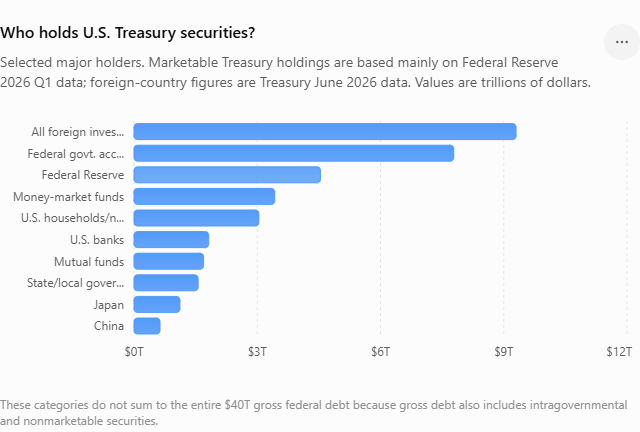
The Federal Reserve’s detailed ownership data show households at about $3.039T, money-market funds at $3.426T, banks at $1.818T, mutual funds at $1.694T, and foreign investors at $9.317T in 2026 Q1. The Fed itself held about $4.54T in Treasuries on August 19, 2026. And Treasury’s latest country table puts Japan at $1.117T, the UK at $939.9B, and China at $633.4B as of June 2026.
The next logical article is actually the scary one: “Can America Ever Pay Off $40 Trillion—or Does It Even Need To?” That lets us calculate what would happen if the U.S. tried to balance the budget using actual tax increases, spending cuts, GDP growth, or inflation instead of political promises.
America’s national debt has now crossed:
$40 TRILLION.
That number is difficult even to comprehend.
But an equally important question is:
Who exactly does America owe $40 trillion to?
China?
Japan?
Banks?
Wall Street?
The Federal Reserve?
Social Security?
American citizens?
The answer is:
ALL OF THEM.
But not in the proportions many people assume.
China owns only a small piece.
Foreign countries collectively own a much larger piece.
And enormous amounts are owned by American households, investment funds, banks, pension funds, the Federal Reserve and even other parts of the federal government itself.
Let’s follow the money.
First: The $40 Trillion Is Really Two Different Kinds of Debt
When the national debt crossed approximately $40.05 trillion on August 18, 2026, Treasury data showed roughly:
| Type of federal debt | Amount |
|---|---|
| Debt held by the public | $32.27 trillion |
| Intragovernmental debt | $7.78 trillion |
| Total | $40.05 trillion |
This distinction is extremely important.
$32.27 Trillion: Debt Held by the Public
Despite the name, “public” does not just mean ordinary American citizens.
It includes Treasury securities held by:
American households,
banks,
mutual funds,
money-market funds,
pension funds,
insurance companies,
the Federal Reserve,
state and local governments,
corporations,
foreign investors,
foreign central banks,
and foreign governments.
In other words:
THIS IS MONEY THE FEDERAL GOVERNMENT OWES OUTSIDE ITS OWN ACCOUNTS.
The Other $7.78 Trillion Is Much Stranger
Approximately:
$7.78 TRILLION
was classified as:
intragovernmental holdings.
That basically means:
ONE PART OF THE FEDERAL GOVERNMENT OWES ANOTHER PART OF THE FEDERAL GOVERNMENT.
How?
Consider Social Security.
Workers pay Social Security payroll taxes.
Historically, when Social Security collected more money than it immediately needed for benefits, the excess cash was invested in special U.S. Treasury securities.
Treasury got to spend the cash elsewhere.
In exchange, Treasury gave the Social Security trust funds government securities.
So Social Security effectively said:
“Here is our surplus cash.”
Treasury said:
“Thank you. Here is an IOU.”
That IOU counts as national debt.
Social Security Is One of America’s Biggest Creditors
The Social Security Old-Age and Survivors Insurance and Disability Insurance trust funds hold special Treasury securities.
These aren’t imaginary accounting entries.
Treasury is legally obligated to redeem those securities when Social Security needs the money to pay benefits.
The Social Security Administration explains that today all securities held by the Social Security trust funds are special issues of the federal government.
So when people say:
“Social Security has a trust fund.”
A substantial part of what that trust fund actually owns is:
U.S. GOVERNMENT IOUs.
Medicare Does the Same Thing
Medicare’s trust funds also invest their accumulated assets in special Treasury securities.
At the end of 2025, Medicare’s combined trust funds held approximately:
$424.1 BILLION
in assets invested through Treasury.
So America’s debt includes money owed to programs Americans themselves have been paying into.
This is why the phrase:
“America owes $40 trillion”
doesn’t mean there is some foreign banker waiting for a single $40 trillion check.
Now Let’s Look at the $32 Trillion Owed Outside Government Accounts
This is where things get really interesting.
Federal Reserve Financial Accounts data for the first quarter of 2026 showed approximately:
$30.64 TRILLION
of marketable Treasury securities outstanding.
Major holders included approximately:
| Holder | Treasury securities |
|---|---|
| Foreign investors | $9.32 trillion |
| Federal Reserve | $4.00 trillion |
| Money-market funds | $3.43 trillion |
| U.S. households/nonprofits | $3.04 trillion |
| U.S. banks | $1.82 trillion |
| Mutual funds | $1.69 trillion |
| State/local governments | $1.56 trillion |
| ETFs | $779 billion |
| Private pension funds | $607 billion |
| Brokers/dealers | $620 billion |
| State/local pension funds | $574 billion |
| Insurance companies and others | hundreds of billions more |
These categories are for marketable Treasury securities and therefore don’t perfectly equal the entire $40 trillion gross national-debt figure.
But they show who is actually financing the United States government.
So Foreigners Own About $9.3 Trillion
Now we get to the part people usually associate with China.
As of the first quarter of 2026, foreign investors collectively held roughly:
$9.3 TRILLION
of U.S. Treasury securities.
That is enormous.
But remember:
Total federal debt:
~$40 TRILLION.
So foreigners collectively hold only roughly a quarter of the overall debt—not most of it.
And “foreigners” includes dozens of countries plus foreign banks, investment funds, companies and individual investors.
It does not mean foreign governments own the entire amount.
Which Countries Own the Most?
Treasury’s June 2026 data show the largest reported foreign holders of U.S. Treasury securities.
#1 — Japan
$1.117 TRILLION
Japan—not China—is America’s largest reported foreign Treasury holder.
#2 — United Kingdom
$939.9 BILLION
But this requires a warning.
The United Kingdom is a massive global financial center.
Some securities attributed to Britain are held through British custodians for investors whose true economic owners may live somewhere else.
Treasury itself warns that country-level ownership cannot always be determined perfectly.
#3 — China
$633.4 BILLION
That’s the number people constantly talk about.
China owns approximately:
$633 BILLION
of Treasury securities.
Compared with America’s roughly $40 trillion total debt:
China holds roughly 1.6%.
So:
“America’s debt belongs to China.”
is simply false.
China is important.
But China is nowhere remotely close to owning most American debt.
Other Major Foreign Holders
As of June 2026:
| Foreign holder | Treasuries |
|---|---|
| Japan | $1.117T |
| United Kingdom | $939.9B |
| China | $633.4B |
| Belgium | $482.5B |
| Canada | $459.6B |
| Cayman Islands | $453.1B |
| Luxembourg | $434.2B |
| France | $389.9B |
| Ireland | $353.5B |
| Taiwan | $302.5B |
| Switzerland | $284.9B |
| Singapore | $284.4B |
| Hong Kong | $255.8B |
| Norway | $203.2B |
| India | $186.4B |
Total foreign Treasury holdings:
$9.299 TRILLION.
China therefore represents only about:
6.8%
of all foreign Treasury holdings.
Even among foreigners, China does not own anywhere close to the majority.
Wait. The Cayman Islands Own $453 Billion?
Yes.
But don’t picture the Cayman Islands government sitting on a pile of $453 billion.
Financial centers complicate Treasury statistics.
Hedge funds, investment vehicles and financial institutions often register or custody assets through:
the Cayman Islands,
Luxembourg,
Belgium,
Ireland,
the United Kingdom,
and other financial centers.
Treasury specifically warns that securities held through foreign custodians can be attributed to the custodian’s country rather than the ultimate investor.
So these numbers are excellent for understanding overall foreign holdings, but country-by-country attribution is not perfect.
The Federal Reserve Owns Trillions Too
This is another strange part.
The Federal Reserve held about:
$4.0 TRILLION
of Treasury securities at the end of the first quarter of 2026.
By August 19, 2026, the Fed’s Treasury portfolio had risen to roughly:
$4.54 TRILLION.
How can America’s central bank own America’s debt?
Because the Federal Reserve can purchase Treasury securities in the financial market as part of monetary policy.
During crises—especially after 2008 and during COVID—the Fed bought enormous quantities of government bonds.
So essentially:
Treasury borrowed money.
Investors bought Treasury securities.
The Fed later bought many of those securities.
Now Treasury owes the Federal Reserve.
Does That Mean America Owes Money to Itself Again?
Sort of—but this is different from Social Security.
The Federal Reserve is part of the government structure but operates with substantial independence.
Interest Treasury pays to the Fed contributes to Federal Reserve earnings and historically much of the Fed’s net income has eventually been remitted back to Treasury after expenses and other obligations.
So economically, Fed-held debt operates differently from debt owned by China or an American pension fund.
American Money-Market Funds Own More Than China
Here’s one number that completely changes the picture.
Money-market funds held approximately:
$3.43 TRILLION
of Treasury securities in the first quarter of 2026.
China:
$633 BILLION.
American money-market funds therefore held more than:
FIVE TIMES
China’s Treasury position.
Every time Americans put cash into certain:
money-market funds,
Treasury funds,
brokerage cash accounts,
retirement accounts,
or short-term bond funds,
some of that money may ultimately finance the federal government.
American Households Directly Own Trillions Too
The Federal Reserve estimates the household/nonprofit sector directly held approximately:
$3.04 TRILLION
in marketable Treasury securities in early 2026.
This includes things such as:
Treasury bills,
Treasury notes,
Treasury bonds
and securities purchased through brokerage accounts.
And that doesn’t even capture all indirect household ownership.
If your retirement account owns a Treasury bond fund…
a mutual fund…
an ETF…
or a pension fund that owns Treasuries…
you indirectly own government debt.
So millions of Americans who complain about the national debt simultaneously own pieces of it through:
401(k)s,
IRAs,
pensions,
money-market accounts,
bond funds
and investment portfolios.
Banks Own Almost $2 Trillion
U.S.-chartered banks held approximately:
$1.82 TRILLION
in Treasuries in early 2026.
Banks like Treasury securities because they are:
liquid,
widely accepted as collateral,
backed by the U.S. government,
and important for managing bank liquidity.
Treasuries are basically the foundation of the modern financial system.
Mutual Funds Own About $1.7 Trillion
Mutual funds held approximately:
$1.69 TRILLION
of Treasury securities.
Exchange-traded funds held another:
$779 BILLION.
Private pension funds:
$607 BILLION.
State and local pension funds:
$574 BILLION.
Again:
Much of “America’s debt” is therefore an asset sitting inside Americans’ retirement and investment accounts.
This Creates a Strange Accounting Reality
For the government:
Treasury bonds are:
DEBT.
For the person who owns the bond:
the exact same Treasury bond is:
AN ASSET.
Suppose you buy:
$100,000 of Treasury bonds.
You might say:
“I have $100,000 in investments.”
The U.S. government says:
“We owe somebody $100,000.”
Same financial instrument.
One person’s asset is another person’s liability.
So Why Should We Care About $40 Trillion If Americans Own Much of It?
Because the government still must:
PAY INTEREST.
It doesn’t matter whether the creditor is:
China,
Japan,
your grandmother,
your retirement fund,
a bank,
or the Federal Reserve.
Treasury securities come with contractual financial obligations.
As debt becomes larger and interest rates become higher, the federal government’s interest expense explodes.
And that is the part becoming increasingly dangerous.
The Interest Bill Is Approaching $1 Trillion a Year
The federal government’s net interest burden has now become one of the largest items in the budget.
Interest costs are around:
$1 TRILLION A YEAR.
That means taxpayers are spending enormous amounts simply servicing debt accumulated from past federal deficits.
Money spent on interest cannot simultaneously pay for:
roads,
schools,
defense,
healthcare,
research,
tax reductions,
or deficit reduction.
That is the real cost of debt.
Here’s the Dangerous Cycle
Imagine the government collects:
$5 trillion
but spends:
$7 trillion.
Deficit:
$2 trillion.
Treasury borrows $2 trillion.
Now the government owes more interest.
Suppose interest adds another:
$100 billion
to future spending.
If tax revenue doesn’t increase or other spending isn’t reduced…
the government must borrow the $100 billion too.
Then it owes interest:
ON THE MONEY IT BORROWED TO PAY INTEREST.
That is where compounding becomes dangerous.
America’s Debt Doesn’t Have to Be “Paid Off” Tomorrow
Governments do not usually handle debt like a family paying off a mortgage.
When a Treasury bond matures, the government often issues a new bond.
This is called:
ROLLING OVER THE DEBT.
Example:
A $10 billion Treasury bond matures.
Treasury owes investors:
$10 billion.
Instead of finding $10 billion of surplus tax revenue, Treasury may issue:
another $10 billion bond
to another investor.
The new money repays the old investor.
The debt continues.
Governments can keep doing this indefinitely—
AS LONG AS INVESTORS CONTINUE TRUSTING THEM.
That last sentence is the important one.
Why Does Everyone Keep Lending America Money?
Because Treasury securities remain one of the world’s foundational financial assets.
Investors believe the United States:
has a huge economy,
can collect enormous tax revenue,
issues debt in its own currency,
has deep financial markets,
has strong legal institutions,
and is extremely unlikely to default.
The U.S. dollar is also the dominant international reserve currency.
That creates extraordinary demand for Treasury securities.
America possesses a privilege most countries don’t have.
America’s Greatest Financial Superpower May Be the Dollar
Imagine Burma wants to borrow internationally.
Investors might demand:
U.S. dollars.
But America gets to borrow primarily in:
ITS OWN CURRENCY.
That is enormously important.
America doesn’t have to earn euros or yuan to repay most Treasury debt.
Its taxes arrive in dollars.
Its bonds are denominated in dollars.
Its economy operates in dollars.
The global financial system wants dollars.
That gives the United States tremendous borrowing capacity.
But That Does NOT Mean Debt Is Free
America cannot simply print unlimited dollars without consequences.
If investors begin believing the government will finance debt through excessive money creation, they may demand:
higher interest rates
to compensate for inflation risk.
Then America’s borrowing becomes more expensive.
That is already becoming one of the central fiscal issues of the 2020s.
The Numbers Changed Extremely Fast
America’s gross federal debt was roughly:
$19.9 trillion in early 2017.
By August 2026:
MORE THAN $40 TRILLION.
It more than doubled in less than ten years.
COVID explains a substantial portion of the jump.
But COVID does not explain everything.
Long-term deficits also reflect:
Social Security,
Medicare,
Medicaid,
defense,
interest,
tax policy,
economic downturns,
emergency programs,
and discretionary government spending.
Administrations and Congresses from both political parties contributed.
This is not mathematically attributable to one president or one political party.
The government has repeatedly spent more than it collects.
Think About the Difference Between Deficit and Debt
These two terms are constantly confused.
DEFICIT
How much the government overspends in ONE YEAR.
Example:
Revenue:
$5 trillion.
Spending:
$7 trillion.
Annual deficit:
$2 trillion.
DEBT
Accumulated borrowing from years of deficits.
If America keeps running:
$1 trillion,
$1.5 trillion,
$2 trillion
annual deficits…
those deficits pile onto the existing debt.
That is how you eventually get:
$40 TRILLION.
So Who Owns America’s $40 Trillion?
The simplest accurate picture is:
Approximately $7.8 trillion:
THE U.S. GOVERNMENT OWES ITS OWN TRUST FUNDS AND ACCOUNTS.
Including programs such as Social Security and other federal trust funds.
Approximately $32.3 trillion:
OWED TO INVESTORS OUTSIDE THOSE GOVERNMENT ACCOUNTS.
Those investors include:
American households,
banks,
investment funds,
pensions,
insurance companies,
the Federal Reserve,
state/local governments,
companies,
and foreign investors.
Within that:
Foreign investors collectively own roughly:
$9.3 trillion of Treasury securities.
And inside that foreign bucket:
China owns:
~$633 billion.
Put China in Perspective
Total U.S. debt:
~$40,050 BILLION
China:
~$633 BILLION
Japan:
~$1,117 BILLION
All foreign Treasury investors:
~$9,299 BILLION
Federal Reserve:
~$4,500 BILLION
Federal intragovernmental holdings:
~$7,800 BILLION
China is important.
But China is not America’s primary creditor.
Not even close.
So Who Is America’s Biggest Creditor?
There isn’t one single answer because ownership is spread across sectors.
But collectively:
AMERICANS THEMSELVES ARE THE BIGGEST FINANCIERS OF THE U.S. GOVERNMENT.
Through:
banks,
funds,
retirement accounts,
pensions,
insurance companies,
household investments,
the Federal Reserve,
and government trust funds.
Foreign investors are extremely important—
but America’s $40 trillion debt is primarily much bigger than the “we owe China” story.
And Here Is the Real Problem
The scariest question is not:
“What if China wants its $633 billion back?”
China’s holdings are manageable relative to the enormous Treasury market.
The bigger question is:
HOW LONG CAN AMERICA ADD TRILLIONS OF DOLLARS OF NEW DEBT WHILE INTEREST COSTS KEEP RISING?
Because every year America runs another deficit, Treasury needs buyers.
Maybe:
American investors buy it.
Maybe:
banks buy it.
Maybe:
the Federal Reserve buys some.
Maybe:
Japan buys it.
Maybe:
Europe buys it.
Maybe:
China buys it.
Someone has to hold the bonds.
And if investors eventually say:
“We will still lend America money—but now we want 6%, 7% or 8% interest.”
then servicing $40 trillion becomes vastly more expensive.
That is the real risk.
America’s problem is not primarily that China owns our debt.
America’s problem is that: