
Healthcare in America for Burmese Immigrants
Healthcare for Burmese immigrants can vary dramatically depending on immigration status, income, age, pregnancy, and the state where the family lives.

Healthcare for Burmese Immigrants: Where to Start
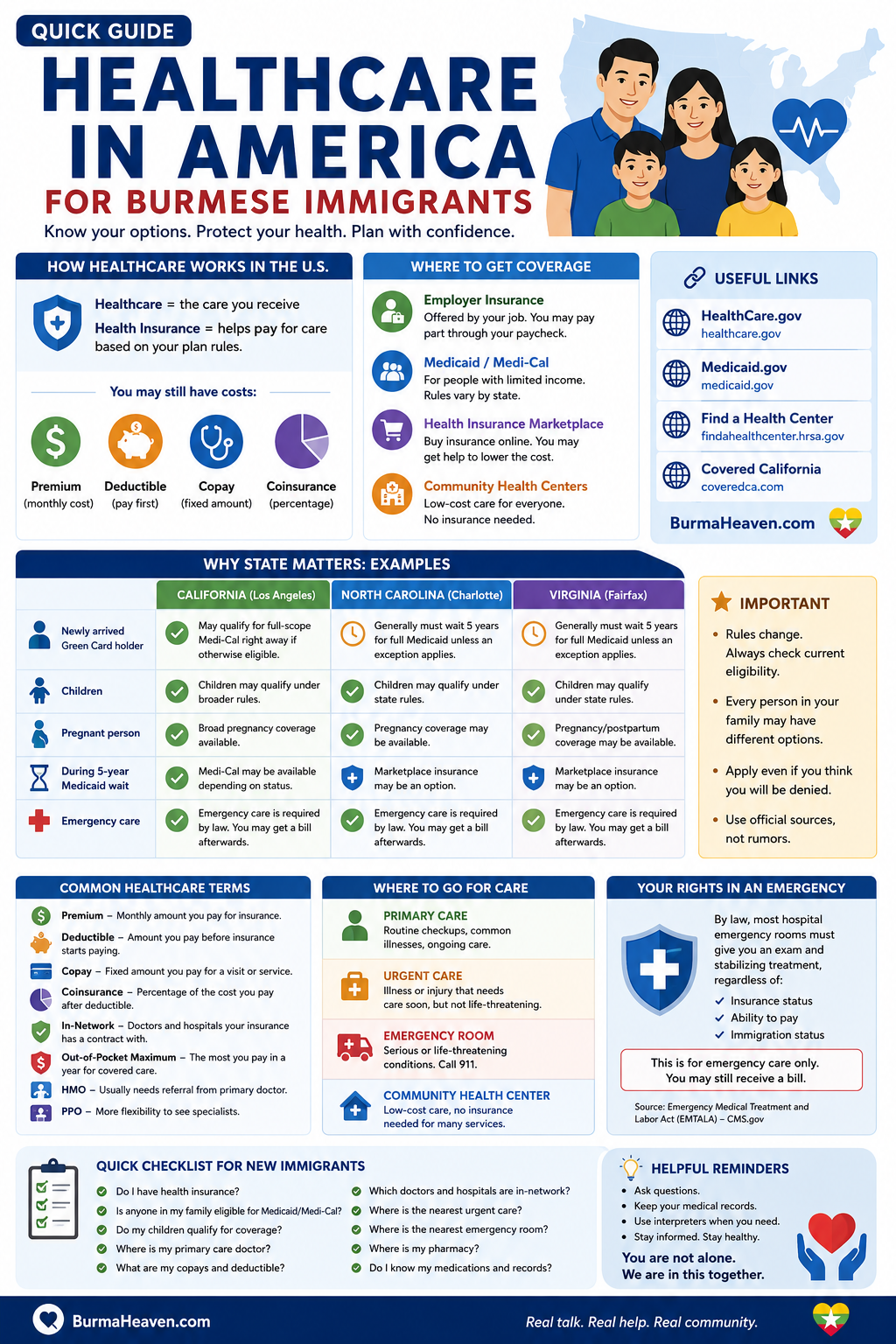
Healthcare in America for Burmese Immigrants
Healthcare in the United States can be one of the most confusing parts of starting a new life in America.
A newly arrived Burmese family may hear words such as:
Medi-Cal. Medicaid. Marketplace. Premium. Deductible. Copay. HMO. PPO. Primary-care doctor. Urgent care. Emergency room.
The rules can be especially confusing because healthcare eligibility is not identical in every state.
A newly arrived Green Card holder in California may qualify for full-scope Medi-Cal if otherwise eligible, while a similar Green Card holder in North Carolina or Virginia may generally face the federal five-year Medicaid waiting period unless an exception applies.
That means two Burmese families with very similar immigration histories can receive very different answers simply because they live in different states.
For a broader newcomer checklist covering Social Security, banking, schools, work, housing, taxes, and other first-year issues, see BurmaHeaven’s First Year in America.
Health Insurance and Healthcare Are Not the Same Thing
Healthcare means the medical services a person receives.
Health insurance is a financial arrangement that helps pay for some of those services according to the rules of the insurance plan.
Having health insurance does not mean every medical service is free.
A person may still have to pay:
- Monthly premiums
- Deductibles
- Copays
- Coinsurance
- Prescription costs
- Charges for out-of-network care
Understanding these basic terms can prevent expensive surprises.
BurmaHeaven’s Money Terms Every New Immigrant Should Understand also explains insurance, deductibles, interest, W-2s, 1099s, taxes, and other financial terms commonly encountered in the United States. A practical guide to healthcare for Burmese immigrants covering Medi-Cal, Medicaid, Marketplace insurance, the federal 5-year rule, free and low-cost clinics, emergency care, insurance terms, and state-by-state differences.
Immigration Status Matters
The question is not simply:
“Can immigrants get Medicaid?”
A more useful question is:
“Can someone with this immigration status, living in this state, with this income and family situation qualify?”
Healthcare eligibility can depend on:
- Immigration status
- State of residence
- Income
- Household size
- Age
- Pregnancy
- Disability
- How long a person has held qualifying immigration status
- Whether the person entered as a refugee or asylee
- Whether the state uses state-only funds to provide additional coverage
A Green Card holder, refugee, asylee, child, pregnant person, or humanitarian entrant may all face different eligibility rules.
The Federal Five-Year Medicaid Rule
Under federal law, many qualified noncitizens, including many lawful permanent residents, are generally subject to a five-year waiting period before becoming eligible for federally funded Medicaid, assuming they otherwise meet program requirements.
There are important exceptions.
Refugees and asylees have historically been exempt from the ordinary five-year waiting period, and states may also choose to remove the waiting period for certain lawfully residing children and pregnant people.
Official federal information:
HealthCare.gov — Coverage for Lawfully Present Immigrants
The five-year rule is only part of the story, because states can adopt broader coverage rules.
Example: Newly Arrived Green Card Holder in Los Angeles, California
Consider a Burmese immigrant who arrives in Los Angeles through family immigration.
The person:
- Has a Green Card
- Recently entered the United States
- Has very little income
- Has not lived in the United States for five years
Under the ordinary federal Medicaid rules, that person might appear to be subject to the five-year waiting period.
California is different.
California uses state funds to provide full-scope Medi-Cal to some lawful permanent residents and other qualifying immigrants who are not yet eligible for federally funded Medicaid because of the five-year bar. Current California guidance continues to identify lawful permanent residents as potentially eligible for full-scope Medi-Cal if they otherwise meet the program’s requirements.
That means a newly arrived low-income Green Card holder in Los Angeles should not automatically assume that five years of U.S. residence are required before applying for Medi-Cal.
Los Angeles County residents can apply through BenefitsCal, by telephone, or through the Department of Public Social Services.
Official resources:
Los Angeles County DPSS — Medi-Cal
Important California Change Beginning in 2026
California expanded full-scope Medi-Cal in previous years, including coverage for many adults regardless of immigration status.
Beginning January 1, 2026, California changed eligibility for some adults without satisfactory immigration status.
New adult applicants age 19 or older who do not have a qualifying immigration status may no longer qualify for the same state-funded adult expansion that was previously available.
However, lawful permanent residents, refugees, asylees, children, pregnant people, and certain other categories may still qualify under different rules.
For that reason, outdated statements such as:
“Everyone in California can get full Medi-Cal regardless of immigration status.”
should not be relied on.
Current eligibility should always be checked directly with California Medi-Cal or the county administering the application.
Example: Newly Arrived Green Card Holder in North Carolina
Now consider the same immigrant living in North Carolina.
The person has:
- The same Green Card
- The same income
- The same age
- The same family circumstances
- The same recent arrival date
North Carolina generally follows the federal five-year waiting period for most lawful permanent resident adults.
The North Carolina Department of Health and Human Services states that most lawful permanent residents must meet the five-year waiting period before becoming eligible for full Medicaid, unless an exception applies.
Official resource:
North Carolina Medicaid — Immigration Status and Eligibility
So a newly arrived Burmese Green Card holder in Charlotte may receive a very different Medicaid decision from a similar immigrant living in Los Angeles.
Example: Newly Arrived Green Card Holder in Virginia
Virginia provides another example of how state rules differ.
A newly arrived adult lawful permanent resident in Virginia generally faces the federal five-year waiting period before qualifying for full Medicaid, unless an exception applies.
Virginia Medicaid identifies lawful permanent residents as generally subject to the five-year requirement while also recognizing exceptions for certain immigration categories and circumstances.
Official resource:
Virginia Medicaid — Information for Noncitizens
The same newly arrived Burmese immigrant could therefore receive three different answers:
Los Angeles, California: may qualify for full-scope Medi-Cal if otherwise eligible.
North Carolina: may generally face the five-year Medicaid waiting period.
Virginia: may generally face the five-year Medicaid waiting period.
This is why healthcare advice from friends or relatives in another state should never be treated as a nationwide rule.
What If Medicaid Is Not Available Yet?
Being in the Medicaid five-year waiting period does not necessarily mean going without health insurance for five years.
Lawfully present immigrants may be eligible to purchase insurance through the Health Insurance Marketplace and may qualify for premium tax credits or other savings depending on household income and circumstances.
For example:
A newly arrived Green Card holder in North Carolina may not yet qualify for full Medicaid.
However, the person may still be able to enroll in a Marketplace plan through HealthCare.gov.
Official resource:
The five-year Medicaid waiting period and Marketplace eligibility are separate issues.
Children Can Have Different Eligibility Than Their Parents
Immigrant families should never assume that if a parent is ineligible for Medicaid, the children are also ineligible.
States can provide Medicaid or CHIP coverage to lawfully residing children without applying the ordinary five-year waiting period.
For example, a household could include:
Father: newly arrived Green Card holder
Mother: newly arrived Green Card holder
Child: 8 years old
The parents may still be subject to the five-year Medicaid waiting period in their state, while the child may qualify for Medicaid or CHIP under separate rules.
North Carolina and Virginia both provide broader eligibility rules for certain lawfully residing children.
Each family member should be evaluated separately.
Pregnant Immigrants May Have Different Rules
Pregnancy can also change healthcare eligibility.
States have flexibility to provide Medicaid or CHIP coverage to pregnant people who would otherwise face immigration-related restrictions.
Virginia, for example, provides pregnancy and postpartum coverage under rules that are broader than ordinary adult Medicaid eligibility.
California also provides pregnancy-related Medi-Cal coverage under broader immigration eligibility rules.
A newly arrived immigrant who is pregnant should therefore not assume that the standard five-year Medicaid waiting period automatically applies.
Refugees and Asylees May Be Treated Differently
This distinction is especially relevant to Burmese communities because many people from Myanmar have entered the United States through refugee or asylum pathways.
Refugees and asylees have historically been exempt from the ordinary five-year Medicaid waiting period that applies to many lawful permanent residents.
That means two Burmese families may have completely different healthcare eligibility even when both recently arrived.
For example:
Family A: entered through an F4 sibling immigrant visa.
Family B: entered as refugees.
Both families may live in the same city and have similar income, but their eligibility may differ because their immigration classifications are different.
For immigration-stage information, see BurmaHeaven’s My Immigration Journey.
Medicaid, Medi-Cal, and CHIP
Medicaid is a joint federal-state healthcare program for certain low-income individuals and families.
Each state administers its own program within federal rules.
That means the name and eligibility rules may differ.
California calls its Medicaid program:
Medi-Cal
North Carolina calls its program:
NC Medicaid
Virginia uses:
Virginia Medicaid
The basic federal-state structure is similar, but eligibility is not identical.
Official federal information:
CHIP: Health Coverage for Children
The Children’s Health Insurance Program, or CHIP, provides low-cost or free health coverage to eligible children whose families may not qualify for Medicaid.
Eligibility rules vary by state.
Children may qualify even when their parents do not.
For immigrant families, this makes it especially important to check coverage separately for every child.
Official federal information:
Medicaid.gov — CHIP Eligibility
Marketplace Health Insurance
People who do not receive affordable insurance through an employer may be able to purchase coverage through the Affordable Care Act Marketplace.
Depending on the state, enrollment happens through:
- HealthCare.gov
- A state-operated Marketplace
California operates its own Marketplace:
Covered California
Official California resource:
Covered California — Information for Immigrants
North Carolina residents generally use HealthCare.gov.
Virginia currently also uses Virginia’s Insurance Marketplace rather than HealthCare.gov, so residents should follow current state enrollment instructions.
Example: Husband Has Employer Insurance but Family Coverage Is Expensive
A Burmese family arrives in America and the husband gets a job.
The employer offers health insurance.
The employee-only cost is:
$120 per month
But coverage for the employee, spouse, and children costs:
$850 per month
The family should not automatically assume everyone must use the employer plan.
Depending on income, affordability rules, and state eligibility:
- The employee may remain on the employer plan
- The spouse may have another option
- The children may qualify for Medicaid or CHIP
- Some household members may qualify for Marketplace coverage
A single household can legally have different types of health coverage.
What Is a Premium?
A premium is the amount paid to keep health insurance coverage active.
Example:
Monthly insurance cost: $600
Employer pays: $450
Employee pays: $150
The employee’s share may be deducted directly from each paycheck.
Paying the premium does not mean all medical care is free.
What Is a Deductible?
A deductible is an amount a patient may have to pay toward covered healthcare before the insurance plan begins paying certain costs according to the plan’s rules.
Example:
Plan A
Premium: $100 per month
Deductible: $6,000
Plan B
Premium: $250 per month
Deductible: $1,000
Plan A has the cheaper monthly premium.
That does not automatically make it the cheaper plan overall.
A healthy young adult and a family expecting frequent medical care may make very different choices.
What Is a Copay?
A copay is usually a fixed amount paid for a particular service.
For example:
Primary-care visit: $25
Specialist: $50
Urgent care: $75
These are examples only.
Actual costs depend on the insurance plan.
What Is Coinsurance?
Coinsurance is usually a percentage of the allowed medical cost.
Example:
Allowed surgery cost: $10,000
Insurance pays: 80%
Patient coinsurance: 20%
The patient’s portion could be $2,000, depending on deductible, network, and out-of-pocket rules.
This is why a percentage that appears small can still become a large bill.
What Does In-Network Mean?
Health insurance companies negotiate with specific doctors, hospitals, laboratories, pharmacies, and other healthcare providers.
Those providers are considered in-network.
Out-of-network care can cost substantially more or may not be covered at all, depending on the plan.
Before scheduling non-emergency care, ask:
“Are you in-network with my exact insurance plan?”
Do not only ask:
“Do you accept Blue Cross?”
A company may offer many different plans with different networks.
HMO Example
A person with an HMO has knee pain.
The person wants to see an orthopedic specialist.
The plan may require this process:
Primary-care doctor → referral → orthopedic specialist
Going directly to the specialist without following the plan’s referral rules could create coverage problems.
PPO Example
A PPO may offer greater flexibility to see specialists directly or use out-of-network providers.
However, a PPO may also have:
- Higher premiums
- Different deductibles
- Higher out-of-network costs
PPO does not automatically mean better.
The best plan depends on the household’s needs.
Primary Care, Urgent Care, and the Emergency Room
Choosing the correct place for care can save a large amount of money.
Example: Mild sore throat for two days
Usually appropriate:
Primary care or urgent care
Example: Minor cut that may require stitches
Possibly appropriate:
Urgent care
depending on severity.
Example: Severe chest pain and trouble breathing
Appropriate:
911 or emergency room
A true medical emergency should never be delayed simply because of cost concerns.
Emergency Rooms and Uninsured Patients
Federal law provides important emergency-care protections.
Under the Emergency Medical Treatment and Labor Act, or EMTALA, covered hospital emergency departments must provide an appropriate medical screening examination and stabilizing treatment for emergency medical conditions regardless of insurance, ability to pay, or citizenship status.
Official resource:
This does not mean emergency-room care is automatically free.
The patient may still receive a bill afterward.
Example: No Insurance and a Broken Arm
A newly arrived immigrant falls and badly injures an arm.
The person has no health insurance and is afraid to go to the hospital.
If the injury may constitute an emergency medical condition, the hospital emergency department cannot simply deny the federally required emergency screening and stabilizing care because the patient cannot pay or is not a U.S. citizen.
After treatment, the patient can ask about:
- Financial assistance
- Charity care
- Payment plans
Community Health Centers
People without insurance should not automatically use an emergency room for routine medical care.
Federally qualified health centers and other community health centers provide primary care in communities across the United States.
HRSA-supported health centers generally provide care regardless of insurance status and use sliding-fee systems based on ability to pay.
Official locator:
Example
A person has no insurance but needs:
- Blood-pressure follow-up
- Diabetes management
- Routine medication
- Basic primary care
A community health center may be a much more appropriate and affordable starting point than an emergency room.
Public Charge and Healthcare
Fear about the immigration “public charge” rule has caused some immigrant families to avoid healthcare programs.
Current HealthCare.gov guidance states that applying for or receiving Medicaid, CHIP, or Marketplace financial assistance generally does not make someone a public charge. Certain government-funded long-term institutional care can be treated differently.
Immigration policies can change, so current USCIS guidance should always be checked when public-charge concerns are relevant to a specific immigration case.
A blanket statement such as:
“If you get Medicaid, you will lose your Green Card.”
is not accurate.
Primary-Care Doctor
A primary-care doctor, often called a PCP, handles routine medical care.
Typical visits may include:
- Annual physicals
- Blood-pressure checks
- Diabetes management
- Cholesterol monitoring
- Routine illnesses
- Preventive care
- Medication management
- Referrals to specialists
Some insurance plans require members to select a primary-care doctor.
Specialists
A specialist focuses on a particular area of medicine.
Examples include:
Cardiologist — heart
Dermatologist — skin
Gastroenterologist — digestive system
Neurologist — brain and nervous system
Orthopedist — bones and joints
Psychiatrist — mental health
Endocrinologist — hormones and conditions such as diabetes
Some insurance plans require a referral before a specialist visit.
Prescriptions and Generic Medicine
Prescription drug prices can vary significantly.
When a doctor prescribes medication, ask:
“Is there a generic version?”
“Does my insurance cover this?”
“Is there a lower-cost alternative?”
FDA-approved generic drugs generally contain the same active ingredient and must meet federal standards for quality and effectiveness.
A brand-name medication could cost significantly more than an available generic equivalent.
Example: Brand Name vs. Generic
A brand-name medication costs:
$180
A generic version may cost:
$20
when one exists and is medically appropriate.
The exact savings depend on the medication, pharmacy, and insurance plan.
Ask What Tests Will Cost
Non-emergency medical tests can be expensive.
Before receiving a scheduled:
- MRI
- CT scan
- Ultrasound
- Laboratory test
- Procedure
ask:
Is the facility in-network?
Does insurance require prior authorization?
What is the estimated patient cost?
The same test can sometimes have very different prices depending on where it is performed.
Explanation of Benefits
After medical care, the insurance company may send an Explanation of Benefits, often called an EOB.
An EOB is generally not a medical bill.
It commonly shows:
- What the provider charged
- What the insurance company allowed
- What insurance paid
- What the insurer says the patient may owe
The healthcare provider may later send a separate bill.
The two documents should be compared.
Example: A $5,000 Hospital Charge
The hospital charges:
$5,000
The insurance company’s negotiated amount is:
$2,000
Insurance pays:
$1,500
The EOB says the patient owes:
$500
The patient should not automatically pay $5,000 simply because the original hospital charge appears on paperwork.
If the bill does not match the insurance processing, contact the provider and insurer.
Ask for an Itemized Bill
If a medical bill appears unusually high, ask for an itemized bill.
Instead of seeing:
Hospital services — $8,000
the patient can review each individual charge.
This can make billing errors easier to identify.
Federal Protection From Some Surprise Medical Bills
The federal No Surprises Act protects many privately insured patients from certain unexpected out-of-network bills, especially in emergency situations and when some out-of-network services are provided at in-network facilities.
Official resource:
CMS — Know Your Medical Billing Rights
Ask for an Interpreter
Medical English can be difficult even for someone who speaks English well.
Patients who do not understand medical information should say so.
Useful questions include:
“Can I have an interpreter?”
“Can you explain that again?”
“Can you write that down?”
“What are the other treatment options?”
“What happens if I do not have this treatment?”
Pretending to understand medical information can lead to serious mistakes.
Children Should Not Be Used as Medical Interpreters
Children often learn English faster than their parents.
That does not mean they should routinely interpret serious medical information for adults.
A child may misunderstand complicated terminology or be exposed to information that is private, frightening, or inappropriate.
Whenever possible, ask the healthcare provider for qualified language assistance.
Mental Health Is Healthcare
Mental-health conditions are medical issues.
They can include:
- Depression
- Anxiety
- Trauma
- PTSD
- ADHD
- Addiction
- Other emotional or psychiatric conditions
Seeking help does not mean someone is weak or “crazy.”
Mental-health treatment may involve:
- Primary-care doctors
- Therapists
- Psychologists
- Psychiatrists
- Counselors
- Community mental-health clinics
For immediate crisis support in the United States, call or text 988.
Keep Vaccination Records From Myanmar
Vaccination records from Myanmar should be kept even if they are incomplete or written in Burmese.
They may be useful for:
- Primary-care doctors
- Pediatricians
- School enrollment
- Immigration medical examinations
- Future vaccination decisions
BurmaHeaven’s U.S. school guide for Burmese parents also explains school enrollment, vaccinations, grade placement, and parent rights.
Keep Personal Medical Records
Maintain copies of important health information, including:
- Vaccination records
- Medication lists
- Allergies
- Major diagnoses
- Surgery history
- Laboratory results
- Imaging reports
- Insurance cards
- Children’s records
Moving to another state or changing doctors is much easier when the patient already has copies of important records.
Know Every Medication You Take
Do not rely on descriptions such as:
“The small white pill.”
Keep a medication list showing:
- Medication name
- Dose
- How often it is taken
- Why it is taken
Keeping the list on a phone can be especially useful during an emergency.
Do Not Stop Prescription Medication Without Asking
Some medications must be taken continuously or for a specific amount of time.
Feeling better does not always mean a medication should be stopped.
If cost is the problem, tell the doctor or pharmacist.
There may be:
- Generic alternatives
- Lower-cost medications
- Patient assistance
- Different pharmacies
- Other treatment options
Do Not Rely Only on Community Advice
Burmese community networks can be extremely helpful.
A local community member may know:
- A Burmese-speaking doctor
- A clinic accepting Medicaid
- A low-cost dentist
- A pediatrician
- A vaccination clinic
- A health-insurance navigator
- A hospital with financial assistance
That information can be valuable.
But healthcare rules are complicated.
A neighbor may have different:
- Immigration status
- Income
- Age
- State residency
- Pregnancy status
- Length of U.S. residence
What worked for one family may not apply to another.
Community advice is a useful starting point.
Important eligibility questions should still be verified through the government program, insurer, healthcare provider, or official website.
Healthcare Rules Vary by State
This is one of the most important lessons for immigrant families.
California
California often provides broader immigrant healthcare eligibility than the federal minimum.
A newly arrived lawful permanent resident may qualify for full-scope Medi-Cal without waiting five years if all other eligibility requirements are met.
North Carolina
Most newly arrived lawful permanent resident adults generally face the federal five-year waiting period unless an exception applies.
Virginia
Most newly arrived lawful permanent resident adults generally face the federal five-year waiting period unless an exception applies.
Children and pregnancy
The rules may be broader.
A child or pregnant person can sometimes qualify even when another adult member of the same household does not.
Never assume one family member’s decision determines everyone else’s eligibility.
Quick State Comparison
| Situation | California | North Carolina | Virginia |
|---|---|---|---|
| Newly arrived low-income adult Green Card holder | May qualify for full-scope Medi-Cal if otherwise eligible | Generally subject to five-year wait unless exempt | Generally subject to five-year wait unless exempt |
| Lawfully residing child | Broader coverage may be available | May qualify under child-specific rules | May qualify under child-specific rules |
| Pregnant person | Broader pregnancy coverage | Special pregnancy eligibility can apply | Special pregnancy/postpartum eligibility can apply |
| Marketplace during Medicaid wait | Available if otherwise eligible | Available if otherwise eligible | Available if otherwise eligible |
| Emergency care | Emergency protections and certain programs may apply | Emergency protections and certain programs may apply | Emergency protections and certain programs may apply |
These examples do not guarantee eligibility. Income, immigration classification, household circumstances, and current state law still matter.
Healthcare Checklist for New Immigrants
During the first few months in America, every household should try to answer these questions:
- Does every family member have health coverage?
- Is anyone eligible for Medicaid or Medi-Cal?
- Does the five-year rule apply?
- Do the children qualify separately?
- Does pregnancy change eligibility?
- Is Marketplace insurance available?
- What is the monthly premium?
- What is the deductible?
- What are the copays?
- What is the out-of-pocket maximum?
- Which doctors are in-network?
- Which urgent care is in-network?
- Which hospital is in-network?
- Who is the primary-care doctor?
- Where is the nearest pharmacy?
- Where are vaccination records stored?
- What medications does each person take?
- How can an interpreter be requested?
Learning these answers before an emergency can make healthcare much easier to navigate.
One Important Rule About Healthcare in America
Do not simply ask:
“Can immigrants get healthcare?”
Ask:
“What coverage can someone with my immigration status, income, age, and family situation qualify for in the state where I live?”
That question leads to a much more accurate answer.
A Burmese immigrant in California may have options that a Burmese immigrant in North Carolina does not.
A child may qualify when a parent does not.
A refugee may qualify differently from someone who arrived through family immigration.
A pregnant person may have broader eligibility than another adult.
The American healthcare system is complicated, but the basic strategy is simple:
Know your status. Know your state. Check each family member separately. Use official sources. Ask questions.
For other newcomer topics, continue with First Year in America.
For insurance, deductibles, taxes, credit, and other financial terminology, see Money Terms Every New Immigrant Should Understand.
For immigration-stage guidance, use My Immigration Journey.
For families still preparing to move to the United States, begin with Start Here.
Healthcare rules change. Always verify current eligibility with the official state or federal program before making a financial or medical decision.
How to Apply for Medi-Cal in Los Angeles County
Medi-Cal is California’s Medicaid program. It provides free or low-cost health coverage to people who meet eligibility requirements. California allows applications at any time of year; there is no annual open-enrollment period for Medi-Cal.
Step 1 — Gather Basic Information
Before applying, gather information for everyone in the household who is applying.
Useful documents may include:
- Identification
- Immigration documents, if applicable
- Social Security numbers, if applicable
- California address
- Household information
- Recent pay stubs
- Tax return if available
- Employer income statement
- Social Security, unemployment, or disability benefit information
- Information about existing health insurance
California says applicants can sometimes self-attest to income when normal proof is unavailable, including some cash-income situations.
Step 2 — Go to BenefitsCal
For Los Angeles County, the easiest online route is BenefitsCal.
Create an account and choose the option to apply for benefits.
Select Medi-Cal.
BenefitsCal can also be used later to upload documents, check notices, report changes, and renew benefits. California DHCS lists BenefitsCal as an official Medi-Cal application partner.
Step 3 — Enter Household Information
The application will ask about things such as:
- Who lives in the household
- Birth dates
- Relationships
- Income
- Employment
- Tax filing
- Immigration/citizenship information where relevant
- Current insurance
Answer for the actual household situation.
Do not assume every person in the family has to qualify under the same rule. A child, pregnant person, refugee, or recently arrived Green Card holder may have different eligibility from another adult in the same home.
Step 4 — Submit the Application
Review everything and submit it.
Save:
- Confirmation number
- Screenshots or PDF copies
- Any notices
- Copies of documents uploaded
This becomes especially useful if something later disappears or the county says it did not receive a document.
Step 5 — Watch for Requests From LA County DPSS
Los Angeles County DPSS may ask for additional verification.
Respond quickly.
Medi-Cal says normal eligibility determinations may take up to 45 days, or up to 90 days for certain disability-based applications.
Step 6 — Read the Notice of Action
The county sends an eligibility decision called a Notice of Action.
Do not throw this away.
It will tell you whether Medi-Cal was:
- Approved
- Denied
- Pending additional information
- Approved under a particular type of coverage
If something appears incorrect, contact DPSS.
Step 7 — If You Need Help, Call LA County
Los Angeles County DPSS currently lists:
Customer Service Center: 866-613-3777
You can apply by phone or request an application. You can also apply in person at a DPSS district office.
Step 8 — Choose a Medi-Cal Health Plan
Once approved, Los Angeles County Medi-Cal members generally receive information about choosing a managed-care plan.
Current LA County options include plans such as L.A. Care and Health Net, depending on eligibility and circumstances.
California says members generally receive a choice packet and normally have 30 days to choose before a plan may be assigned.
Step 9 — Choose a Doctor
After plan enrollment, choose a primary-care provider.
Do not wait until someone gets sick.
Know:
- Primary doctor
- Pediatrician
- Nearest urgent care
- Nearest emergency room
- Pharmacy
Another Way to Apply: Covered California
A person can also start through Covered California.
If the information indicates Medi-Cal eligibility, the application can be routed to Medi-Cal. If Medi-Cal is not available, Covered California may show private insurance options.
No Insurance? Look for Community Health Centers
This should be a big box on your page because “free healthcare” is rarely one universal program.
The better wording is:
Free or Low-Cost Healthcare
Federally supported community health centers treat people with or without health insurance. HRSA says these centers provide medical and dental care and charge on a sliding scale based on ability to pay.
National locator:
HRSA — Find a Health Center Anywhere in the U.S.
That is probably the single most valuable nationwide healthcare link for a newly arrived Burmese family without insurance.
Free or Low-Cost Healthcare in 10 Major Burmese U.S. Cities
Important: Most of these programs are free or sliding-scale, not automatically free for every person. Income, household size, insurance status, and services received can affect the charge.
| Burmese community | Free / low-cost healthcare resource | What newcomers should know |
|---|---|---|
| St. Paul, Minnesota | Open Cities Health Center | Federally Qualified Health Center with medical, dental, behavioral health and other services. Sliding-fee discounts are based on income and family size, and interpreter services are available. |
| Fort Wayne, Indiana | Alliance Health Centers | Offers primary care, pediatrics, OB/GYN and behavioral healthcare. Sliding-fee discounts are available to qualifying patients, and the clinic states it serves people regardless of ability to pay. |
| New York City, New York | NYC Care | One of the strongest programs on this list. NYC Care provides low- or no-cost care through NYC Health + Hospitals for qualifying NYC residents who cannot get or afford insurance. Fees can start at $0, and immigration status is not asked for eligibility. |
| Milwaukee, Wisconsin | Milwaukee Free & Low-Cost Clinics | The city maintains a current list of free and low-cost clinics, including community health centers and the Saturday Clinic for the Uninsured. |
| Omaha, Nebraska | OneWorld Community Health Centers | Serves uninsured and underinsured patients and offers sliding-fee discounts based on income and family size. OneWorld also specifically states it serves people regardless of immigration status or ability to pay. |
| Buffalo, New York | Neighborhood Health Center | Uninsured and underinsured patients can apply for a sliding-fee program based on household income and size. The center says patients are not turned away simply because they lack insurance. |
| Utica, New York | Upstate Family Health Center | Offers a Community Discount Program for qualifying uninsured and underinsured patients. Discounts are based on household income. |
| Bowling Green, Kentucky | Fairview Community Health Center | Particularly useful for BH: Fairview offers sliding-scale care and specifically lists Burmese and several Myanmar ethnic-language interpretation options. It says patients are not refused because they cannot pay, though a nominal charge may apply. |
| Des Moines, Iowa | Primary Health Care Iowa | Multiple Des Moines locations provide medical, dental, behavioral-health and other services. Uninsured patients can use a sliding-fee discount program, and the organization states patients are not turned away solely because of inability to pay. |
| Tulsa, Oklahoma | Morton Comprehensive Health Services | Federally Qualified Health Center offering medical, dental and vision services. Uninsured patients can qualify for sliding-fee discounts, and Morton says nobody is denied primary care because of insurance status or inability to pay. |
Don’t see your city? Use the federal HRSA Health Center locator. There are more than 16,000 health-center service sites around the country, and patients can receive care whether or not they have insurance. Costs are adjusted according to ability to pay.
Find a Community Health Center Near You
“Free clinic” does not always mean every service costs $0. Some clinics provide completely free care, while others use sliding-scale fees based on income and household size. Call before visiting and ask: “I do not have insurance. Do you have a sliding-fee program, and what documents should I bring?”