
Culture Shock in America for Burmese Immigrants

Culture shock for Burmese immigrants can show up in everyday life through food, clothing, communication, family expectations, school, work, holidays, and social customs.
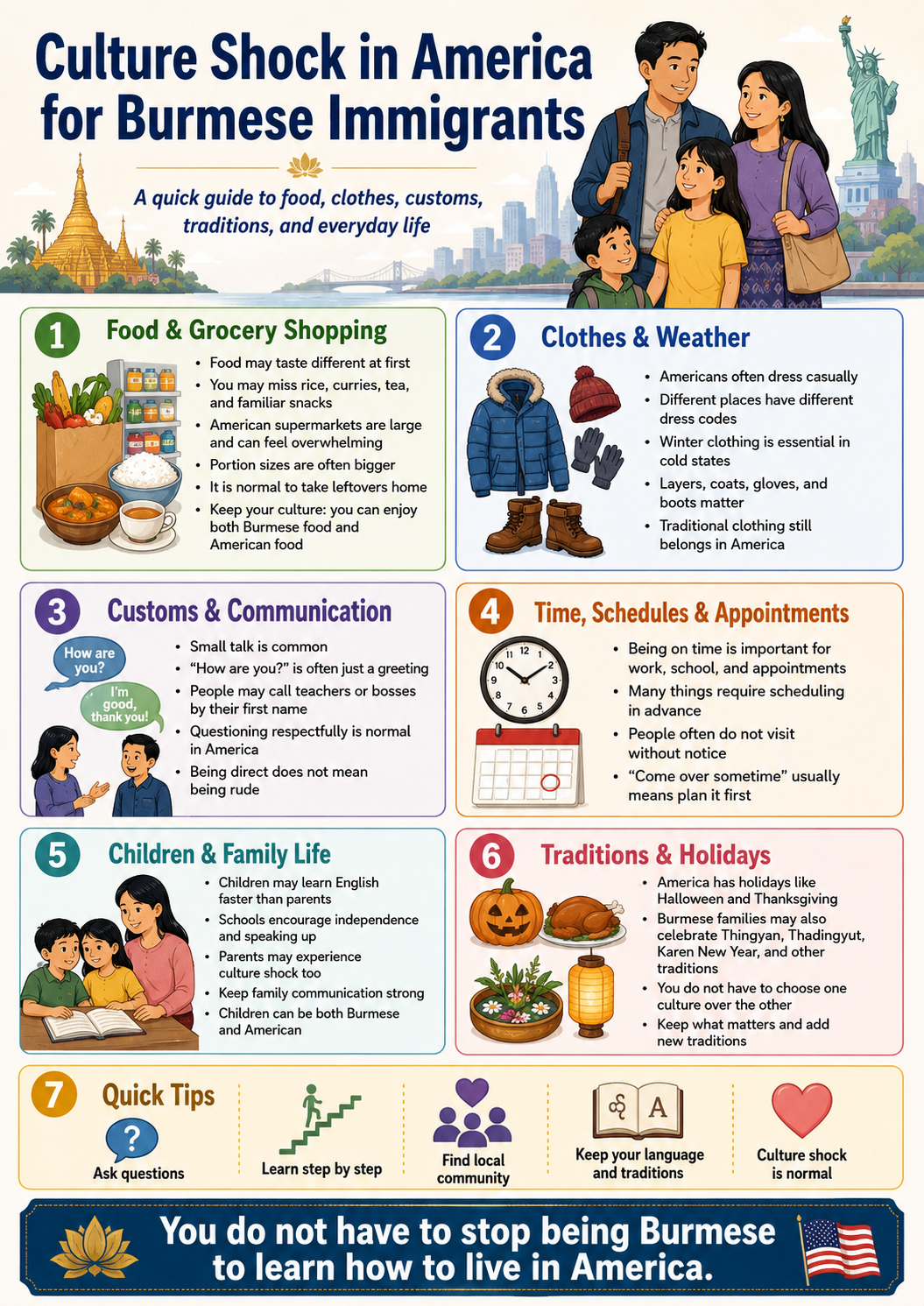
Understanding Culture Shock for Burmese Immigrants in America
Moving to the United States is not only an immigration process.
It is a cultural adjustment.
You may understand that America speaks English, uses dollars, and drives on the right side of the road. But many of the hardest adjustments are smaller things nobody warns you about:
Food tastes different.
Clothes are different.
People talk to elders differently.
Children question adults more openly.
Coworkers may call the boss by a first name.
People schedule almost everything.
Americans may smile and say hello to strangers but never become close friends.
Your children may begin acting “American” much faster than you expected.
You may suddenly miss foods, sounds, people, routines, and traditions you barely thought about while living in Myanmar.
Culture shock does not mean something is wrong with America or Myanmar.
It means your brain is learning an entirely different environment.
For families who have recently arrived, BurmaHeaven’s First Year in America covers the practical side of settling in, including Social Security, healthcare, schools, work, money, housing, and everyday life.
This page focuses on something less visible:
How life can feel different.
America May Not Feel Like the America You Imagined
Many people build an image of America before they ever arrive.
Movies show:
- Large houses
- Nice cars
- Shopping
- Freedom
- Good jobs
- Beautiful cities
- Successful families
Then reality arrives.
Rent is expensive.
People work long hours.
Childcare costs money.
Healthcare is complicated.
Family members may live hours away.
Neighbors may barely know each other.
A study involving Burmese refugee communities found that some newcomers had imagined the United States as an almost idealized place before resettlement and then experienced frustration when employment, healthcare, and everyday survival were much harder than expected.
That disappointment itself can be culture shock.
America can offer tremendous opportunity.
But opportunity and difficulty can exist at the same time.
Food May Be One of the First Things You Miss
Food is not just something we eat.
Food is family.
Food is memory.
Food is culture.
Food is home.
Research involving Karen refugees from Burma found that traditional food, gardening, cooking, and eating together remained important ways families preserved cultural identity after moving to the United States.
For many families from Myanmar, familiar foods may include:
- Rice
- Curries
- Mohinga
- Laphet thoke
- Ngapi
- Fish
- Soups
- Noodles
- Fresh herbs
- Chili
- Fermented foods
- Tropical vegetables
- Burmese snacks
Then suddenly someone takes you to an American supermarket.
There are 40 kinds of cereal.
Twenty kinds of bread.
An entire aisle of frozen dinners.
But somehow you cannot find the one vegetable you actually want.
Research on refugee food adaptation found that Burmese refugees, particularly early after resettlement, sometimes had difficulty finding familiar foods.
That experience has changed somewhat as Burmese communities have grown.
Cities with large Burmese populations now often have:
- Burmese grocery stores
- Asian supermarkets
- Community gardens
- Restaurants
- Facebook food sellers
- Temple or church food events
But smaller cities may still have limited options.
Rice Is Not Weird
One older cultural orientation guide for refugees from Burma observed that rice was a staple across many ethnic communities from Myanmar and that a rice cooker was considered practically essential in many homes.
That sounds obvious to Burmese families.
But children growing up in America may eventually encounter classmates who ask:
“Why do you eat rice every day?”
The answer can simply be:
Because that is what our family eats.
Immigrant children do not need to choose between pizza and mohinga.
They can eat both.
American Food Portions Can Be Huge
One immediate surprise can be portion size.
A restaurant meal may be much larger than what one person would normally eat at home.
That does not mean everything needs to be finished.
Taking leftovers home is extremely normal in the United States.
If a server asks:
“Do you want a box?”
they mean a container for the remaining food.
Nobody thinks it is strange.
Tipping Can Be Confusing
Restaurants introduce another American custom:
tipping.
At many full-service restaurants, customers normally leave a gratuity for the server in addition to the menu price.
You may also encounter tipping at:
- Hair salons
- Nail salons
- Taxi or rideshare services
- Food delivery
- Hotels
- Bars
- Other personal services
Then you will encounter a tablet asking:
18% — 20% — 25%
for something that took ten seconds.
Welcome to America.
Tipping customs can vary by service, and not every tip screen means a tip is legally required.
American Food Is Not One Culture
Another adjustment is realizing there really is no single “American food.”
The United States contains enormous regional and immigrant influences.
Depending on where you live, everyday food might include:
- Mexican
- Chinese
- Korean
- Indian
- Thai
- Vietnamese
- Italian
- Middle Eastern
- Ethiopian
- Southern
- Cajun
- Soul food
- Tex-Mex
- Burgers
- Barbecue
A Burmese family in Los Angeles may have a completely different food environment from a Burmese family in rural Iowa.
Clothing Can Be a Bigger Adjustment Than Expected
Most people from Myanmar already know Western clothing.
Jeans and T-shirts obviously are not mysterious.
The bigger adjustment can be understanding when Americans wear what.
American clothing is often highly informal.
People may wear:
- Shorts to the supermarket
- Leggings almost anywhere
- Sweatpants outside the house
- Athletic clothes without exercising
- Sandals
- Pajama-looking clothing on a school drop-off
Someone who expects people to dress formally in public may be surprised.
At the same time, workplaces, schools, religious organizations, weddings, interviews, and formal events can have completely different expectations.
When unsure, ask:
“What is the dress code?”
Winter Clothing Is Not Optional
This becomes serious for families arriving in:
- Minnesota
- Indiana
- New York
- Wisconsin
- Nebraska
- Iowa
People arriving from Myanmar, Thailand, Malaysia, or refugee camps may understand that America gets cold but not fully understand what below freezing feels like.
Older refugee-resettlement guidance specifically documented difficulty adjusting to winter clothing among refugees from Burma, including the need to learn the importance of socks, winter footwear, coats, hats, and gloves.
A hoodie is not a Minnesota winter coat.
Children may need:
- Insulated coat
- Gloves
- Hat
- Warm socks
- Boots
- Layers
Snow can look beautiful through a window.
Driving in it is another matter.
Traditional Clothing Still Belongs in America
Karen, Chin, Kachin, Shan, Mon, Bamar, Karenni, Zomi, Rohingya, and other Myanmar communities have distinctive clothing traditions.
Traditional clothing may still appear at:
- New Year celebrations
- Weddings
- Church
- Temple
- Cultural festivals
- Community gatherings
- Graduation celebrations
- Religious ceremonies
CDC cultural materials describing Karen communities specifically note the continued importance and symbolism of traditional clothing.
Wearing American clothing does not erase your culture.
Wearing traditional clothing does not mean you have failed to assimilate.
Both can belong in the same closet.
Taking Shoes Off Can Become a Cultural Negotiation
Many Burmese households remove shoes before entering the living area.
Many American households do too.
Others do not.
So you may visit someone’s house and watch them walk across the carpet wearing outdoor shoes and think:
What are you doing?
There is no national American rule.
If you are visiting someone’s home, follow the host.
In your own home, make whatever rule you want.
You are allowed to have an American address and a Burmese shoe policy.
Respect for Elders Can Feel Very Different
Respect for older people is strongly emphasized in many Myanmar families.
A U.S. State Department cultural guide to Myanmar describes age hierarchy and respect for elders as important elements of Burmese etiquette.
Research comparing caregiving practices in Myanmar and the United States has similarly described Burmese parents emphasizing respect for authority, including teaching children not to interrupt adults.
American culture generally places more emphasis on:
individual expression
and
speaking for yourself.
That can produce serious culture shock.
A Burmese parent may hear an American child say:
“I disagree.”
and think:
How dare you talk to an adult like that?
An American teacher may hear the same sentence and think:
Good — the child explained their opinion respectfully.
Neither culture necessarily views respect the same way.
Questioning Authority Is Much More Normal
This is one of the biggest adjustments for many immigrant families.
In America, questioning someone does not automatically mean disrespect.
People question:
- Teachers
- Principals
- Doctors
- Employers
- Government employees
- Police procedures
- Banks
- Insurance companies
- School districts
The tone matters.
But asking:
“Why?”
“Can you explain that?”
“Where is that written?”
“Can I have a copy?”
“Who can review this decision?”
is normal.
This principle comes up repeatedly throughout BurmaHeaven because it affects schools, healthcare, employment, immigration, and money.
For workplace examples, see BurmaHeaven’s Work Culture in America for Burmese Immigrants guide.
For families with children, the U.S. School System for Burmese Parents guide explains why parents sometimes need to question placement, credits, special-education decisions, or other school decisions.
Americans May Call Their Boss by Their First Name
Another strange moment can happen at work.
The CEO walks into the room.
Everyone says:
“Hey, Mike.”
To someone from a more hierarchical environment, that can sound disrespectful.
American workplaces vary enormously, but first-name culture is common even between employees and supervisors.
That does not necessarily mean hierarchy disappeared.
Mike can still fire you.
The language is simply more informal.
Americans Say “How Are You?” Without Expecting the Full Answer
This one confuses people.
Someone says:
“Hi, how are you?”
Often the expected response is simply:
“Good, how are you?”
It may function more like a greeting than a genuine request for a detailed health and family update.
Of course, with close friends the question can be genuine.
Context matters.
Small Talk Is Part of American Social Life
Americans frequently talk casually about:
- Weather
- Traffic
- Weekend plans
- Sports
- Children
- Work
- Television
- Vacations
This is called small talk.
For someone learning English, it may seem pointless.
But small talk often serves a social purpose.
It helps strangers or coworkers establish comfort before discussing anything important.
Useful phrases can be extremely simple:
“How was your weekend?”
“Crazy weather today.”
“How long have you worked here?”
You do not need perfect English.
Personal Space Can Be Different
Americans often maintain more physical space between themselves and strangers than people in some other cultures.
Standing extremely close in line can make someone uncomfortable.
Americans may also be highly sensitive about:
- Touching strangers
- Touching someone’s child
- Asking personal questions
- Looking through someone’s belongings
- Showing up at someone’s home without notice
Again, these norms vary by family, region, age, and personality.
“Come Over Anytime” May Not Literally Mean Anytime
This is an important one.
Someone may say:
“You should come over sometime!”
That usually means:
We should arrange something.
It does not necessarily mean:
Arrive at my house tomorrow at 7:00 without calling.
American social life is often heavily scheduled.
People schedule:
- Dinner
- Children’s playdates
- Coffee
- Birthday parties
- Meetings
- Doctor appointments
- Visits with friends
For immigrants from communities where people regularly stop by family homes, that can feel distant.
Time Is Treated Differently
American culture places significant importance on punctuality in many settings.
If a job begins at 8:00 a.m., arriving at 8:15 is generally not considered approximately on time.
If a doctor’s appointment is at 10:00, the office may expect arrival before 10:00 for paperwork.
If a school says pick-up is at 2:30, parents are expected to follow the schedule.
Social events may be more flexible depending on the group.
But for:
- Work
- Interviews
- School
- Medical appointments
- Government appointments
being on time matters.
Independence Is Encouraged Very Early
American children are often encouraged to become independent.
Depending on age, they may be expected to:
- Choose clothes
- Express preferences
- Order their own food
- Talk to teachers
- Complete schoolwork independently
- Choose college majors
- Move away for college
- Find jobs
- Eventually live independently
Many Burmese families place greater emphasis on family obligation and collective decision-making.
Research involving young Karen refugees in America identified both filial obligation and community commitment as important values while young adults simultaneously adapted to U.S. expectations.
That creates negotiation rather than a simple choice between two cultures.
Your Children May Become American Faster Than You Do
This can become one of the biggest sources of family conflict.
Children attend American schools for six or seven hours every day.
They hear English.
They make American friends.
They learn slang.
They watch American media.
They understand school culture.
Soon they may correct their parents’ English.
Then they begin saying:
“But everyone else’s parents let them.”
Welcome to immigrant parenting.
Research on recently resettled Karen families has noted this difference: younger people often develop English proficiency much faster than adults, affecting family relationships and cultural adjustment.
Do Not Make Your Child the Adult of the Family
When children learn English faster, parents can become dependent on them.
The child may begin translating:
- Bills
- School letters
- Medical appointments
- Government paperwork
- Work documents
Sometimes that is unavoidable for small everyday matters.
But a child should not become responsible for running the family’s adult systems.
Parents should gradually learn how to:
- Request interpreters
- Use translation tools
- Call agencies
- Access online accounts
- Speak with schools
- Understand bills
The child can help.
The child should not become the parent.
Keeping Burmese Language Can Become Harder Than Expected
Many immigrant parents assume:
“Of course my children will speak Burmese.”
Then English slowly takes over.
Children answer Burmese questions in English.
Vocabulary disappears.
Eventually grandparents and grandchildren cannot fully communicate.
Research on resettled refugees from Burma consistently finds cultural identity and community connection important during adjustment.
Keeping Burmese or another family language may require deliberate effort.
That might include:
- Speaking the language at home
- Burmese books
- Burmese movies
- Calling grandparents
- Religious/community programs
- Burmese language classes
- Visits to Myanmar when feasible
- Cooking together
- Teaching family stories
Bilingualism does not require rejecting English.
Children can have both.
Religion Can Feel Different Too
Myanmar is religiously diverse.
Families may be:
- Buddhist
- Christian
- Muslim
- Hindu
- Animist
- Other traditions
- Nonreligious
Religious communities often become extremely important after immigration because temples, churches, mosques, and community organizations provide more than worship.
They may provide:
- Friends
- Translation
- Employment leads
- Food
- Transportation
- Childcare
- Cultural events
- Help with paperwork
- Emotional support
For many immigrant families, religious institutions become part of the social safety net.
American Religious Life Can Also Surprise You
The United States has strong religious communities, but religion is also treated as highly personal.
People may openly practice different religions in the same workplace or school.
Some people practice no religion at all.
Children may have classmates who are:
- Christian
- Muslim
- Jewish
- Hindu
- Buddhist
- Sikh
- Atheist
- Agnostic
Religious diversity is part of American life.
Dating Can Cause Serious Family Conflict
This can be particularly difficult between immigrant parents and American-raised children.
American teenagers may encounter:
- Dating
- School dances
- Prom
- Boyfriends/girlfriends
- Mixed-gender friendships
Parents may have completely different expectations around:
- Dating age
- Sex
- Marriage
- Curfews
- Clothing
- Privacy
- Relationships
Ignoring the subject does not make American dating culture disappear.
Families usually do better when expectations are discussed clearly rather than only after conflict begins.
Privacy Is a Major American Value
American children and adults may expect more individual privacy.
Examples:
- Bedroom privacy
- Phone privacy
- Medical privacy
- Financial privacy
- Personal mail
- Personal decisions
American law also recognizes privacy in many institutional settings.
This can feel strange in families where information normally belongs to everyone.
Family culture can remain close while still understanding that American schools, doctors, employers, and government agencies may have legal privacy obligations.
Leaving Home at 18 Is Not Actually a Rule
Immigrants sometimes hear:
“American parents kick children out at 18.”
That is not some universal American law or custom.
Many American young adults:
- Live with parents through college
- Return home after college
- Remain home while saving money
- Live with family because housing is expensive
Multigenerational households are also increasingly common.
A Burmese family does not need to force an 18-year-old out simply to become “American.”
Elder Care Can Feel Very Different
Many Burmese families expect adult children to care for aging parents.
America has more institutional systems surrounding aging:
- Retirement communities
- Assisted living
- Nursing homes
- Home-health aides
- Medicare
- Social Security
- Long-term care
That does not mean American families do not care about parents.
It means the structure can be different.
Immigrant families often combine both systems.
Mental Health May Be One of the Biggest Cultural Adjustments
In some Burmese communities, mental health can carry significant stigma.
Someone may think:
Therapy is for crazy people.
Research involving refugees from Burma found barriers including limited understanding of mental health, language difficulties, stigma, and differences in cultural beliefs about treatment.
But American healthcare treats mental health as part of health.
People seek professional help for:
- Depression
- Anxiety
- Trauma
- PTSD
- Grief
- Addiction
- ADHD
- Family conflict
- Stress
Seeking therapy does not automatically mean someone has a severe psychiatric illness.
BurmaHeaven’s healthcare guide explains more about navigating Healthcare in America for Burmese Immigrants.
Loneliness Can Surprise You
Myanmar can feel crowded.
Family is nearby.
Neighbors know each other.
People stop by.
America can feel physically enormous and socially lonely.
You may have a:
bigger house
but fewer people inside it.
A person can move to America, earn more money, own a car, and still feel lonely.
Research on Burmese refugee resettlement repeatedly identifies community networks as important for navigating both practical and emotional challenges.
That is one reason connecting with local Burmese communities can matter enormously.
Holidays Suddenly Change
America introduces a new calendar.
Children may quickly become excited about:
- Halloween
- Thanksgiving
- Christmas
- Valentine’s Day
- Easter
- Fourth of July
Meanwhile parents may want to preserve:
- Thingyan
- Thadingyut
- Tazaungdaing
- Karen New Year
- Chin National Day
- Kachin celebrations
- Religious festivals
- Other ethnic/community traditions
You do not necessarily have to choose.
An immigrant household can celebrate Thanksgiving and Thingyan.
Culture can expand rather than disappear.
Halloween Can Be Extremely Strange the First Time
Imagine explaining this tradition objectively:
Children wear costumes.
They knock on strangers’ doors after dark.
The strangers give them candy.
Normally every part of that sentence would sound like something parents should prevent.
Yet on Halloween it is completely ordinary.
Children may hear:
“Trick or treat!”
and receive candy from participating homes.
Parents should still supervise children appropriately and follow neighborhood safety practices.
Thanksgiving Is Not a Religious Requirement
Thanksgiving is a major American holiday celebrated on the fourth Thursday of November.
Many families gather and eat:
- Turkey
- Stuffing
- Potatoes
- Cranberry sauce
- Pie
Immigrant families frequently modify it.
A Burmese Thanksgiving table might have:
turkey + rice + curry + spicy fish + mohinga.
That is still Thanksgiving.
Personal Choices Are More Visible
American culture tends to place strong emphasis on individual choice.
People openly choose:
- Careers
- Partners
- Religion
- Clothing
- Political views
- Where to live
- Whether to marry
- Whether to have children
Families still influence those choices.
But adults generally have substantial legal and social autonomy.
That can feel very different from family-centered cultures where decisions are treated as collective.
Saying “No” Is More Acceptable
A Burmese newcomer may agree to something because refusing feels rude.
American communication can be more direct.
It is acceptable to say:
“No, thank you.”
“I can’t make it.”
“I’m not comfortable with that.”
“I need to think about it.”
You do not always need an elaborate excuse.
This becomes particularly important at work.
Being polite does not require agreeing to everything.
You May Need to Become More Direct
American institutions often reward people who clearly state what they need.
For example:
Instead of:
“Maybe perhaps if possible somebody could look at this.”
say:
“I believe this bill is incorrect. Can you review it?”
Instead of staying silent when a school places a child incorrectly:
“Can you explain how this placement was determined?”
Instead of quietly accepting a payroll problem:
“My hours are incorrect. I worked 46 hours, not 40.”
Direct does not have to mean rude.
Driving Changes Everyday Life
In many American cities, especially outside New York, driving is practically necessary.
A supermarket might be four miles away.
School might be six miles away.
Work might be twenty miles away.
Public transportation varies dramatically.
A Burmese family living in New York City may function easily without a car.
A Burmese family living in suburban Indiana may find life extremely difficult without one.
That itself is culture shock.
Everything Requires an Account
Modern American life seems to require:
an app
a password
a username
a verification code
for everything.
School.
Doctor.
Bank.
Insurance.
Utility company.
Employer.
Government.
Restaurant.
Parking.
Keeping control of your own accounts is part of becoming independent in America.
Do not allow one relative or community helper to remain the only person who knows how to access your important accounts.
Customer Service Culture Can Feel Different
In America, customers are often expected to complain when something is wrong.
Wrong restaurant order?
Say something.
Incorrect charge?
Ask.
Package never arrived?
Contact the company.
Insurance denied something incorrectly?
Appeal.
Immigrants who are uncomfortable complaining can lose money simply because they remain silent.
Being respectful and speaking up can happen at the same time.
Returns Can Be Surprisingly Easy
Many American retailers have generous return policies.
Depending on the store, an item may be returnable if:
- Wrong size
- Defective
- Unwanted
- Purchased accidentally
Keep receipts and learn the store’s policy.
Do not automatically keep something simply because you already paid for it.
Sales Tax Can Surprise Newcomers
A shelf says:
$9.99
Then the cashier says:
$10.87.
Nothing went wrong.
In many U.S. locations, sales tax is added at checkout rather than included in the displayed price.
The tax rate varies by state and locality.
Some states do not have a general statewide sales tax.
American Prices Often Hide the Final Cost
This happens everywhere.
Hotel:
$150
plus taxes and fees.
Phone plan:
$40
plus taxes and charges.
Apartment:
$2,000
plus utilities, parking, insurance, and other expenses.
Restaurant:
Menu price + tax + tip.
Healthcare:
Nobody knows until three companies send paperwork six weeks later.
Learning to ask:
“What is the total cost?”
is a useful American survival skill.
America Is Huge
Another cultural adjustment is distance.
Someone says:
“My sister lives nearby.”
Nearby may mean:
45 minutes away.
A family trip may involve driving eight hours.
California alone is larger than many countries.
This affects:
- Family visits
- Community
- Work
- Schools
- Housing
- Healthcare
Where you live matters enormously.
Burmese America Is Not One Community
People from Myanmar include many ethnic, linguistic, and religious communities.
Someone may identify primarily as:
- Bamar/Burmese
- Karen
- Karenni
- Chin
- Zomi
- Kachin
- Shan
- Mon
- Rohingya
- Rakhine
- Another ethnic identity
Experiences can differ dramatically.
Culture shock can also occur inside the Burmese diaspora when people who had little interaction in Myanmar suddenly live in the same American city.
BurmaHeaven’s community resources include organizations serving multiple Myanmar ethnic communities because there is no single Burmese-American experience.
You Do Not Have to Choose Between Burmese and American
This may be the most important lesson.
Adjustment does not require:
Myanmar culture OUT → American culture IN
Research on young refugees from Burma found strong cultural pride and a desire to maintain traditions and community connections while also pursuing education, careers, and opportunities in America.
A healthier model can be:
Keep what matters.
Learn what helps.
Change what no longer works.
Add new traditions.
Your children can:
Speak English.
Speak Burmese.
Eat hamburgers.
Eat mohinga.
Celebrate Halloween.
Celebrate Thingyan.
Respect grandparents.
Question a school decision.
Go to an American university.
Wear traditional clothing at a community celebration.
None of these things have to cancel the others.
Culture Shock Often Happens in Stages
There is no exact schedule, but immigrants commonly experience something like:
Stage 1 — Everything Is New
America feels exciting.
Stores are interesting.
The roads seem enormous.
Everything is different.
Stage 2 — Everything Is Annoying
Why does healthcare work like this?
Why does everything require an appointment?
Why does nobody visit?
Why does food taste different?
Why does my child argue with me?
Why is everything expensive?
Stage 3 — Things Become Normal
You know which grocery store has the food you want.
You know which doctor to call.
You understand school emails.
You complain when the bill is wrong.
You know how to drive there without GPS.
Stage 4 — You Build Your Own Version of America
Eventually, the question may no longer be:
“Should I live Burmese or American?”
It becomes:
“Which parts of both belong in my family’s life?”
Practical Culture-Shock Checklist for New Burmese Immigrants
During your first year, give yourself time to learn:
- American food and grocery shopping
- Tipping
- Restaurant customs
- Weather and seasonal clothing
- Workplace dress codes
- Punctuality
- Small talk
- Personal space
- Appointment culture
- School expectations
- Questioning authority respectfully
- Children’s independence
- Privacy expectations
- American holidays
- Driving and transportation
- Customer-service culture
- Healthcare communication
- Mental-health resources
- American banking and bills
- Local Burmese community resources
Nobody learns all of this immediately.
When You Miss Myanmar
There may be days when you miss:
The food.
The weather.
The noise.
Your family.
Your friends.
The language.
The smell after rain.
The tea shop.
The temple.
The church.
The market.
People who understood your jokes without explanation.
That does not mean you failed to adjust.
And loving your new life does not mean you stopped loving the old one.
Migration creates something strange:
Eventually, you may have pieces of home in two countries.
Build Community
One of the strongest protections against isolation is community.
Research involving Burmese and Karen refugee communities repeatedly identifies family, community support, faith, and cultural traditions as important parts of successful adaptation.
Connect with:
- Burmese organizations
- Karen/Karenni organizations
- Chin/Zomi organizations
- Kachin organizations
- Temples
- Churches
- Mosques
- Community centers
- Cultural associations
- Local families
But remember that not every useful community network exists online.
Some of the most helpful people may simply be longtime residents who know how everything works.
Keep Learning America Without Losing Myanmar
Culture shock becomes easier when you stop expecting yourself to understand everything immediately.
The United States is not something you memorize.
You experience it.
You make mistakes.
You ask questions.
You learn.
Eventually things that once seemed strange become ordinary.
Then one day a newly arrived Burmese family asks you:
“Why did the restaurant charge more than the menu price?”
and you casually explain sales tax.
That is when you realize how much you learned.
For practical newcomer information, continue with First Year in America.
For employment expectations and immigrant job networks, read Work Culture in America for Burmese Immigrants.
For insurance, doctors, Medicaid, Medi-Cal, and medical costs, see Healthcare in America for Burmese Immigrants.
For families with children, continue to U.S. School System for Burmese Parents.
And if you are still preparing to move to the United States, begin with Start Here.
You do not have to stop being Burmese to learn how to live in America. The goal is not to erase where you came from. It is to understand where you are now while deciding what you want to carry forward.
🇺🇸 Is This Normal in America?
Choose something that happened and get a plain-English explanation of the custom, what it may mean, and when you should ask more questions.