
Work Culture in America for Burmese Immigrants

Work Culture in America for Burmese Immigrants
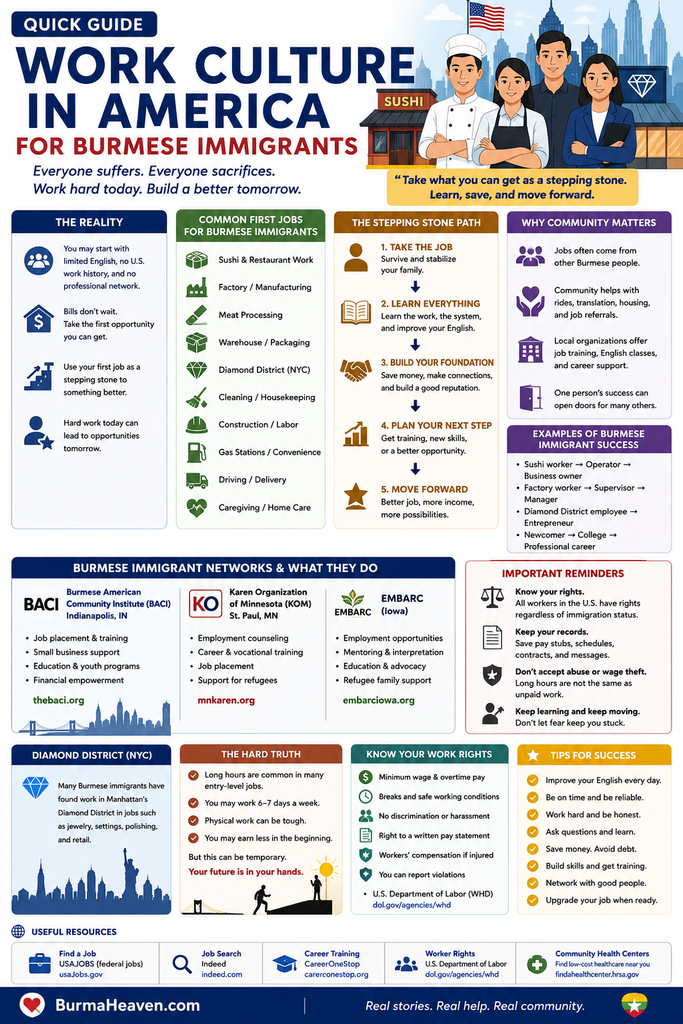
For many Burmese immigrants, the first job in America is not the job they dreamed about.
It is the job they can get.
You may arrive with limited English, no American work history, no professional network, and no idea how hiring works in the United States. Even if you had education, professional experience, or a respected job in Myanmar, American employers may not immediately understand your qualifications.
Rent does not wait while you figure everything out.
Food does not wait.
Bills do not wait.
So many immigrant families do what immigrants have always done:
Take the first opportunity. Work hard. Learn the system. Build a reputation. Then move forward.
Your first job can be a stepping stone.
It does not have to be your final destination.
If you recently arrived in the United States, BurmaHeaven’s First Year in America guide covers the other systems newcomers encounter at the same time, including Social Security, healthcare, banking, schools, housing, and taxes.
Why Burmese Immigrants Often Find Work Through Other Burmese People
One of the strongest resources immigrants have is community.
Someone already living in America may know:
A restaurant owner who needs help.
A factory that is hiring.
A sushi company looking for workers.
A jewelry business that needs employees.
A warehouse with openings.
A manager who does not require perfect English.
Sometimes there is one person in the community who has helped dozens of newcomers find employment.
That person may not work for a nonprofit.
They may not have a website.
They may simply have a good reputation.
This kind of informal employment network is not unique to Burmese immigrants, but research on Burmese refugees shows how important community connections are when language and unfamiliar American systems create barriers.
A study of Burmese refugee experiences found that people frequently used community networks as bridges to American institutions and services, especially when language created barriers.
Formal Burmese organizations now perform similar work.
The Burmese American Community Institute in Indianapolis, for example, operates employment and microenterprise programs that help newcomers with job placement, training, and small-business development.
The Karen Organization of Minnesota has employment counselors who help refugees apply for jobs, interpret during orientations, communicate with employers, and move into career training.
And Iowa’s EMBARC, founded by refugees from Burma, specifically connects refugee families with employment opportunities, mentoring, interpretation, education, and other resources.
Community networks are not simply social.
For many newcomers, they are part of the employment system.
Why So Many Burmese Immigrants Ended Up Making Sushi
This one is real.
There is actually documented research and reporting on the unusually strong connection between Burmese immigrants and grocery-store sushi businesses in the United States.
Researcher Tammy Ho has described sushi entrepreneurship as one of three important employment patterns she identified among refugees from Burma, alongside meat processing and refugee/community farming.
One reason sushi became accessible to newly arrived Burmese workers was practical:
You could learn the work without being fluent in English.
Ho traced part of the industry’s growth to Burmese immigrant entrepreneur Philip Maung, who learned the grocery-store sushi business in California and later founded Hissho Sushi in North Carolina.
The company grew by training and employing other newcomers from Myanmar.
According to Indiana Public Media’s reporting on Ho’s research, the model spread through the Burmese community because sushi preparation could be taught relatively quickly, did not initially require strong English, and could eventually lead from worker to operator or business owner.
That pattern created something powerful:
One Burmese immigrant learned the business.
Then another Burmese person learned from him.
Then another.
Eventually an informal employment pathway developed.
From Sushi Worker to Business Owner
This did not always remain low-wage employment.
For some Burmese immigrants, sushi became a path into entrepreneurship.
The Fiscal Policy Institute documented the case of Burmese refugee Gam Aung, who moved from operating one grocery-store sushi counter to three and then trained other Burmese immigrants to operate counters themselves.
Another Indianapolis Burmese entrepreneur described working for a sushi company for nearly eight years before saving enough to open his own Burmese restaurant.
His description of those early years was brutal: he said he worked seven days a week and for years essentially had only Christmas Day off.
That story captures both sides of immigrant employment.
The first job may be extremely difficult.
But sometimes the knowledge, money, contacts, and confidence gained there become the foundation for something better.
Employee → experienced worker → operator → business owner.
That is the stepping-stone idea in its clearest form.
Burmese Workers in New York’s Diamond District
New York developed another unusual Burmese employment network:
Manhattan’s Diamond District.
NYC’s Endangered Language Alliance notes that members of New York’s Burmese community have found work in the Diamond District.
There are also individual documented examples.
Myo Lin Thway, who later founded Burmese Bites, came to New York from Burma in the 1990s, completed a mechanical-engineering degree, and worked as a manager in Manhattan’s Diamond District before eventually starting his own food business.
So when older Burmese New Yorkers talk about Burmese people working in the Diamond District, that is not simply community folklore.
There is evidence of that employment connection.
What I cannot find is reliable data showing exactly how many Burmese people worked there or what percentage of New York’s Burmese population entered the jewelry trade.
So BurmaHeaven should say:
Some Burmese immigrants in New York developed employment connections in Manhattan’s Diamond District.
not:
Most Burmese New Yorkers worked in the Diamond District.
That distinction keeps the page credible.
Factory and Manufacturing Work
Another heavily documented employment path for refugees from Myanmar has been manufacturing.
Early refugee-resettlement studies found newly arrived Karen refugees being placed in assembly and manufacturing jobs, often because the work could be learned despite limited English.
The Karen Organization of Minnesota still offers career preparation in fields such as:
- Manufacturing
- Construction
- Warehouse work
- Commercial driving
- Healthcare
- Interpreting and translation
That tells an important story.
The first generation may begin on the factory floor.
But community organizations increasingly try to help people move from simply getting a job to developing a career.
Meatpacking Became a Major Employment Path
Research is especially strong here.
Burmese, Karen, and Karenni refugees have been heavily represented in meat-processing employment in parts of:
- Indiana
- Minnesota
- Iowa
- South Dakota
- Colorado
Academic research documented Karen and Karenni refugees working in a Tyson pork-processing plant in Logansport, Indiana, including Burmese workers who traveled from Fort Wayne for the jobs.
A University of Northern Iowa study found Burmese refugees moving within Iowa partly because of employment opportunities in meatpacking. In Marshalltown, participants were particularly concentrated in meatpacking, while refugees in Waterloo had access to somewhat more varied employment.
Earlier research on Karen resettlement in Minnesota similarly found that many employed participants or their spouses worked in meatpacking facilities in Minnesota, Iowa, or South Dakota.
This is a classic example of what economists sometimes call an immigrant employment niche.
Once one community establishes a connection with an employer, new arrivals hear about the opportunity.
Then relatives move.
Friends move.
People tell each other:
“They are hiring.”
Eventually a workplace can develop a significant Burmese or Karen workforce.
Why Employers Recruit Refugees
There is an uncomfortable side to this.
Employers often praise refugees as:
Hardworking. Reliable. Willing to work.
Those qualities are positive.
But researchers have also warned that those same stereotypes can make refugee workers vulnerable.
Recent academic work examining refugee employment in meatpacking and manufacturing describes how employers can perceive refugees as particularly desirable for physically demanding jobs because they are considered hardworking and unlikely to complain.
That can turn:
“Burmese people are hard workers.”
into:
“Burmese workers will tolerate conditions other workers won’t.”
Those are very different statements.
Hard work should create opportunity.
It should not become permission for exploitation.
The Pressure to Become Self-Sufficient Quickly
Refugees in particular historically entered an American resettlement system designed around relatively fast economic self-sufficiency.
That can mean newcomers feel pressure to take whatever employment becomes available rather than spending years retraining for the profession they had before migration.
Research on Burmese refugee employment describes this pressure as one factor pushing refugees toward readily available jobs in industries such as:
- Meatpacking
- Warehouses
- Manufacturing
- Hotel cleaning
- Food processing
A doctor, teacher, government employee, engineer, or business owner from Myanmar may therefore arrive in America and initially work in a factory.
That does not necessarily mean their skills disappeared.
It means the first American labor market did not know what to do with those skills yet.
English Can Determine Which Doors Open First
Language is one of the biggest reasons newcomers become concentrated in particular jobs.
Imagine two jobs.
Job A
Requires:
- Constant customer communication
- Telephone calls
- Written reports
- Interviews
- Professional English
Job B
Requires:
- Learning a physical process
- Following demonstrations
- Repetition
- Limited customer interaction
For someone who has been in America for three weeks, Job B is much easier to enter.
That does not mean the person is less intelligent.
It means the language requirement is lower.
EMBARC specifically notes that refugees from Burma who had professional skills and experience sometimes struggled to find employment because of language barriers and limited opportunities.
The Karen Organization of Minnesota therefore combines job placement with English-access support, orientation interpretation, and career training.
Your First American Job May Be Below Your Ability
This is extremely common in immigrant communities.
You may have been:
A teacher in Myanmar.
An engineer.
A government worker.
An accountant.
A nurse.
A business owner.
Then you arrive in America and someone offers you:
$15 an hour packaging food.
It can feel humiliating.
But sometimes the first job is simply the bridge between:
Survival
and
Opportunity.
The important thing is not to confuse your starting point with your value.
Take the First Opportunity — But Keep Looking Forward
There is nothing wrong with taking a job because you need money immediately.
Most immigrants do not arrive wealthy enough to wait six months for the perfect position.
The first job can give you:
Income
American employment history
References
English practice
Transportation money
Credit history
Knowledge of American workplaces
Connections
Then the question becomes:
What is next?
The Danger Is Getting Stuck
The stepping-stone strategy only works if there is another step.
Sometimes fear keeps immigrants in the same job for years.
The worker thinks:
My English isn’t good enough.
Nobody else will hire me.
At least I know this employer.
My friend got me this job.
What if the next place is worse?
That can turn temporary survival employment into permanent limitation.
One reason organizations such as the Karen Organization of Minnesota now offer career pathways in construction, commercial driving, healthcare, manufacturing, and interpreting is to help immigrant workers move beyond initial job placement.
The Burmese Community Can Become Your Employment Network
Community networks can be extremely powerful.
One person learns about a factory.
They tell their brother.
The brother tells his cousin.
The cousin tells someone at church.
Suddenly ten people from the same community work there.
Then somebody becomes a supervisor.
Someone else learns payroll.
Another becomes a manager.
Eventually the company realizes:
We should hire a Burmese-speaking HR employee.
That has actually happened.
Reporting from Fort Wayne described businesses with growing immigrant workforces hiring bilingual Burmese employees in human resources to support their workforce.
That is how immigrant labor networks evolve.
Community Networks Can Also Create Businesses
The process can eventually move beyond employment.
A worker learns:
How the business works.
Where supplies come from.
How customers behave.
How pricing works.
How employees are managed.
Then they think:
Why am I doing this for somebody else?
That is part of the reason ethnic entrepreneurship grows.
The Burmese sushi story is a good example.
One successful operator trained other Burmese workers.
Some eventually operated their own counters.
Some opened restaurants.
Some created completely different businesses.
Community knowledge became business knowledge.
But Community Employment Can Also Create Exploitation
Community trust has another side.
If your cousin tells you:
“This owner is Burmese. He will take care of you.”
you may trust that employer much more than a stranger.
That can be wonderful.
It can also make exploitation easier.
New immigrants may tolerate:
- Very long hours
- Unpaid overtime
- Incorrect payroll
- Cash payments without clear records
- Missing breaks
- Unsafe work
- Verbal abuse
- Wage theft
because they feel indebted to the person who hired them.
A Burmese employer is still an employer.
A family friend is still an employer.
A person who helped you get your first job is still subject to labor law.
Hard Work Does Not Mean Accepting Everything
Many immigrant families take pride in sacrifice.
There is nothing wrong with that.
Parents work two jobs.
People live with relatives.
Couples work opposite shifts.
Someone drives an hour to a factory because that is where the job is.
Someone works sushi seven days a week while saving money.
People sacrifice because they are trying to build something.
But sacrifice should have a purpose.
Survive → stabilize → learn → improve.
It should not become:
Suffer forever because you are afraid to leave.
Learn American Workplace Rules Early
An immigrant who knows American workplace rules has more power than an immigrant who only knows how to work hard.
Learn:
- Minimum wage
- Overtime
- Pay stubs
- Payroll deductions
- W-2 vs. 1099
- Workplace safety
- Workers’ compensation
- Unemployment insurance
- Discrimination laws
- How to document hours worked
The U.S. Department of Labor provides worker-rights information and says its Wage and Hour Division protects workers under the laws it enforces without regard to immigration status.
Official resource:
U.S. Department of Labor — Worker Rights
BurmaHeaven’s Money Terms Every New Immigrant Should Understand explains W-2s, 1099s, taxes, interest, insurance, and other financial terms that become important once someone begins working in America.
Keep Your Pay Records
Save:
- Pay stubs
- Work schedules
- Time sheets
- Text messages about shifts
- Employment contracts
- Cash-payment records
- Tax documents
- W-2 forms
- 1099 forms
Do not rely entirely on the employer’s records.
If there is ever a wage dispute, your own records can become very important.
Do Not Let Someone Else Control Your Career Forever
It is normal to depend heavily on other Burmese people when you first arrive.
Someone may:
Find your job.
Drive you there.
Translate your orientation.
Help fill out your paperwork.
That is community.
But eventually learn to do those things yourself.
Learn how to:
- Search job websites
- Create a resume
- Apply online
- Interview
- Negotiate pay
- Read benefits
- Understand a job offer
- Ask for a raise
- Leave professionally
- Build references
The goal is not to stop relying on the Burmese community.
The goal is to reach the point where you become part of the network helping the next newcomer.
There Is More Than One Burmese American Work Story
It is important not to freeze the community in its refugee-era employment patterns.
Today Burmese Americans work in:
- Healthcare
- Education
- Technology
- Finance
- Government
- Small business
- Restaurants
- Manufacturing
- Transportation
- Construction
- Professional services
- Nonprofits
- Interpretation
- Entrepreneurship
Pew’s 2023 data show Burmese household income and personal earnings have increased substantially from older refugee-resettlement-era figures, although they remain below the Asian-American average.
The community is changing.
The first generation may have built the foundation through sushi counters, factories, restaurants, meatpacking, and long hours.
The next generation does not have to begin in exactly the same place.
Use Burmese Employment Organizations
Burmese and Myanmar ethnic-community organizations across the United States may provide:
- Job placement
- Resume assistance
- Career counseling
- English classes
- Vocational training
- Interpretation
- Small-business support
- Financial coaching
Examples include:
Burmese American Community Institute — Indianapolis
Employment, job training, small-business assistance, education, and newcomer support.
Burmese American Community Institute
Karen Organization of Minnesota — St. Paul
Employment counseling, job placement, career training, CDL preparation, construction pathways, healthcare training, and financial coaching.
Karen Organization of Minnesota
EMBARC — Iowa
Refugee-led organization providing employment opportunities, interpretation, education, advocacy, and community support.
BurmaHeaven’s Find a Burmese Community Near You directory can also be used to locate community organizations and informal networks across the United States.
Remember that many people who help newcomers find jobs do not have websites or official organizations.
Talk to people locally.
A First Job Is a Beginning, Not a Ceiling
Many immigrant success stories look impressive when viewed twenty years later.
What disappears from the story is the beginning.
The shared apartment.
The factory shift.
The seven-day workweek.
The sushi counter.
The night shift.
The bus ride.
The second job.
The broken English.
The fear of asking questions.
The paycheck that finally allowed the family to pay rent.
That beginning matters.
There is no shame in starting wherever someone will give you an opportunity.
But keep moving.
Learn English.
Learn the workplace.
Learn your rights.
Build skills.
Save money.
Ask people how they moved into better positions.
Use community connections.
Apply for jobs that make you uncomfortable.
Take training.
Go back to school if it makes sense.
Start a business if that is your path.
The first job may be what America gives you.
What you build from it can be something completely different.
The Lesson
Immigration often involves sacrifice.
People leave careers, status, family, language, familiarity, and comfort behind.
Then they arrive and sometimes begin at the bottom again.
That can be painful.
But taking a difficult first job does not mean accepting a difficult life forever.
Take what you need to survive. Learn everything you can from it. Build your American experience. Then move when a better opportunity appears.
That first job is a stepping stone.
Do not mistake the stepping stone for the destination.
For broader newcomer guidance, continue to First Year in America, and for payroll, W-2, 1099, tax, credit, and financial basics, visit Money Made Simple.
Minimum wage by state — 2026
General/basic hourly minimum wage in effect as of August 20, 2026. For states without a higher applicable state rate, $7.25 shows the federal FLSA minimum for covered workers.$0$5$10$15$20AlabamaAlaskaArizonaArkansasCaliforniaColoradoConnecticutDelawareFloridaGeorgiaHawaiiIdahoIllinoisIndianaIowaKansasKentuckyLouisianaMaineMarylandMassachusettsMichiganMinnesotaMississippiMissouriMontanaNebraskaNevadaNew HampshireNew JerseyNew MexicoNew YorkNorth CarolinaNorth DakotaOhioOklahomaOregonPennsylvaniaRhode IslandSouth CarolinaSouth DakotaTennesseeTexasUtahVermontVirginiaWashingtonWest VirginiaWisconsinWyoming
New York, Oregon, New Jersey, Ohio and a few other states have regional, employer-size or other special rates. Local minimum wages may also be higher.
2026 Minimum Wage — All 50 States
| State | General minimum wage |
|---|---|
| Alabama | $7.25* |
| Alaska | $14.00 |
| Arizona | $15.15 |
| Arkansas | $11.00 |
| California | $16.90 |
| Colorado | $15.16 |
| Connecticut | $16.94 |
| Delaware | $15.00 |
| Florida | $14.00 |
| Georgia | $7.25* |
| Hawaii | $16.00 |
| Idaho | $7.25 |
| Illinois | $15.00 |
| Indiana | $7.25 |
| Iowa | $7.25 |
| Kansas | $7.25 |
| Kentucky | $7.25 |
| Louisiana | $7.25* |
| Maine | $15.10 |
| Maryland | $15.00 |
| Massachusetts | $15.00 |
| Michigan | $13.73 |
| Minnesota | $11.41 |
| Mississippi | $7.25* |
| Missouri | $15.00 |
| Montana | $10.85† |
| Nebraska | $15.00 |
| Nevada | $12.00 |
| New Hampshire | $7.25 |
| New Jersey | $15.92‡ |
| New Mexico | $12.00 |
| New York | $16.00–$17.00 |
| North Carolina | $7.25 |
| North Dakota | $7.25 |
| Ohio | $11.00§ |
| Oklahoma | $7.25* |
| Oregon | $14.55–$16.80 |
| Pennsylvania | $7.25 |
| Rhode Island | $16.00 |
| South Carolina | $7.25* |
| South Dakota | $11.85 |
| Tennessee | $7.25* |
| Texas | $7.25 |
| Utah | $7.25 |
| Vermont | $14.42 |
| Virginia | $12.77 |
| Washington | $17.13 |
| West Virginia | $8.75 |
| Wisconsin | $7.25 |
| Wyoming | $7.25* |
The rates and exceptions above come from the U.S. Department of Labor’s current state minimum-wage table, updated July 1, 2026.
Important notes : * means the state has no state minimum wage, has a lower state rate, or has special coverage rules, so FLSA-covered workers generally must receive at least the federal $7.25 rate. Georgia and Wyoming technically have state rates of $5.15, but federally covered workers must generally receive $7.25; Oklahoma also has unusual coverage rules.
New York: $17.00 in New York City, Nassau, Suffolk and Westchester counties; $16.00 elsewhere in the state. Oregon: $16.80 Portland metro / $15.55 standard / $14.55 non-urban counties. New Jersey: the general rate is $15.92, while qualifying small and seasonal employers have a $15.23 rate. Ohio: $11.00 for employers meeting the state’s gross-receipts threshold and $7.25 for smaller employers.
Minimum wage can depend on where you work, not just your state. Some cities and counties have minimum wages higher than the state rate, and different rules may apply to tipped workers, minors, certain small employers, agricultural workers, and other occupations. Always check your state and local labor department for the current rate.
Being a new immigrant does not allow an employer to pay you below the minimum wage that legally applies to your job. Immigration status does not erase wage protections under laws enforced by the U.S. Department of Labor.
Official source for readers: U.S. Department of Labor — State Minimum Wage Laws
What Employers Normally Take Out of an Employee’s Paycheck
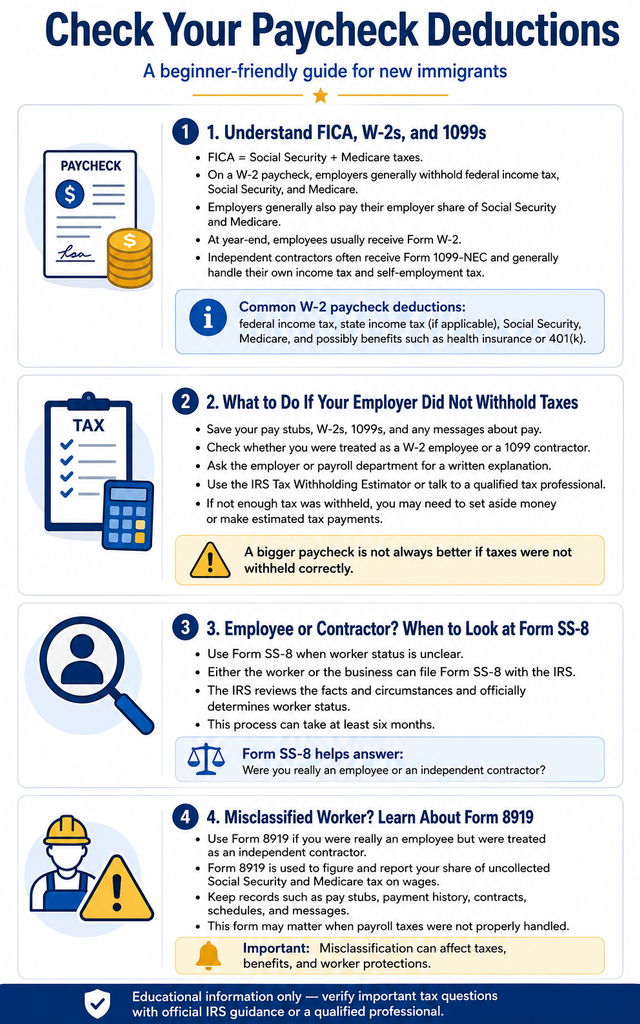
If you are a regular W-2 employee, your gross pay is not usually the same as the amount you take home.
For most employees, the employer generally withholds:
- Federal income tax — based largely on your wages and the information you gave on Form W-4. The amount is not one fixed percentage for everyone.
- Social Security tax — 6.2% of covered wages in 2026, up to the annual Social Security wage base of $184,500.
- Medicare tax — 1.45% of covered wages, with no ordinary wage cap.
- Additional Medicare Tax — an extra 0.9% must be withheld by the employer once that employer pays an employee more than $200,000 in wages during the calendar year.
- State income tax, where the state imposes one and withholding applies.
- Sometimes local income or payroll taxes, depending on the city or locality.
Social Security and Medicare together are commonly called FICA.
The employee’s ordinary FICA share is therefore:
6.2% Social Security + 1.45% Medicare = 7.65%
And the employer generally pays another 7.65% out of the employer’s own money. That employer share is not supposed to come out of your paycheck.
Example: $1,000 Gross Pay
Suppose a W-2 employee earns:
Gross pay: $1,000
Before even considering federal or state income-tax withholding, ordinary employee FICA would generally be:
Social Security: $62.00
Medicare: $14.50
Total FICA deducted:
$76.50
So even before income taxes or optional benefits, the paycheck is already down to:
$923.50
Then federal income tax and possibly state/local income tax may come out too.
That is why:
Gross pay ≠ take-home pay.
What the Employer Pays That You Usually Do NOT See Deducted From Your Check
There are also payroll costs the employer generally pays separately.
For example:
- Employer’s 6.2% Social Security share
- Employer’s 1.45% Medicare share
- Federal unemployment tax, or FUTA
- State unemployment taxes in applicable states
- Workers’ compensation insurance in applicable situations
- Other employer payroll costs
The IRS specifically distinguishes taxes withheld from the employee from taxes paid by the employer.
So if you earn $20 an hour, the employer’s real cost of employing you can be more than $20 an hour.
Then There Are Optional Deductions
This is where a large company like McDonald’s can look very different from a tiny business.
Some deductions are not mandatory government taxes.
They happen because the employee signs up for a benefit or authorizes the deduction.
Examples can include:
- Employee share of health insurance
- Dental insurance
- Vision insurance
- 401(k) retirement contributions
- Health Savings Account contributions
- Flexible Spending Account contributions
- Life insurance
- Disability insurance
- Union dues where applicable
- Certain parking or transit programs
- Other voluntary employee benefits
California, for example, generally allows deductions authorized in writing by the employee for insurance premiums, benefit-plan contributions, or certain other lawful purposes.
Example: McDonald’s vs. a Small Employer
Imagine two people both earn:
$16 per hour
and both work:
40 hours
Their gross weekly pay is:
$640
But their paychecks can look very different.
Worker A — Larger Employer
A worker at a large employer such as McDonald’s might see something like:
Gross pay: $640
Then deductions such as:
- Social Security
- Medicare
- Federal income tax
- State income tax
- Health insurance, if enrolled
- Dental/vision, if enrolled
- 401(k), if participating
- Other elected benefits
The final take-home pay might look much smaller than $640.
But that does not necessarily mean the employer is paying less.
It may mean the payroll system is properly showing taxes and benefits.
Worker B — Tiny Company
Another employee works for a small business earning the exact same:
$640 gross
But the employer hands over a check for almost the whole $640.
At first, the employee may think:
“This job pays so much better!”
But look closely.
If the check shows:
No Social Security withheld
No Medicare withheld
No federal withholding
No state withholding
that is a very different situation.
A bigger check does not automatically mean a better-paying job.
It could mean the employer is not processing payroll correctly, has classified the worker differently, or is not withholding taxes that normally apply to a W-2 employee.
A Bigger Paycheck Can Be an Illusion
This is exactly why newcomers need to look at gross pay and deductions, not just the check amount.
Imagine:
Proper payroll
Gross pay:
$1,000
After taxes:
$820 take-home
Improper or missing withholding
Gross pay:
$1,000
Check received:
$1,000
The second employee might think:
“I make $180 more than that other person.”
Not necessarily.
The second employee may simply be receiving money now that should have been accounted for through payroll withholding.
Then tax season comes.
The IRS calculates the person’s actual tax liability.
And suddenly that employee owes a large amount of money.
The paycheck looked bigger during the year because the tax bill was effectively being pushed into the future.
This Is What Happened to Me at My First Job
When I started my first American job, I already had legal permission to work.
I had my Green Card.
I had my Social Security number.
I was not trying to avoid taxes.
I simply did not understand payroll.
I was young, new to the American workplace, and came from an environment where employees were expected to do what they were told rather than question the person in charge.
My employer gave me checks that looked larger because she was not properly withholding taxes from my pay.
At first, I did not understand what that meant.
Then I filed my tax return.
I owed a large amount of money.
I confronted my employer and was told the problem would be fixed.
It wasn’t.
The following tax year, the same thing happened again.
That experience taught me something I wish someone had explained on my first day of work:
A large paycheck does not tell you whether payroll is being handled correctly. Read the pay stub.
Your W-4 Matters — But the Employer Still Has Payroll Responsibilities
A W-2 employee normally completes Form W-4 so the employer can determine federal income-tax withholding.
The amount withheld can change depending on:
- Income
- Filing situation
- Dependents
- Multiple jobs
- Additional withholding requested
- Other information on the W-4
The IRS says employers generally must use the employee’s W-4 and federal withholding tables to calculate federal income-tax withholding.
A worker can also submit a new W-4 when circumstances change.
Official IRS tool:
Can an Employee Choose to Have No Taxes Taken Out?
Not simply because they feel like it.
There are specific rules for claiming exemption from federal income-tax withholding.
And even when someone legitimately qualifies for exemption from federal income-tax withholding, that does not automatically eliminate Social Security and Medicare taxes.
FICA operates under separate rules.
So if an employer tells a new immigrant:
“You chose not to pay taxes.”
the employee should ask:
Where is my W-4?
What exactly did I select?
Why isn’t Social Security being withheld?
Why isn’t Medicare being withheld?
Am I a W-2 employee or a 1099 contractor?
W-2 vs. 1099 Is a Huge Difference
A legitimate independent contractor generally handles taxes differently from an employee.
A contractor may receive the full payment without employee payroll withholding and then be responsible for paying income and self-employment taxes.
But an employer cannot simply call someone a 1099 contractor because it wants to avoid employee payroll obligations.
Worker classification depends on the actual working relationship and applicable law.
If the company controls when you work, how you do the work, supervises you, and otherwise treats you like an employee, classification may need closer examination.
Things an Employer May Deduct Only Under Certain Conditions
Employers do not have unlimited authority to subtract money from a paycheck.
Federal law limits deductions when they would reduce covered employees below required minimum wage or overtime. For example, employer-benefit items such as certain uniforms, tools, shortages, or business losses cannot simply be shifted to the employee in ways that violate FLSA minimum-wage or overtime protections.
California has even stricter rules.
California says employers generally may make deductions only when:
- Required or permitted by federal/state law;
- Expressly authorized in writing by the employee for lawful items such as insurance or benefit contributions; or
- Authorized under certain collective-bargaining or wage agreements.
So an employer cannot simply decide:
“The register was short $100, so I’m taking $100 from everyone.”
California specifically limits deductions involving shortages, breakage, and lost equipment.
Your Pay Stub Should Tell a Story
Every payday, look for:
Gross wages
Hours worked
Hourly rate
Overtime
Federal withholding
State withholding
Social Security
Medicare
Benefit deductions
Net pay
If something is missing, ask.
If your coworker says:
“Don’t worry about it.”
ask anyway.
If the employer says:
“That’s how we do it here.”
ask what the payroll classification is.
If you are a W-2 employee and there is no FICA withholding appearing over multiple paychecks, that is worth investigating.
McDonald’s Paycheck vs. Small Business Paycheck
Here is the simple lesson I would put in a box on BurmaHeaven:
| Large employer payroll | Small employer with questionable payroll | |
|---|---|---|
| Gross wages | $1,000 | $1,000 |
| Social Security | Deducted | Maybe missing |
| Medicare | Deducted | Maybe missing |
| Federal withholding | Based on W-4 | Maybe missing |
| State withholding | Where applicable | Maybe missing |
| Benefits | May have optional deductions | May offer few/no benefits |
| Pay stub | Usually detailed | May be incomplete |
| Check received | Looks smaller | Looks larger |
| Tax season | Withholding already credited | Worker may suddenly owe much more |
The second worker is not necessarily earning more.
The payroll may simply be hiding the true cost until tax time.
One Rule for Every New Immigrant Worker
Do not compare jobs only by:
“How much is my check?”
Compare:
Hourly wage
Hours
Overtime
Taxes withheld
Benefits
Health insurance
Retirement contribution
Paid time off
Job security
Working conditions
Opportunities to move up
A job producing a smaller paycheck can sometimes have much greater total compensation than a job handing you a larger check with no benefits and incorrect payroll.
And a paycheck that is unusually large because nothing is being withheld is not a gift.
The tax bill may simply be waiting for you later.
Frequently Asked Questions
Let’s talk about work culture in America from the perspective of Burmese immigrants.
For many Burmese newcomers, especially those who arrive with limited English, the first job is often whatever feels accessible and safe. People are scared of making mistakes, scared of interviews, and scared of working somewhere they cannot communicate. That is one reason so many Burmese immigrants have historically ended up in familiar industries such as sushi, restaurants, salons, factories, and, in New York, the Diamond District. In my own circle, almost everyone knew someone who had worked in the Diamond District at some point.
A lot of these jobs come through community reputation and word of mouth. There are trusted people in Burmese communities who seem to know everybody—who is hiring, which employer treats people fairly, where newcomers can get a job quickly. I knew a woman like that who helped place many Burmese people into jobs. She was trusted, and people listened to her because she had built a good reputation. There are people like her in many immigrant communities, even though they may never have an official organization, website, or job-placement title.
Factories also became an entry point. I remember places such as 3M hiring large numbers of newly arrived immigrant workers. The workforce included Burmese workers and immigrants from many other backgrounds. The common denominator was often that people needed work immediately and were willing to do difficult jobs.
And that is where vulnerability comes in.
Having legal immigration papers does not automatically protect someone from exploitation. A new immigrant can have a Green Card, a Social Security number, and complete authorization to work and still have no idea what minimum wage is, what overtime means, what should appear on a pay stub, or what an employer is legally allowed to deduct.
My own family has many stories like this.
About twenty years ago, my brother-in-law worked delivering for a sushi business for around $3 an hour. My aunts started in salons doing laundry and other low-level work before eventually moving up to shampooing customers. Looking back, I sometimes wonder what they tolerated or gave up simply because having a stable job felt more important than challenging the employer.
My mother-in-law also worked for a Burmese-owned store. She was a refugee and was extremely vulnerable as a newcomer. The owner treated her badly and took advantage of the fact that she needed the job. Eventually she received asylum, but during those early years she was simply trying to survive and establish herself.
And my own experience was no different.
One thing I have realized looking back is that many of us did not come from environments where workers were encouraged to question employers. We were taught to work hard, be thankful, keep our heads down, and do what we were told. When everyone around you is another frightened newcomer doing the same thing, unfair treatment can start to feel normal.
That is the part that bothers me most.
Immigrant advocacy often focuses on people who are afraid because of immigration enforcement or uncertain status, and those protections matter. But there is another group that can easily disappear from the conversation: immigrants who entered legally, followed the rules, had permission to work, and were still exploited because they did not understand the system.
Legal status does not teach you labor law.
A Green Card does not teach you how payroll works.
A Social Security card does not teach you how to recognize wage theft.
And being hardworking does not automatically protect you from an abusive employer.
There are probably thousands of stories like the ones in my own family that were never reported. People simply endured the situation, eventually found something better, and moved on.
That is why I think newly arrived Burmese workers need to hear something many of us did not hear when we first came here:
Take the job you need when you are starting out. Use it as a stepping stone. Work hard. Build experience. Learn English. Learn how American workplaces operate. But learn your rights at the same time.
Being grateful for an opportunity does not mean accepting abuse.
Being quiet does not make an employer right.
And having a first job that helped you survive does not mean you owe that employer the rest of your working life.
W-2 vs 1099 Comparison Chart
| Topic | W-2 Employee | 1099 Independent Contractor |
|---|---|---|
| What it means | You are an employee. | You are generally self-employed / in business for yourself. |
| Who controls the work | The company can control what you do and how you do it. | The payer usually controls the result, but not the details of how you do the work. |
| Main IRS idea | If there is an employer-employee relationship, you are generally not an independent contractor. | If you are an independent contractor, you are generally self-employed. |
| Typical year-end form you receive | Form W-2 | Form 1099-NEC (commonly for nonemployee compensation) |
| Federal income tax withholding | Employer generally withholds federal income tax from your wages. | Generally not withheld by the payer. You usually handle your own taxes. |
| Social Security & Medicare tax | Employer generally withholds Social Security and Medicare from your pay. | Your earnings are generally subject to self-employment tax. |
| Employer share of Social Security & Medicare | Employer generally pays the matching employer portion. | No matching employer share in the same W-2 sense; you handle self-employment tax yourself. |
| Federal unemployment tax (FUTA) | Employer generally pays FUTA on wages paid to employees. | Generally not paid by the payer on payments to independent contractors. |
| Employee benefits | Employee-type benefits can exist, such as retirement plan, insurance, vacation pay, etc. | Independent contractors generally are not treated like employees for employee-type benefits. |
| How classification is decided | Based on the real relationship, not just what the company calls you. | Same rule — the label alone does not decide it. |
| If classification is unclear | Business or worker may file Form SS-8 with the IRS for a determination. | Same — business or worker may file Form SS-8. |
| If you think you were misclassified | A misclassified worker may be able to use Form 8919 to report uncollected Social Security and Medicare tax. | Same issue applies if you were wrongly treated as a contractor instead of an employee. |
This chart is based on IRS guidance on independent contractors, employee classification, and employment taxes.【turn683329view0†L103-L108】【turn683329view1†L104-L121】【turn507812view0†L105-L166】
Quick “red flag” signs someone may be treated like a 1099 but might really be an employee
These do not automatically decide classification, but they are the kinds of things the IRS says matter:
- The company controls how the work is done
- The company controls important financial parts of the work
- The worker is treated like part of the business’s normal operations
- The relationship includes employee-type benefits or looks ongoing/long-term
- The worker does work that is a key aspect of the business【turn507812view0†L123-L131】
Important note for audience
A job is not a real 1099 job just because:
- the employer says so,
- no taxes are taken out,
- or the paycheck looks bigger.
The IRS says classification depends on the actual relationship and the degree of control and independence, not just the label used by the employer.【turn507812view0†L123-L131】【turn683329view0†L106-L108】
💼 Is This Job Offer Good?
Compare two job offers side by side. Look beyond the hourly wage and include hours, overtime, commute, health insurance cost, paid time off, retirement match, bonuses, and whether the job is W-2 or 1099.