How Did America End Up Owing China Hundreds of Billions of Dollars?
You have probably heard the phrase:
“America owes China.”
That is true.
But it is often misunderstood.
China does not own America.
China does not own most of America’s national debt.
And the United States government did not simply walk into China and borrow $1 trillion.
What actually happened is much stranger.
For decades, Americans bought enormous quantities of Chinese products.
China accumulated enormous quantities of American dollars.
Then China turned around and used many of those dollars to buy:
U.S. GOVERNMENT DEBT.
In other words:
America bought Chinese products.
China received dollars.
China lent some of those dollars back to America.
America then spent the borrowed money.
That cycle became one of the defining economic relationships of the modern world.
How Much U.S. Debt Does China Actually Own?
As of June 2026, mainland China held approximately:
$633 BILLION
of U.S. Treasury securities.
That is a lot of money.
But total U.S. federal debt has now exceeded roughly:
$40 TRILLION.
So China owns only around:
1.6% OF TOTAL U.S. FEDERAL DEBT.
China is therefore an important creditor.
But it is absolutely incorrect to say:
“China owns America’s debt.”
Most American government debt is held elsewhere.
American investors, banks, pension funds, mutual funds, the Federal Reserve, government trust funds and investors from many other countries hold the rest.
China is only one creditor.
But China Used to Own Much More
This is where the story becomes interesting.
China’s holdings of U.S. Treasury securities exploded during the 2000s.
Approximate holdings:
2002:
$118 billion
2004:
$223 billion
2006:
$397 billion
2008:
$727 billion
2010:
$1.16 trillion
2012:
$1.20 trillion
November 2013:
ABOUT $1.32 TRILLION
2016:
about $1.06 trillion
2020:
about $1.07 trillion
2024:
about $759 billion
June 2026:
ABOUT $633 BILLION
China therefore accumulated well over $1 trillion of American government debt during the great expansion of U.S.-China trade.
And then, during the following decade, China gradually reduced its exposure.
China’s U.S. Treasury Holdings Exploded After 2000
The change is dramatic.
In 2002 China held approximately:
$118 BILLION.
By late 2013:
$1.32 TRILLION.
That is an increase of roughly:
$1.2 TRILLION
in only about eleven years.
China’s holdings increased more than tenfold.
Why?
Because during roughly the same period, China became one of America’s factories.
The Major Turning Point: China Joined the WTO
One of the biggest economic events occurred in:
DECEMBER 2001.
China entered the:
World Trade Organization — WTO.
This did not suddenly create trade between America and China.
The countries were already trading.
But China’s WTO membership greatly reduced uncertainty surrounding access to the U.S. market.
American companies dramatically expanded:
manufacturing,
sourcing,
factory investment,
supplier relationships,
and imports
from China.
American consumers gained access to huge quantities of inexpensive products.
And American corporations gained access to enormously productive manufacturing networks.
The result was an explosion of trade.
Imagine Walmart Buying $1 Million Worth of Chinese Products
Here is the easiest way to understand what happened.
Imagine an American importer orders:
$1 MILLION
worth of products from China.
The American company pays:
$1 MILLION IN U.S. DOLLARS.
The Chinese exporter now has dollars.
But its employees, suppliers and expenses are mostly paid in:
CHINESE YUAN.
So those dollars need to be exchanged.
Historically, China’s government heavily managed the value of its currency.
Chinese exporters often exchanged the dollars they earned for yuan through China’s financial system.
The Chinese central bank accumulated enormous foreign-exchange reserves.
Now China had a problem:
What do you do with hundreds of billions of dollars?
Keeping mountains of physical dollars would accomplish nothing.
China needed somewhere:
safe,
large,
liquid,
and interest-paying
to store that money.
There was one market capable of absorbing hundreds of billions of dollars.
U.S. TREASURY SECURITIES.
America Basically Sold China IOUs
A Treasury bond is essentially an American government IOU.
The U.S. government says:
Give us money today.
In exchange:
We will pay you interest and return your money later.
China bought massive quantities of those IOUs.
So the cycle looked roughly like this:
STEP 1
American consumer buys:
$1,000 of Chinese products.
↓
STEP 2
American dollars eventually reach China.
↓
STEP 3
China exchanges dollars into yuan for its domestic economy.
↓
STEP 4
China’s central bank accumulates dollars.
↓
STEP 5
China invests part of its dollar reserves in U.S. Treasury securities.
↓
STEP 6
The U.S. government gets money that it can borrow and spend.
↓
Then Americans continue buying imports.
The cycle repeats.
Why Would China Lend Money to the Country Buying Its Products?
Because China had an economic reason to do it.
China built an economy heavily dependent on exports.
A stronger Chinese currency would make Chinese products more expensive to Americans.
For example:
Imagine a Chinese product costs:
700 yuan.
If:
$1 = 7 yuan,
the American price is:
$100.
But imagine China’s currency appreciates and:
$1 = 5 yuan.
The exact same 700-yuan product now costs:
$140.
Chinese exports become much less attractive.
Therefore, for many years Chinese authorities intervened heavily in currency markets.
China accumulated dollars and foreign reserves partly as a consequence.
The Congressional Research Service specifically identified China’s exchange-rate intervention and large trade/current-account surpluses as major reasons for China’s enormous accumulation of U.S. securities.
And America Had Its Own Reason to Accept the Money
America was simultaneously running federal budget deficits.
The U.S. government regularly spent more money than it collected in:
taxes,
fees,
and other revenue.
The difference had to be borrowed.
So the Treasury issued:
Treasury bills,
Treasury notes,
and Treasury bonds.
China wanted safe dollar investments.
America wanted people willing to lend it money.
The two needs fit perfectly.
China essentially said:
We have hundreds of billions of dollars that need somewhere safe to go.
America said:
We have hundreds of billions of dollars of bonds to sell.
Deal.
Globalization Created a Giant Circular Flow
It looked something like this:
AMERICAN CONSUMER
buys Chinese product
↓
CHINESE FACTORY
receives dollars
↓
CHINESE FINANCIAL SYSTEM
accumulates dollars
↓
CHINA
buys U.S. Treasury securities
↓
U.S. GOVERNMENT
receives borrowed money
↓
Government spends money inside the American economy
↓
American consumers buy more products
↓
And some of that money again flows overseas.
It was an enormous circular financial system.
This Is Why Saying “The Money Left America” Is Only Half the Story
When America imports $1 billion of products from China, China receives dollars.
But China cannot spend those dollars directly throughout its domestic economy.
Ultimately those dollars have to come back into dollar-denominated assets.
China can:
buy American products,
invest in American companies,
buy American real estate,
buy U.S. stocks,
or
buy U.S. government bonds.
For many years China chose Treasury securities in enormous quantities.
So the dollars returned to America.
But they returned differently.
Instead of China buying American manufactured goods…
China often bought:
AMERICAN FINANCIAL ASSETS.
That distinction matters.
America got inexpensive products.
China accumulated claims on American assets.
Here Is the Part That Should Make People Think
Consider two hypothetical arrangements.
Scenario A
America buys:
$100 billion of Chinese products.
China then buys:
$100 billion of American airplanes, machinery, agricultural products and technology.
Goods trade roughly balances.
Both countries produce things for each other.
Scenario B
America buys:
$100 billion of Chinese products.
China buys only:
$30 billion of American products.
China now has:
$70 billion left over.
It uses that $70 billion to purchase:
U.S. Treasury bonds and other American assets.
America received the products.
China received:
financial claims against America.
Repeat that process for decades and the numbers become enormous.
That is roughly the structural issue behind persistent trade deficits.
Did China Cause America’s National Debt?
No.
This distinction is extremely important.
CHINA DID NOT CREATE THE $40 TRILLION NATIONAL DEBT.
Congress and successive U.S. administrations created federal deficits because the government repeatedly spent more than it collected.
China simply purchased some of the debt securities that America chose to issue.
If China had not purchased those bonds, America could have sold them to:
Americans,
Japan,
Europe,
banks,
investment funds,
pension funds,
insurance companies,
or other investors.
Potentially at different interest rates.
But the underlying federal deficit was created in Washington.
Think About It Like a Credit Card
Imagine someone earns:
$80,000.
But spends:
$100,000.
They need to borrow:
$20,000.
Suppose their neighbor lends them $5,000.
It would be strange to say:
“The neighbor caused my debt.”
No.
The person created the debt by spending more than they earned.
The neighbor simply financed part of it.
China is somewhat similar.
America chose to borrow.
China became one of the lenders.
But China Buying U.S. Debt Benefited America Too
There is another uncomfortable part.
China’s demand for Treasury securities helped create demand for American government debt.
Greater demand for bonds generally helps keep borrowing costs lower than they otherwise might be.
Cheap borrowing benefited:
the U.S. government,
American businesses,
and potentially American consumers.
So America benefited twice from this relationship:
CHEAP IMPORTS
and
ACCESS TO FOREIGN CAPITAL.
That helped support decades of American consumption.
But There Was a Cost
There is no free economic lunch.
America could consume more than it produced domestically.
But the difference had to be financed somehow.
One way was by selling assets and debt to foreigners.
This is why a country can run enormous trade deficits for decades without “running out of money.”
Foreign countries accumulate dollars.
They then reinvest those dollars into America.
But eventually foreigners own more:
American debt,
American stocks,
American companies,
American property,
and other financial claims.
China’s Treasury Holdings Became Enormous
By 2010 China held approximately:
$1.16 TRILLION
of Treasury securities.
At the time, China represented approximately:
26% OF ALL FOREIGN TREASURY HOLDINGS.
That is enormous.
Roughly one out of every four dollars of Treasury securities held by foreign investors was associated with China.
By around 2013, China’s Treasury position reached roughly:
$1.3 TRILLION.
That was close to the high-water mark.
But Something Very Important Has Happened Since Then
China has been reducing its Treasury holdings.
Late 2013:
~$1.32 TRILLION
June 2020:
~$1.07 TRILLION
June 2023:
~$836 BILLION
June 2024:
~$780 BILLION
June 2025:
~$731 BILLION
June 2026:
~$633 BILLION.
China has therefore reduced its reported Treasury position by approximately:
$680 BILLION
from its late-2013 level.
That is roughly a:
52% DECLINE.
This is important.
The popular image of China endlessly buying more American debt is outdated.
China has actually been moving in the opposite direction.
Why Is China Reducing Its American Treasury Holdings?
Several factors can contribute.
China has reasons to diversify its foreign-exchange reserves.
Relations between Washington and Beijing have deteriorated.
Trade wars and sanctions have demonstrated that financial assets can become part of geopolitical conflict.
China has also sometimes needed foreign reserves to support its own currency.
And China’s economy is very different today from the export boom of the 2000s.
China therefore has strong incentives not to keep an unlimited portion of its national savings concentrated in American government debt.
Could China Destroy America by Selling All Its Treasury Bonds?
People sometimes say:
“China could dump all our debt and destroy America.”
It is not that simple.
If China suddenly tried to sell hundreds of billions of dollars of Treasuries:
bond prices could fall,
interest rates could rise,
financial markets could become volatile,
and the dollar could weaken.
That could hurt the United States.
But China would hurt itself too.
A giant forced sale could reduce the value of the remaining Treasury securities China still owned.
A weaker dollar would also reduce the value of China’s dollar assets.
And a serious American financial crisis would damage one of China’s largest customer markets.
Congressional researchers have repeatedly pointed out this mutual vulnerability.
The countries are financially intertwined.
It is less like:
CHINA HAS AMERICA HOSTAGE
and more like:
TWO GIANT ECONOMIES ARE FINANCIALLY TIED TO EACH OTHER.
And China Is Not Even America’s Largest Foreign Creditor Anymore
China once held the top position.
But Japan overtook China in 2019 as the largest foreign holder of Treasury securities.
China’s relative importance has continued to decline since then.
That fact alone should change the way people talk about “America owing China.”
The $633 Billion Needs Perspective
$633 billion sounds terrifying.
But compare it with total federal debt of roughly:
$40 TRILLION.
China’s Treasury holdings represent only approximately:
1.6%.
Even if China somehow sold every Treasury security it owned tomorrow, the United States would still owe roughly:
$39+ TRILLION
to everybody else.
The American debt problem therefore is primarily:
AN AMERICAN FISCAL PROBLEM,
not a Chinese problem.
America repeatedly spends more money than the federal government collects.
So Who Does America Really Owe?
Broadly, U.S. debt is held by:
American investors,
mutual funds,
banks,
pension funds,
insurance companies,
the Federal Reserve,
government trust funds,
foreign governments,
foreign central banks,
foreign corporations,
and foreign investors.
China is one participant in an enormous global Treasury market.
Why This Story Still Matters
China may own a relatively small percentage of total American debt today.
But the history reveals something much bigger.
For approximately two decades, the United States followed an economic system that often worked like this:
AMERICA CONSUMED.
CHINA MANUFACTURED.
AMERICA SENT DOLLARS.
CHINA SENT PRODUCTS.
CHINA SAVED THE DOLLARS.
CHINA LENT SOME OF THEM BACK TO AMERICA.
And then America consumed some more.
For consumers, this system produced an extraordinary abundance of inexpensive products.
For corporations, it produced enormous global supply chains and profits.
For China, it helped produce perhaps the fastest industrial transformation of a major country in modern history.
But for the United States, it also contributed to a profound transformation away from some forms of manufacturing and toward:
consumption,
services,
technology,
finance,
and borrowing.
The Strange Part Is That Both Countries Needed Each Other
America needed:
cheap products
and
buyers for its debt.
China needed:
American customers
and
a safe place to invest its dollar earnings.
America’s strength supported China’s rise.
China’s savings helped finance American borrowing.
That relationship benefited both countries.
But it also created dependency on both sides.
So Who Won?
That depends on what you measure.
American consumers won.
They received extremely inexpensive products.
American multinational corporations often won.
They gained access to low-cost manufacturing and enormous profit opportunities.
Chinese workers gained.
Hundreds of millions of people participated in China’s industrialization and economic development.
China gained manufacturing capacity.
It developed enormous:
factories,
ports,
supplier networks,
industrial expertise,
infrastructure,
and engineering capability.
America retained extraordinary financial power.
The dollar remained the world’s dominant reserve currency.
The United States could borrow enormous amounts of money in its own currency.
The Treasury market became the world’s primary safe financial asset.
But some American manufacturing communities clearly lost.
Factories disappeared.
Supply chains moved.
Skills disappeared.
And entire regions struggled to replace manufacturing jobs.
The Most Important Question Isn’t “Why Does America Owe China?”
The answer to that question is actually straightforward.
China earned enormous quantities of dollars selling products to America.
It invested some of those dollars in American government bonds.
America was happy to borrow the money.
The more difficult question is:
WHY DID AMERICA BECOME SO COMFORTABLE CONSUMING MORE THAN IT PRODUCED AND BORROWING THE DIFFERENCE?
That question cannot be blamed entirely on China.
China acted in China’s economic interest.
American corporations acted in their shareholders’ interests.
American consumers pursued lower prices.
American politicians repeatedly approved spending and tax policies that produced budget deficits.
Each decision individually made sense to someone.
Together, those decisions created the system we have today.
That is how America ended up simultaneously:
buying hundreds of billions of dollars of foreign products,
running enormous trade deficits,
running enormous federal budget deficits,
and owing hundreds of billions of dollars to the countries helping manufacture the things Americans buy.
The shocking part isn’t that China lent America money.
The shocking part is how perfectly the entire system encouraged both countries to keep doing it.
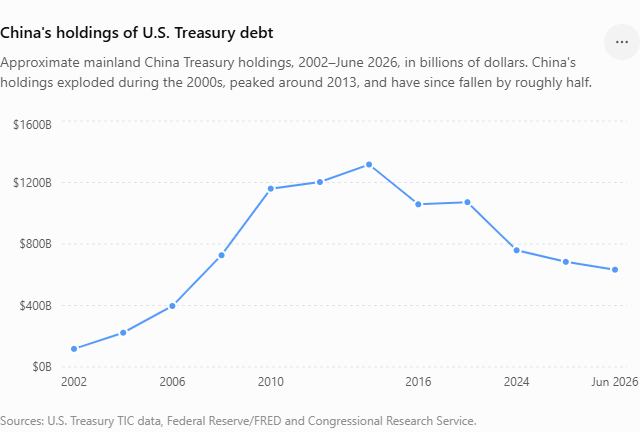
And this chart tells the entire story visually:
China’s holdings of U.S. Treasury debt
Approximate mainland China Treasury holdings, 2002–June 2026, in billions of dollars. China’s holdings exploded during the 2000s, peaked around 2013, and have since fallen by roughly half.$0B$400B$800B$1200B$1600B20022006201020162024Jun 2026
Sources: U.S. Treasury TIC data, Federal Reserve/FRED and Congressional Research Service.
The historical numbers are particularly striking: Congressional Research Service data show China at only $118 billion in 2002, $727 billion by 2008, $1.16 trillion by 2010 and about $1.2 trillion by 2012. Treasury/Fed data show the position reaching roughly $1.317 trillion in November 2013, versus $633.4 billion in June 2026.
SUMMARY
America did not go to the Chinese government and negotiate a giant direct loan like, “China, please lend us $1 trillion.”
Instead, the U.S. Treasury publicly sold government securities, and China chose to buy huge amounts of them.
But economically, yes — that is lending money to the United States.
Here’s the clean version:
1. The U.S. government spends more than it collects in taxes.
Say the government collects $4 trillion but spends $5 trillion. It has a $1 trillion deficit.
2. The Treasury has to borrow that $1 trillion.
It sells Treasury bills, notes, and bonds.
3. Investors buy them.
Buyers can be Americans, banks, pension funds, Japan, China, etc.
4. China buys $100 billion of those Treasury bonds.
China gives the U.S. Treasury $100 billion today.
5. The United States promises to repay China later, with interest.
That is absolutely a loan.
The distinction I was trying to make was only about how the loan happened.
It wasn’t:
U.S. government → asks China for a bilateral $1 trillion loan.
It was:
U.S. government → issues debt to the market → China voluntarily buys a giant amount of that debt.
So saying “China lent America money” is correct.
And saying “America borrowed money from China” is also correct, as long as we understand that it happened mainly through China’s purchases of Treasury securities.
The really crazy circular part is this:
America buys Chinese goods → China receives dollars → China uses some of those dollars to buy U.S. government debt → America gets the dollars back, but now owes China principal + interest.
For example:
America sent China $100 for products. China sent America the products. China then took some of that $100 and lent it back to the U.S. government by buying Treasury bonds. America got its dollars back—but now those dollars came with an IOU attached.