California Homeschool Guide
Learn the legal ways to homeschool in California, including Private School Affidavits (PSA), Private Satellite Programs (PSP), charter schools, and public independent study. Compare the pros, cons, costs, and requirements so you can choose the best option for your family.

What Are My Homeschooling Options?
California families generally have five legal ways to educate children at home:
- Private School Affidavit (PSA)
- Private Satellite Program (PSP)
- Public Charter School
- Public Independent Study Program
- Credentialed Private Tutor (less common)
Each option has different requirements for curriculum, funding, testing, record keeping, and teacher oversight.
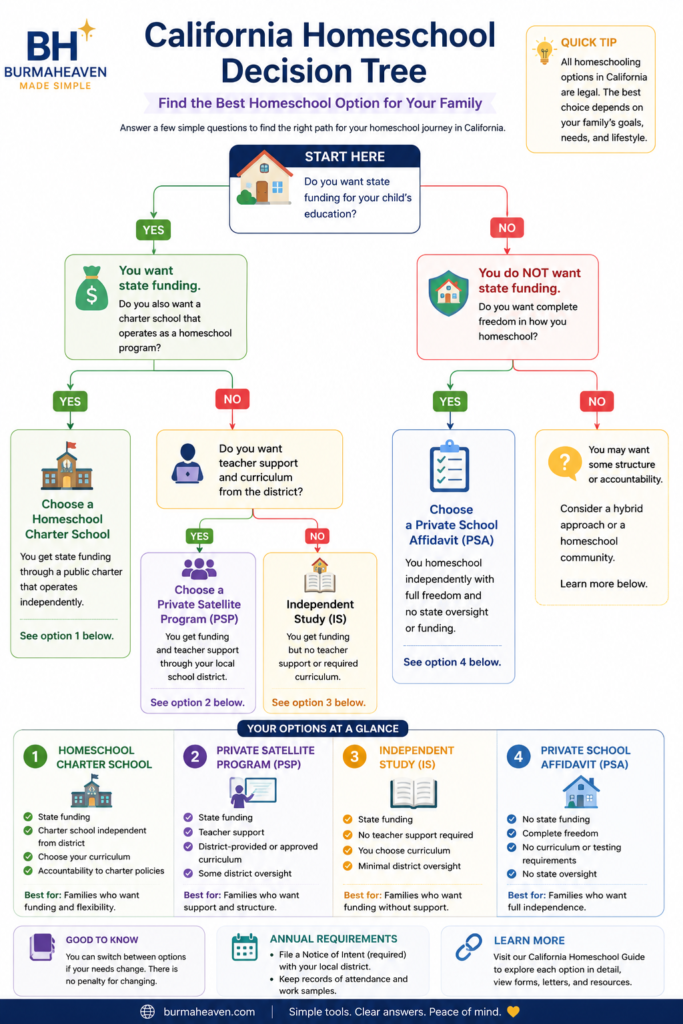
California Homeschool Decision Tree
Not sure which homeschooling option is right for your family? Follow this California Homeschool Decision Tree to compare Charter Schools, PSPs, Independent Study, and Private School Affidavits (PSAs) before reading the detailed guides below.
Compare California Homeschool Options
| Option | School Type | Cost | Instructional Funds | State Testing | Who Teaches? | Curriculum Freedom |
|---|---|---|---|---|---|---|
| Private School Affidavit (PSA) | Private homeschool | Free to file | No | Generally no public-school testing | Parent | Very high |
| Private Satellite Program (PSP) | Private school program | Usually tuition-based | No | Depends on the private program | Parent, with PSP support | High |
| Homeschool Charter School | Public charter school | Free | Often available for approved educational expenses | Yes | Parent with credentialed-teacher oversight | Moderate |
| District Independent Study | Public district program | Free | Usually no separate parent-controlled funds | Yes | District teacher with parent support | More structured |
| Credentialed Private Tutor | Private instruction | Tutor fees | No | Generally no public-school testing | Credentialed tutor | Depends on arrangement |
Important:
This chart provides a general comparison. Requirements vary by program, school, student grade, and individual circumstances. Public charter and district independent-study students remain public-school students and must follow applicable testing, attendance, and program requirements. PSA and PSP students are private-school students and do not receive public instructional funds.
Private School Affidavit (PSA)
- you become your own private school
- annual filing
- complete curriculum freedom
- record-keeping responsibilities
- no instructional funds
- no assigned teacher
Private Satellite Program (PSP)
- umbrella private school
- annual tuition
- homeschool community
- field trips
- transcripts
- graduation assistance
- parent still teaches
Charter School Homeschool
👉 Read our complete California Charter School Guide
- instructional funds
- credentialed teacher
- state testing
- community providers
- curriculum approval
- enrichment
Public Independent Study
- district-operated
- You prefer district support.
- You want a structured curriculum.
- You plan to return to a district school easily.
- credentialed teacher
- state testing
- attendance/work requirements
- generally fewer curriculum choices than a homeschool charter
Which Option Is Right for You?
Choose PSA if…
You do not need instructional funds.
You want maximum freedom.
You want to choose any curriculum.
Choose PSP if…
You want a homeschool community.
You want graduation support.
You do not mind paying tuition.
Choose Charter if…
You want instructional funds.
You want enrichment classes.
You do not mind state testing.
Choose Independent Study if…
You prefer district support.
You want a structured curriculum.
You plan to return to a district school easily.
How to Start Homeschooling
Step 1
Choose the legal option.
Step 2
Withdraw from your current school if applicable. Download Sample Withdrawal Letter Here.
Step 3
Complete any required enrollment or filing. For a home-based private school, a PSA is filed with the California Department of Education each year; charter and district independent-study programs have their own enrollment processes.
Step 4
Choose curriculum.
Step 5
Begin teaching.
Frequently Asked Questions
Is homeschooling legal?
Yes. Homeschooling is legal in California. Families may educate their children at home through several legal options, including a home-based private school (using a Private School Affidavit), a public charter school, a public independent study program, an existing private school, or instruction by a credentialed tutor.
What is the easiest homeschool option?
There isn’t one “best” option for every family, but many parents find a public homeschool charter school to be the easiest because the school typically provides curriculum, a credentialed teacher, recordkeeping support, and guidance throughout the year. Families who want maximum independence often choose a Private School Affidavit (PSA) instead, but that comes with more responsibility.
What is the cheapest?
A Private School Affidavit (PSA) is generally the least expensive option because there is no filing fee. However, parents are responsible for purchasing their own curriculum, books, educational supplies, and other learning materials. Public charter schools and independent study programs are also tuition-free, and many provide curriculum or educational resources.
Which option gives instructional funds?
Among the common homeschooling options, public homeschool charter schools are the ones that often provide instructional funds or educational budgets for approved curriculum, classes, educational materials, and enrichment activities. These funds remain public-school funds and may only be used for approved educational purposes. PSA and PSP programs do not provide public instructional funds.
Can I switch later?
Yes. Families may change homeschooling options or return to a traditional public or private school. The process depends on the receiving school or program. You may need to complete enrollment paperwork, provide educational records, and follow any applicable admission or placement procedures.
Do I have to file a PSA every year?
Yes, if you are operating a home-based private school under a Private School Affidavit (PSA). California private schools, including home-based private schools, must file a new PSA each school year. The statutory filing period is October 1 through October 15, although the online filing system is available during most of the school year to accommodate new schools established after the school year begins.
Can homeschool students play sports?
It depends on the homeschooling option.
- Public charter school and public independent study students may participate in activities offered through their enrolled public school, subject to that school’s policies.
- PSA and PSP families are not automatically entitled to participate in public-school sports simply because they homeschool. Participation depends on applicable laws, district policies, and the student’s enrollment status. Families should check with their local school district or private-school program.
Can homeschool students attend college?
Yes. Homeschool graduates regularly attend community colleges, California State University campuses, University of California campuses, and private universities. Admission requirements vary by institution, so families should maintain good academic records, transcripts, course descriptions, and other documentation as needed. Students may also complete standardized tests or dual-enrollment coursework when appropriate for their college plans.
Related Guides
TK Eligibility Calculator
Check whether your child meets California Transitional Kindergarten age requirements.
School Age Calculator
Determine whether your child meets California Kindergarten age requirements.
Education Tools
Browse all of our calculators, guides, and parent resources.